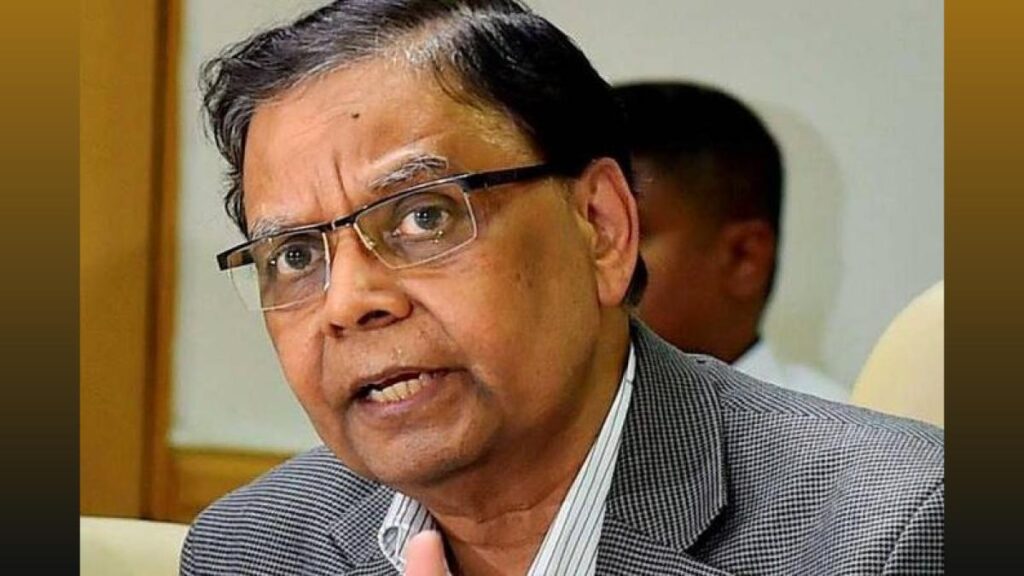
Arvind Panagariya urges India to prosecute the ALE aggressively with the EU, accelerate the reforms of faster growth. Key trade and economy information.
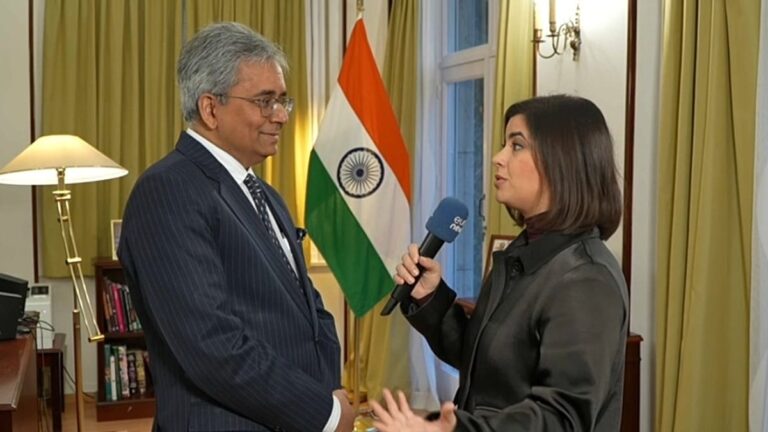
Speaking during the Business Today India @ 100 event, Panagariya said that India is confronted at a pivotal moment in the current geopolitical order of higher export prices and that the country should now push the pedal on its reform program.
“At this pivotal moment, we must aggressively continue the free trade agreement with the European Union. It is very, very important. As a market seems to be somehow closed, we must open another market … The EU agreement must be done, then there are reforms which must be made in particular with the labor market and the land market,” said Panagariya.
On August 6, the United States announced an additional 25% rate on all Indian imports, in addition to an existing right of 25%, bringing total law to 50% from August 27.
The White House said that the measure responded to the continuous purchase of Russian oil by India.
To a question about what must be done so that India becomes a nation developed in the context of the current dismantling of the world commercial order, Panagariya declared that it was a central moment for us to seek how India should change its growth path.
“In particular, in the current context in some respects, it looks practically at the time of 1991 in which there is a crisis which was caused by the massive prices that the United States (imposed) … It is the right time to look back and to take stock and to think of what we could do. A certain number of things to do.” Our reform agenda … said a lot.
He said India has come out of much more important crises and that the economy is currently “robust”. In the event of a commercial crisis, he said that supply chains change depending on where the best transaction is available.
“If we face higher prices in the United States and the lower prices of the European Union, and Vietnam faces lower prices in the United States, then our exports can leave from the United States to the EU … In the markets, the reason for profit is strong and the entrepreneurs are so intelligent that they readjust the supply chains very quickly,” said Panagariya.
He said in the longer term: “If we put our own house in order, (I do not see), there is nothing to stop our growth trajectory. I see a considerable place for acceleration (of the growth trajectory) that we have”.
India is the major great economy for the fastest growth with an economic growth expected at 6.5% in the current financial year. India is about to become the third world economy by 2027. Currently, this is the fifth largest economy in the world with a GDP of around 3.9 billions of dollars.
When asked if India could be called a protectionist nation, Panagariya said: “There may be protectionist measures. But if you ask if India is an open economy, yes of course”.
Asked about the jibe of “the dead economy”, Panagariya said: “You do not grow at 7% more (if the economy is dead), and in terms of a dollar, we really increase to more than 7%. I do not know what the definition (of the dead economy). Perhaps the corpses move”.
Last week, US President Donald Trump had noticed that India is a “dead economy” because he imposed a high price of 25% plus a penalty for Russian imports.
To a question on the additional reforms that can be undertaken, Panagariya has declared at the level of the central government, there could be more trade agreements and also the emphasis on the Asian markets for exports, moreover, “re -evaluating our position with China”.
In addition, the implementation of work codes, which has already been approved by Parliament, will be crucial for the creation and manufacturing of jobs.
At the level of the government of the state, Panangariya suggested that the reforms linked to the lands should be made. “When we think of urbanization, we are thinking about how to improve the life of citizens of cities and cities. We do not think of preparing our cities for businesses,” he said, as he suggested that he mitigates the process of land acquisition.
In addition, reducing the number of regulations in the center and the state will help facilitate business.
Observing that no country requires so much authorization for exports and quality control orders (QCOS) are protective instruments, Panagariya said: “We are probably the only country in the world which, through these multiple authorizations, put a restriction on our exports”.
About The Author