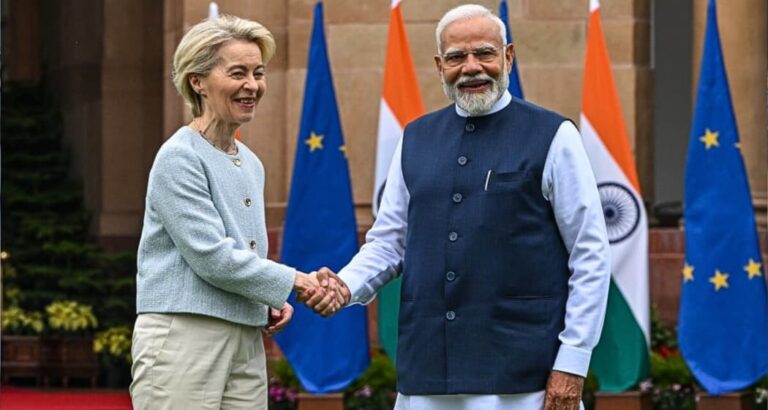
With time running out ahead of Republic Day, the million-dollar question arises: will European Union President Ursula von der Leyen be the guest of honor at the parade? The answer to this question depends on the answer to the other: the India-EU FTA is about to be signed.
Randhir Jaiswal, a spokesperson for the Ministry of Foreign Affairs, was cautious, saying only that “the teams have remained in contact to discuss outstanding issues, and both sides are committed to moving these discussions forward.”
Commerce Secretary Rajesh Agrawal also reportedly said that India and the E.U. reduce differences through sustained engagement, with more physical and virtual meetings planned.
Could the negotiations go through given that the EU is keen for India to open its agricultural and dairy markets? What about the carbon border adjustment mechanism which is now coming into force and which concerns steel and aluminum? CBAM risks eroding Indian export competitiveness just when trade diversification becomes most critical.
Or will the pressure to reach an FTA with India push EU negotiators to give Delhi some breathing space in these areas? Ajay Srivastav of the Global Trade Research Institute (GTRI) says negotiations are on a fast track, with both sides aiming for a conclusion in early 2026.
“The expected announcement of a bilateral trade and investment agreement between India and the EU (its official name) in early 2026 could bring some relief to India at a time of growing global trade uncertainty,” he said. “With the US imposing a 50% tariff regime, India’s exports to its largest market have already taken a hit, falling 21% in November 2025 compared to May. »
This would be India’s largest trade agreement, covering merchandise trade of over $140 billion and covering over 20 commercial and non-commercial areas.
Srivastava highlighted the importance of the EU as an export destination, noting that in 2024, India exported $91 billion worth of goods to the bloc, led by petroleum products, electronics including smartphones, textiles and clothing, iron and steel, machinery, chemicals, pharmaceuticals, gems and jewelry, and automobile components.
Many of these sectors, particularly labor-intensive industries like textiles, clothing, leather and auto parts, face EU tariffs ranging from 6% to 20%. An FTA could significantly reduce these duties and help restore export competitiveness.
Dr Ajay Sahai, Director General and CEO, Federation of Indian Export Organizations (FIEO), termed the agreement transformative for Indian exporters.
“The long-awaited India-EU Free Trade Agreement is a historic milestone that promises to reshape the global trade landscape for Indian goods and services,” he said. “A comprehensive FTA will unlock much greater potential by reducing tariff and non-tariff barriers across a wide range of sectors. »
Dr Sahai said Indian products, from textiles and engineering products to pharmaceuticals and specialty chemicals, should benefit from more predictable and preferential access to European markets, while trade in services would benefit from clearer, rules-based entry conditions.
“The EU FTA presents an alternative pathway to support growth, diversify market dependence and thereby reduce risks to India’s export ecosystem,” he said.
Beyond the commercial economy, the expected announcement is also significant on a diplomatic level. Both sides share concerns about supply chain resilience, strategic autonomy and the need to move beyond rhetorical commitments toward tangible cooperation.

About The Author