India, the EU seeks to emerge as poles of stability in an uncertain world – the diplomat
India and the European Union announced last week a “new era” in links, revealing a roadmap To deepen relations because they marked the start of the third decade of their strategic partnership in the midst of a major unsubscribe in global economy and political.
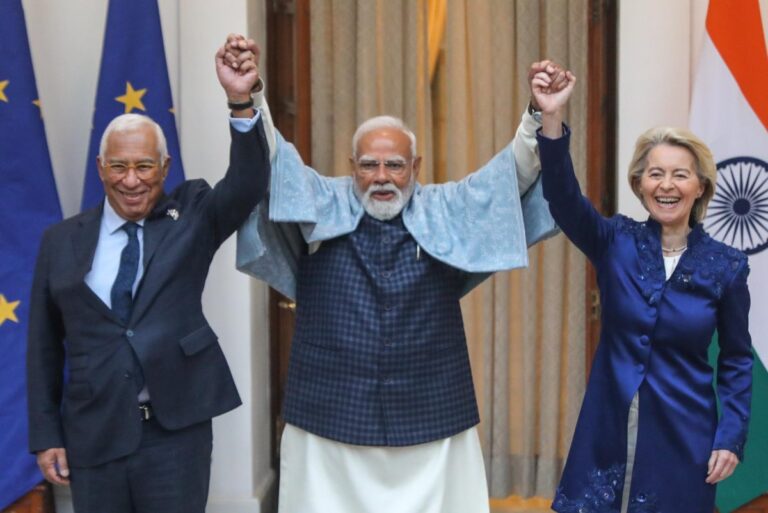
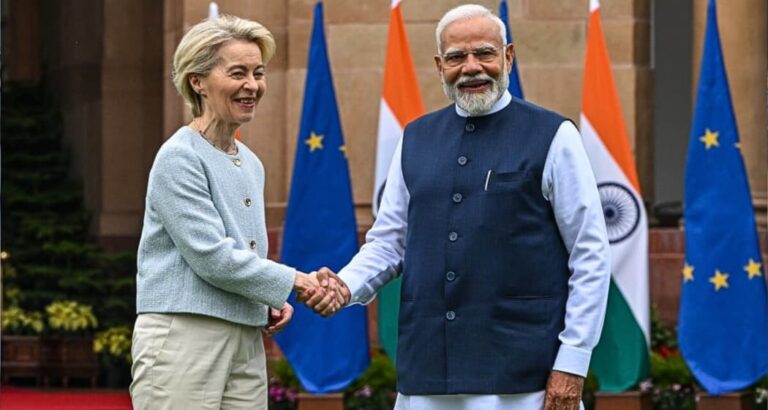
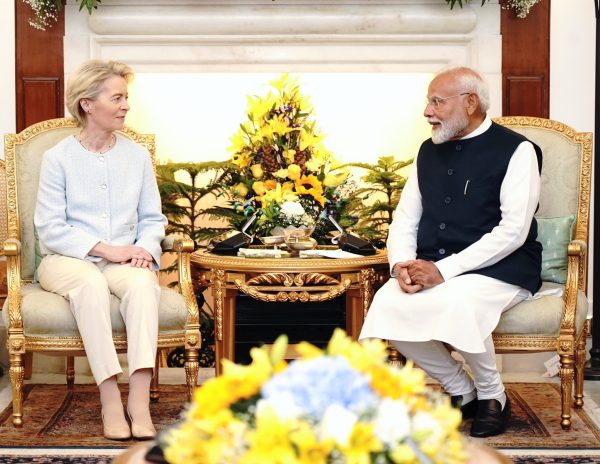
The president of the European Commission (CE), Ursula von der Leyen, who was in New Delhi on February 27 to 28, and the Indian Prime Minister Narendra Modi agreed to upgrade the links in a series of fields covering critical and new technologies, security, the supply chain and resilience and trade.
Certain areas that have been listed – Including cooperation in renewable energies, climate, water, intelligent and sustainable urbanization, disaster management, mobility and migration of professionals, and safety collaboration in Indo-Pacific – are not new.
However, several new elements have been added. This includes the fixing of a end of year deadline for the completion of talks for a free trade pact, which began in 2007. The EU also seeks to associate India in defense and security with projects under the permanent structured cooperation of the EU (PESCO) and to discuss the signing of an Information Security Agreement (Soia). These underline a feeling of urgency in the definition of an energy program in the context of pressing global uncertainties.
Von der Leyen was accompanied by 25 of the 27 EU commissioners for his visit to India, which makes him unprecedented in India-EU relations. It was also the first visit outside Europe for the new College of Commissioners, which took office in December.
“Touchdown in Delhi with my team of commissioners. At a time of conflict and intense competition, you need friends of confidence. For Europe, India is a friend and a strategic ally. I will discuss with @narendramod how to pass our strategic partnership to the next level, “said Von der Leyen in a job on X.
India has established diplomatic relations with the European Economic Community, the EU precursor in 1962. The India-EU summits at the level of leadership were institutionalized as an annual characteristic of the year 2000.
According to an Indian official, the visit of Von Der Leyen in India was about six months in preparation. However, it materialized that after Donald Trump, who considers Europe as a competitor and rival rather than an ally and partner of the Organization of the North Atlantic Treaty (NATO), took over as 47th President of the United States in January. The transatlantic partnership seems smaller that never when Europe is based for the imposition of a 25% price On his exports to the United States, and as Trump seeks to resolve the conflict that rages in Ukraine directly with Russia, without Europe or Ukraine at the table.
India has traditionally had close links With Russia, which, to the chagrin in Europe, he maintained even after the start of the Ukrainian conflict in February 2022. New Delhi was forced to abandon the purchase of Russian oil at a reduced price, which, according to Western leaders, generated funds for Russia to maintain its war against Ukraine. India has resistant such pressure, partly due to worries On the growing proximity between Russia and China since the start of the Ukraine War. While individual members in Europe perceive China variously as a partner and a competitor, the EU sees it as “systemic rival. “”
Trump’s probable reduction on support for Ukraine could ensure that certain districts in India care about the possibility that the American president concluded an agreement with China afterwards and reculed Asia, giving Beijing a frantic swing on the continent. India is worried with the idea that China dominates Asia and has often pleaded for a Multipolar Asia.
No wonder while Modi and Von der Leyen referred to the global disorder during the latter’s visit to Delhi, because they called for closer links between the two economic powers. It is clear that both are looking for options to stabilize their interests and hide their bets in the current global crisis.
“Geoeconomic and political circumstances are evolving quickly. And the old equations decompose. In moments like these, the partnership between India and the EU becomes even more important, ”said Moda said At the start of the interviews with Von der Leyen. “A belief shared in democratic values, strategic autonomy and the world order based on the rules unite India and the EU. Both countries are mega-diverse market savings. In a sense, we are natural strategic partners, “he continued.
Von der Leyen has agreed that India and the EU face similar opposite winds. To one public event In New Delhi, she said that the EU and India were placed only to respond, given a great alignment of interests. The Indian-EU partnership as essential in current global turbulence, Von Der Leyen said that the two parties could “offer themselves alternatives and distinctive tools to make us stronger, safer and more sovereign”.
This gave collaboration with the potential to be one of the “determining partnerships of this century,” said Von der Leyen, borrowing A familiar sentence Previously used by Indian and American leaders to describe their bilateral relations.
The new phase of the India-UE partnership would see the two parties continue the new security partnership and connectivity projects such as the India-Middle-East-Europe-Economic corridor, in addition to convergence in areas like “Do in India” And “Made in Europe. “”
The areas where complementarities between India and the EU exist include electronics, semiconductors, telecommunications, engineering, pharmaceutical products and the need to guarantee reliable supply chains. The two parties are also focused on updating collaboration in artificial intelligence, quantum computers, space technology and 6G – which will all contribute to proceeding in advance.
During the meeting in New Delhi, the two parties made efforts to highlight common ground. Therefore, the stress On shared democratic values, open market economies and various pluralist societies with “their commitment and their shared interest to shape a resilient global multipolar order which underlies peace and stability, economic growth and sustainable development”.
THE Declaration of joint leaders Also talked about “shared values and principles”, including the rule of law and the international order based on the rules in accordance with the objectives and principles of the Charter of the United Nations.
“The India-EU strategic partnership is necessary now, more than ever, to jointly solve global problems, promote stability and promote mutual prosperity,” he said.
There have also been actions to operate a relatively new business and technology council. Created in April 2022, the Council is a crucial platform to smooth the challenges that occur in “the confluence of trade, technology and security of trust”.
“The TTC reflects a common recognition between the EU and India more and more critical links between trade and technology, the potential for cooperation on these questions to improve the savings of the two partners and the need to work together on related security challenges,” said a statement After the talks.
While an India-UE partnership has forged in the middle of a crisis could provide results, the two parties will have to work hard to keep the bilateral track isolated from external challenges in an agitated world. India and the EU will have to spend time, resources and energy to ensure that the new partnership roadmap is respected so that India and Europe emerge stable and reliable reference poles for others in an unstable world.