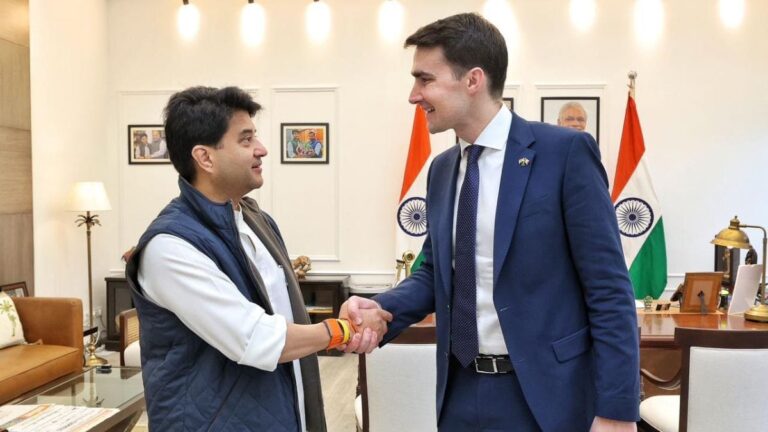
On Monday February 2, the High Commission of Cyprus in New Delhi celebrated both its accession to the presidency of the European Union and the deepening of the partnership between India and Cyprus. The event highlighted how the two nations are translating a shared history into modern strategic, economic and cultural cooperation.
Relations between the two former British colonies are thriving, based on historical ties and contemporary geopolitical considerations. The two nations share a history of invasions in Central Asia – Cyprus by the Ottomans and India by the Mughals – and a long-standing commitment to self-determination.
An autonomous registration – open to the world
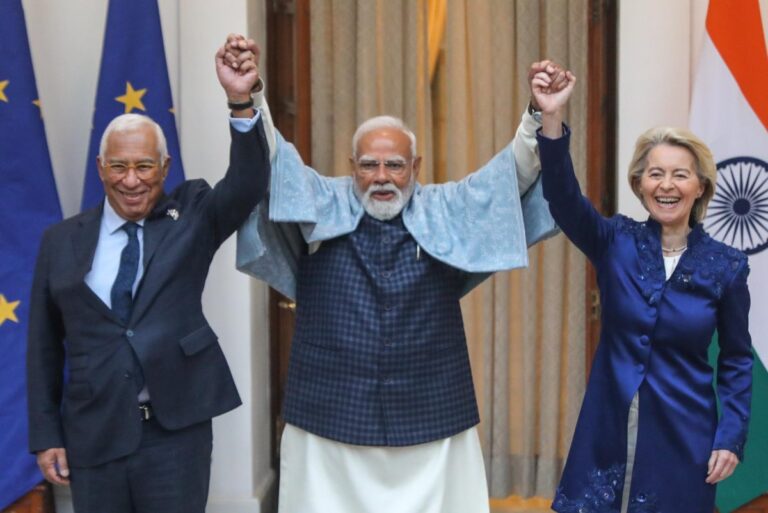
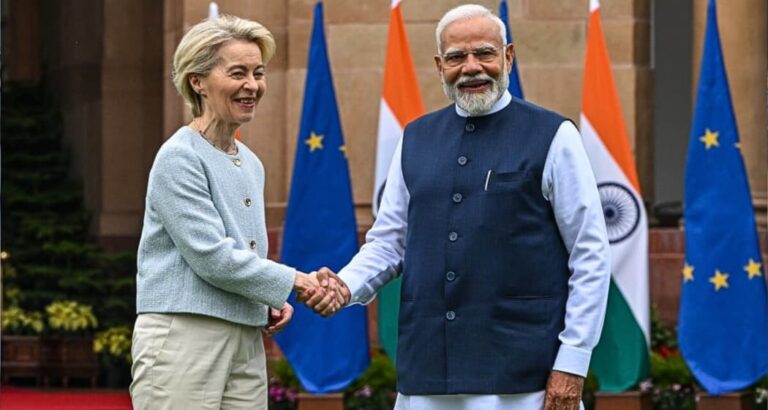
Cyprus, under the motto “An autonomous Union open to the world”, will hold the presidency of the Council of the European Union for the second time from January 1 to June 30, 2026. The presidency is expected to strengthen relations between India and Europe, particularly following the recent free trade agreement between India and the EU.
Cypriot High Commissioner to India Evagoras Vryonides reaffirmed on February 2 that his country would strive to facilitate and accelerate the implementation of the agreement for mutual benefit. Minister of State for Foreign Affairs Kirti Vardhan Singh has welcomed the Cypriot EU Presidency, noting that its theme of ‘self-reliance’ resonates with India’s vision of Aatmanirbharata (self-reliance). High-level diplomatic visits are planned in the coming months, including those of the Deputy Minister of Research, Innovation and Digital Policy for the AI Summit, the Minister of Foreign Affairs for the Raisina Dialogue in March and the President of Cyprus in May.

A friendship rooted in history
The India-Cyprus friendship has deep historical roots. In the 1950s, India defended the independence of Cyprus at the United Nations. Archbishop Makarios III, a strong supporter of Nehru’s Non-Aligned Movement, expressed solidarity with India, notably during the Sino-Indian War of 1962. Nehru recalled welcoming Makarios to the Bandung conference, noting: “A small island of courageous people rose to the might of a vast empire…I was deeply impressed by his personality. »
Spyros Kyprianou, Cyprus’ foreign minister in the 1960s and later president, supported India’s vision of regional unity. Cyprus also shares personal ties with India: former First Lady Lilla Irene (Erulkar) Clerides was born in India in 1921 to a Scottish mother and an Indian Jewish father, whose family actively contributed to India’s struggle for independence. In 1997, Shankar Dayal Sharma, then President of India, hosted a ceremonial reception for President Glafkos Clerides and Mrs. Lilla-Irene Clerides at Rashtrapati Bhavan.

Modi and Cyprus
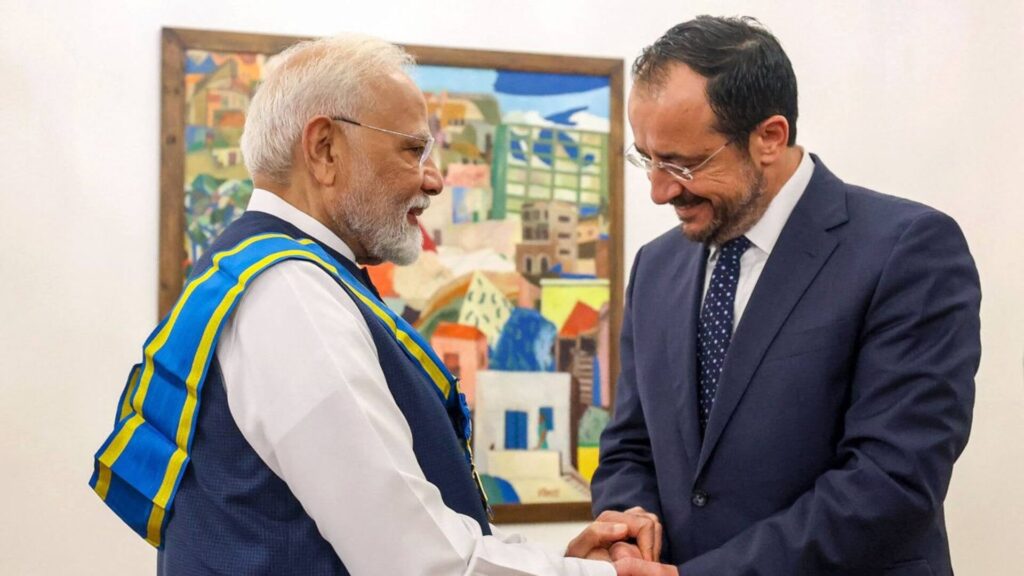
In 2025, Cypriot President Nikos Christodoulides hosted Prime Minister Narendra Modi on an official visit. Modi was awarded Cyprus’ highest honor, the ‘Grand Cross of the Order of Makarios III’, named after the island’s first president and long-time friend of India, Archbishop Makarios III. The leaders reaffirmed their stance against cross-border terrorism, condemning the attacks in Pahalgam, Jammu and Kashmir, and emphasizing a policy of zero tolerance.
The two countries also agreed to strengthen defense cooperation, particularly in cybersecurity and emerging technologies. Both highlighted their role as a connector between regions, particularly through the India-Middle East-Europe Economic Corridor (IMEC), a transformative initiative promoting peace, economic integration and sustainable development. High Commissioner Vryonides highlighted the role of IMEC in strengthening collaboration between India and Cyprus, whose bilateral trade is currently estimated at around €180 billion.
Advancing Democratic Partnership and National Security Concerns
India and Cyprus deepen their parliamentary and political ties. A delegation led by Annita Demetriou, Speaker of the Cypriot House of Representatives, visited Rashtrapati Bhavan to meet Indian President Droupadi Murmu. She recognized growing political, economic, defense and cultural ties and emphasized cooperation across multilateral platforms, including the UN, EU and Commonwealth.
National security remains a pillar of India-Cyprus relations. Cyprus commemorates the 1974 Turkish invasion, which occupied 35 percent of the island, killing 3,000 people and displacing around 200,000 Greek Cypriots. Similarly, India honors its fallen soldiers on Vijay Diwas, marking the 1971 war with Pakistan that gave birth to Bangladesh. Recent demonstrations of Indian defense capability, such as the interception of Turkish drones used by Pakistan, highlight common security concerns, particularly regarding Turkey under President Erdoğan.

A proximity based on shared concerns
During the Iran-Israel conflict, Modi visited the Greek Cypriot administration on June 15-16, en route to the G7 summit in Canada. This was Modi’s first official visit to a foreign country after the conflict with Pakistan in May 2025. This made him the first Indian Prime Minister to visit Cyprus since 2002.
From the outset, Greek Cypriot leaders have expressed support for India’s bid to become a permanent member of a potentially expanded UN Security Council. The leaders also expressed their desire to deepen cooperation within international organizations and agreed to support each other’s candidacies in multilateral forums. In a remarkable diplomatic gesture, the Greek Cypriot administration expressed its full support for India’s stance on the Kashmir issue and awarded Modi the ‘Makarios Medal’, the highest honor bestowed on foreign dignitaries.
A shared road ahead
High Commissioner Vryonides stressed that the Cypriot Presidency of the Council of the EU aims to promote a self-sufficient Union, fostering economic growth, employment and a strong defense, while maintaining transatlantic ties through the EU-NATO partnership. For India, the presidency provides a platform to strengthen ties with Europe through Cyprus, deepen bilateral cooperation and strengthen strategic, economic and cultural ties.
The India-Cyprus partnership continues to grow on the basis of shared history, democratic values and regional collaboration, guiding both nations towards a future of mutual prosperity, stability and enduring friendship.
*Arunansh B. Goswami is a historian and lawyer based in India, with expertise on Hellenic and Indian connections, he is a regular contributor to Neos Kosmos.
About The Author