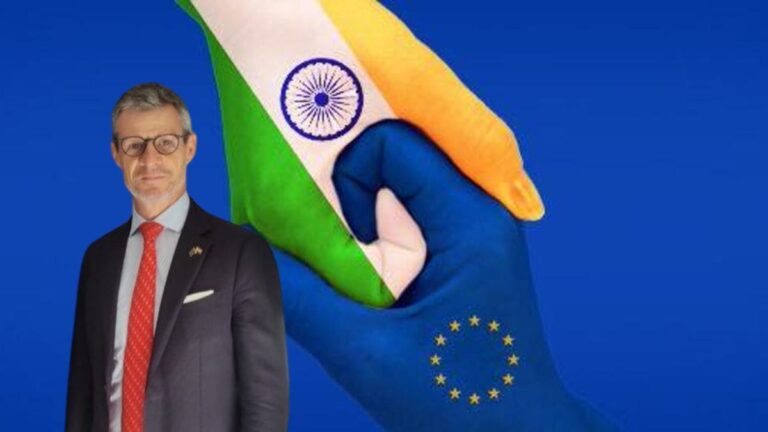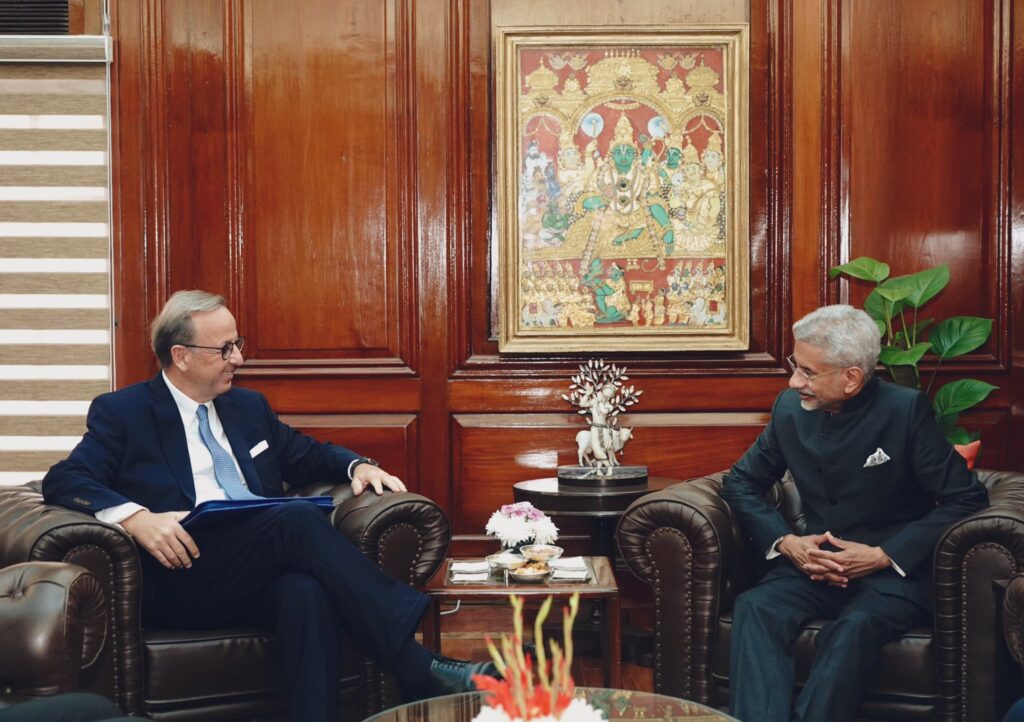
Decode39 interviewed Italian Ambassador to India, Antonio Bartoli, to assess how the EU-India Free Trade Agreement fits into a broader strategic shift linking trade, economic security and connectivity. Beyond tariffs, the deal reflects India’s growing centrality in a fragmented global economy and Europe’s search for resilient partnerships, with Italy positioning itself as a key Indo-Mediterranean bridge through industry, ports and security cooperation.
The EU-India free trade agreement (FTA) comes at a time of profound geoeconomic realignment, where trade policy, economic security and supply chain diversification increasingly overlap. Alongside the strengthening of ties between Brussels and New Delhi – and the parallel deepening of relations between India and the United States – India is emerging as one of the main poles of stabilization in an international system marked by fragmentation and strategic competition.
In this context, Italy intends to play an active role by leveraging its industrial assets, its logistical positioning and its strategic cooperation across the Indo-Mediterranean region, as highlighted by the ambassador.
Why it matters: Antonio Bartoli has served as Italian Ambassador to India and Nepal since July 29, 2024, a role that coincides with a period of renewed momentum in relations between India and Italy.
- He is directly witnessing a phase of strategic deepening marked by stronger political alignment and expanded cooperation.
- This revitalization was formalized last year with the Joint Strategic Action Plan 2025-2029, which places a strong emphasis on industrial cooperation, technology and defense, as well as trade, connectivity and security.
- Bartoli’s role lies at the center of this evolving partnership, at the intersection of diplomacy, geoeconomics and Indo-Mediterranean strategy.
Q: With the final announcement of the EU-India free trade agreement, a phase of almost complete integration between the two trading systems begins, intended to multiply economic and industrial opportunities. In this new context, in which sectors can Italy express specific added value, both in response to the needs of the Indian market and in light of the progressive reduction of tariff and customs barriers provided for by the agreement?
Q: Europe and India together represent around a quarter of global GDP, a market of more than two billion people. The signing of the free trade agreement marks a historic turning point. The EU is India’s main trading partner. According to several estimates, bilateral trade – which currently exceeds 120 billion euros – is expected to double by the end of the next decade. India is the world’s fourth largest and fastest growing economy in terms of GDP. The most populated market in the world represents an opportunity not to be missed.
- The agreement will result in significant reductions in tariff barriers, opening up important opportunities for Italian companies looking to expand into the Indian market. This includes industrial machinery – which already accounts for 40% of Italian exports – as well as automotive components, chemicals and pharmaceuticals.
- This also includes wine, whose customs duties will gradually increase from the current 150% to 20%, and other products such as olive oil and pasta, whose customs duties will be completely removed.
- Our prime ministers agreed to increase bilateral trade to 20 billion euros by 2029. More trade means more investment, but also more jobs and greater mobility of talents and professions.
- Italy is the second largest manufacturing country in Europe and India is considering with great interest cooperation with Italy in several recognized areas of excellence: mechanical engineering and agricultural machinery, industrial design and furniture, defense and space industries, circular economy, technologies for culture and sport, and much more.
- With this agreement, we will bring more Italy to India and more India to Italy.
One of the elements supposed to play the role of structural »structural catalysts” of EU-India relations is the India-Middle East-Europe Economic Corridor (IMEC), which aims to strengthen physical and logistical integration between India and Europe via the Middle East. At the same time, the project faces geopolitical and operational complexities. In this scenario, can Italy already act in a pragmatic and anticipatory manner, for example by developing bilateral links between port hubs such as Trieste and Mumbai?
- Absolutely. IMEC is a long-term perspective that requires conviction and vision, even beyond the current tensions in the Middle East. In the meantime, Italy and India can move forward with concrete projects that will contribute to the success of the corridor.
- As peninsular countries projecting into a common basin – the Indo-Mediterranean – an increasingly integrated and interdependent space, Italy and India share converging visions and interests.
- We intend to create a corridor for accelerated and fully digitalized port customs procedures.
- We will soon complete the laying of a high-capacity underwater digital cable for high-speed data traffic between our markets.
- We will also continue to deepen synergies in infrastructure, logistics and energy. On these issues, Deputy Prime Minister and Minister of Foreign Affairs Antonio Tajani will host a conference on March 17 in Trieste open to partner countries and neighboring European states, aimed at mobilizing the private sector in favor of IMECs.
- We expect strong participation from businesses and stakeholders from India, as well as other countries along the corridor.
Strategic cooperation between the European Union and India also extends to the areas of security and defense. What role can Italy play, both industrially and operationally, particularly in terms of maritime security in the Indo-Mediterranean region?
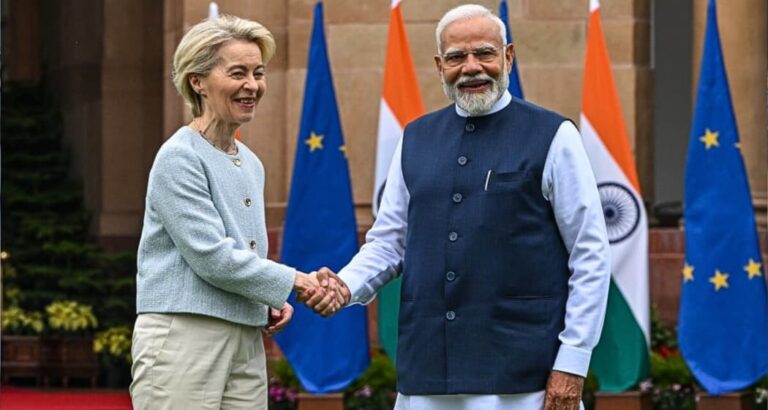
- Cybersecurity, fight against hybrid threats and terrorism, cooperation in the defense industry, etc. The recent visit to New Delhi by the President of the European Council, António Costa, and the President of the European Commission, Ursula von der Leyen, focused, in addition to the FTA and mobility, on security and defense.
- The EU and India have signed a strategic partnership and Italy has been moving in the same direction for some time.
- Security and defense are at the heart of the joint action plan adopted in 2024 by Prime Ministers Giorgia Meloni and Narendra Modi.
- With New Delhi, we support the principles of stability, freedom of navigation and protection of trade in the Indo-Mediterranean region.
- We have intensified the presence of Italian naval units in Indian ports and conducted joint exercises between our navies.
- We will soon launch a dialogue dedicated to maritime security to improve the sharing of best practices, the exchange of information and interoperability between our respective assets.
The bottom line: The EU-India Free Trade Agreement is not just a trade agreement, but a strategic instrument linking economic integration, connectivity and security.
- For Italy, the opportunity lies in early action – leveraging industrial strength, ports, digital infrastructure and maritime cooperation to position itself as a central node of the emerging Indo-Mediterranean system, rather than a peripheral beneficiary of it.
About The Author