After months of intense negotiations, the European Commission on Tuesday agreed a free trade deal with India that slashes tariffs on EU products, from cars to wine, as the world seeks alternative markets following President Donald Trump’s tariffs.
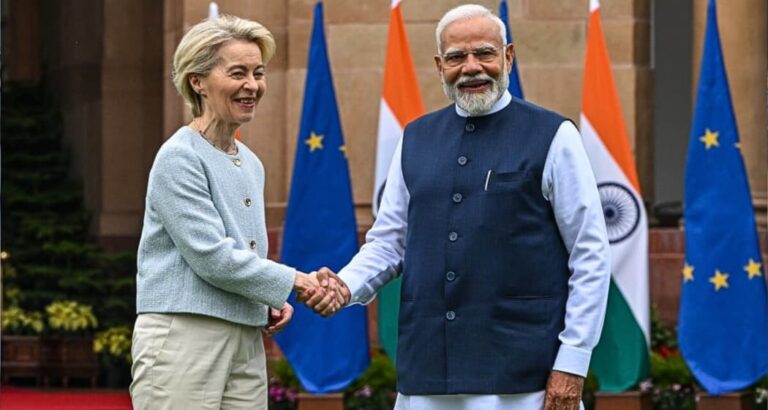
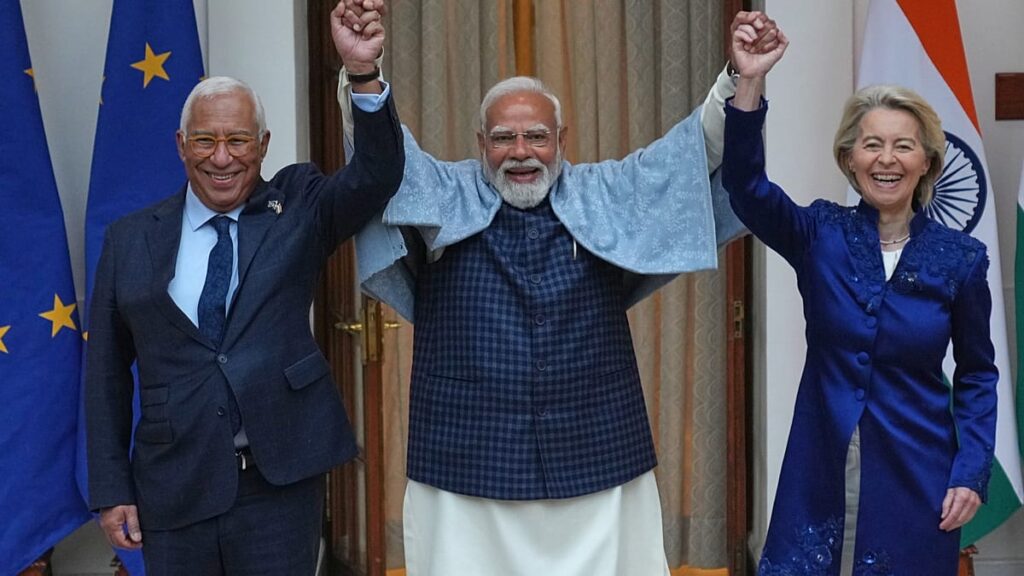
The announcement was made during a high-level visit by European Union leaders, including Commission President Ursula von der Leyen. The two countries welcomed the opening of a “new chapter in their strategic relations”, as both sides seek alternatives to the American market.
India is currently facing 50% tariffs imposed by the Trump administration, which has seriously hurt its exports. After concluding the Mercosur deal with Latin American countries earlier this month, the EU said it wanted to accelerate its trade agenda with new partners.
“We did it – we made the mother of all deals,” von der Leyen said after the deal was announced. “It’s the story of two giants choosing a truly win-win partnership. A strong message that cooperation is the best response to global challenges.”
The talks proceeded to completion, with negotiators meeting over the weekend and into the early hours of Monday. The deal says it will boost the “untapped” potential of their combined markets, but does not include some politically sensitive agricultural sectors.
Von der Leyen’s powerful trade chief Maroš Šefčovič, in charge of negotiations on behalf of the 27 EU member states, said Brussels was aiming for rapid implementation by 2027.
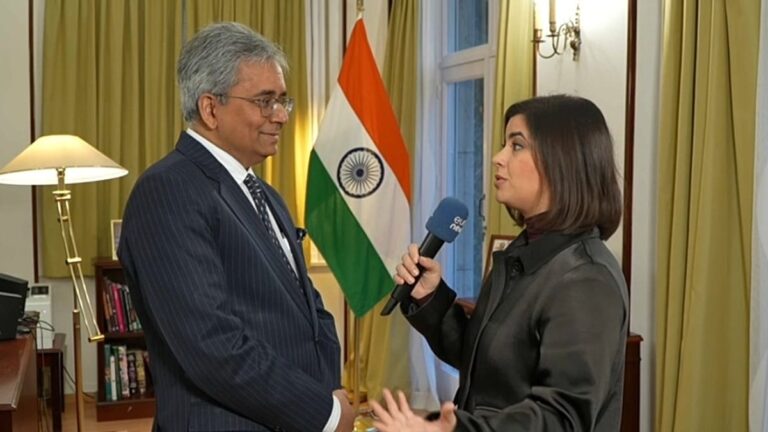
In an interview with Euronews from Delhi after the deal was announced, Šefčovič said the deal with India showcases the EU’s new approach to trade: more pragmatic about outcomes, rather than getting stuck on political red lines.
“We resumed negotiations with a new philosophy, saying very clearly: if it’s sensitive for you, let’s leave it alone,” Šefčovič told Euronews, describing the strategy as a game changer.
A victory for European exports seeking to exploit the Indian market
Under the agreement, the EU aims to double its exports of goods to India by 2032 by reducing customs duties on around 96% of EU exports to that country, saving around €4 billion a year in customs duties. At its full potential, the deal creates a market of 2 billion people.
European car manufacturers stand to benefit, with Indian customs duties gradually reduced from 110% to 10% under a quota system. Tariffs in sectors such as machinery, chemicals and pharmaceuticals will also be almost entirely eliminated.
Wines and spirits, the main export products for countries like France, Italy and Spain, will see their duties reduced from 150% to around 20 to 30%. Duties on olive oil will be reduced to zero, from 40%.
After years of tensions with European farmers, The Commission said sensitive agricultural products had been excluded from the deal, leaving out beef, chicken, rice and sugar.
As far as India is concerned, the agreement keeps trade conditions on dairy products and cereals intact, in accordance with the demands of the Indian authorities, who see it as a red line.
The Commission said it included a chapter dedicated to sustainable development “which strengthens environmental protection and fights climate change”.
The agreement does not cover geographical indications, another controversial area for negotiators, which will be addressed in a separate agreement aimed at protecting EU products against imitation in the Indian market.
Deal canceled under pressure from Trump tariffs
The timing of this deal is important as both sides seek to de-risk their economies from the threat of Trump’s tariffs.
The EU saw tariffs triple to 15% last year in a controversial deal and India is currently subject to a 50% tariff regime imposed by Washington.
Last year, the Trump administration imposed an additional 25% tax on India as punishment for buying Russian oil, which India defended by citing the need for cheap energy to power a country of 1.4 billion people.
Negotiations between the EU and India began in 2007 but quickly ran into obstacles.
Negotiations were restarted in 2022 and intensified last year as the two men sought to cushion the impact of Trump’s return to the White House.
After signing the deal during a two-day trip on Tuesday, during which the heads of the European Commission and Council were the guests of honour, the EU said the agreement showed that “rules-based cooperation” remained the preferred path for the bloc – as well as for a growing number of partners from Latin America to India.
Before the agreement can be implemented, the European Council and the European Parliament will need to ratify it, which can become an arduous process.
The Commission hopes to start implementing the agreement from January 2027.
This story has been updated with comments from Commissioner Šefčovic to Euronews. Watch online and on TV.
About The Author