After nearly 20 years of negotiations, India and the European Union claim to have concluded “the mother of all agreements” on trade.
The new deal could affect nearly 2 billion people and a third of global trade.
This comes as Donald Trump’s administration pursues an aggressive tariff strategy against New Delhi and Brussels.
Here’s what India and the EU should get out of this deal, what it means for global trade, and what it could say about future agreements.
What does the EU get from this agreement?
The deal is expected to see EU exports to India double by 2032.
EU exporters will see Indian tariffs currently imposed on 30 percent of goods removed immediately.
Customs duties will also be eliminated or reduced entirely for more than 96 percent of goods traded by value, saving European businesses some 4 billion euros ($6.87 billion) a year, the EU said.
“This agreement will bring major opportunities to the people of India and Europe,” Indian Prime Minister Narendra Modi said in a virtual speech to an energy conference.
“It accounts for 25 percent of global GDP and a third of global trade.“
India will cut tariffs on imported European cars from 110 to 10 percent over five years.
It will enact a quota of 250,000 cars that will likely benefit European manufacturers like Volkswagen, Mercedes-Benz and Renault.
European automakers can expect to be among the biggest winners from the new deal. (Reuters: Matthias Rietschel/File photo)
India is also immediately reducing tariffs on alcoholic beverages like wine from 150 percent to 75 percent, then gradually to 20 percent.
Customs duties on spirits will be lowered to 40 percent, the EU has announced.
New Delhi will also remove all customs duties on machinery, electrical equipment, chemicals and pharmaceuticals.
What does India get out of this deal?
Indian marine products, leather, textiles, chemicals, rubber, base metals, precious stones and jewelry will not be subject to any import taxes into the EU.
EU customs duties on 99.5 percent of Indian products will be reduced over seven years, with 93 percent of products exempt from customs duties in the same time frame.
India will be allowed to continue imposing certain tariffs on European cars and agricultural products.
Indian leather manufacturers will have easier access to the EU under the new agreement.
(Reuters: Francis Mascarenhas, file)
New Delhi excluded dairy products such as milk and cheese, as well as cereals, from the deal, citing “national sensitivities” regarding these products.
The EU will also not allow concessional tariffs on imports of Indian sugar, meat, poultry and cattle products, Indian commerce ministry officials said.
India and the EU also agreed on a framework agreement for deeper defense and security cooperation.
They also signed a separate pact aimed at facilitating the mobility of skilled workers and students, a move that could create a significant number of jobs in both economies.
Why was the agreement signed now?
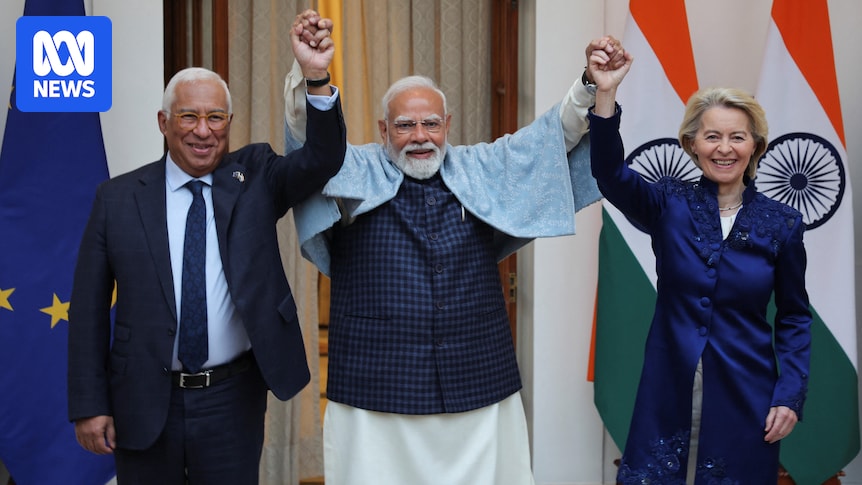
Speaking at a joint press conference in New Delhi with European Commission President Ursula von der Leyen and European Council President António Costa, Narendra Modi said the partnership with the EU “will strengthen the stability of the international system” at a time of “turbulence in the global order”.
Washington targets both India and the EU with high tariffs, disrupting established trade flows and pushing major economies to seek other partnerships.
India signed a new trade deal with the UK last year and recently signed new deals with New Zealand and Oman.
Negotiations on the India-EU deal gained momentum after US President Donald Trump’s heavy-handed tactics on tariffs and Greenland.
Narendra Modi and Donald Trump have not yet reached a trade agreement between their two countries. (Reuters: Kevin Lamarque)
“Europe and India are making history today. We have concluded the mother of all deals,” von der Leyen said in an article on X.
In a speech later, she said the agreement was a story of “two giants” – the world’s second and fourth largest economies – “who chose partnership, in a truly win-win way”.
She also said it sent “a strong message that cooperation is the best response to global challenges.”
India faces additional tariffs of 25% from the United States on its purchase of Russian oil, which Washington says is helping to finance that country’s war in Ukraine.
It has sought to diversify its export markets, as its products face 50 percent tariffs to enter the U.S. market.
For the EU, the deal gives the bloc expanded access to one of the world’s fastest-growing major economies and helps European exporters and investors reduce their dependence on more volatile markets.
Trade between India and the EU stood at $136.5 billion ($196 billion) in the financial year ending March 2025, compared to $132 billion ($189 billion) in trade between India and the United States and $128 billion ($184 billion) between India and China.
Is it the “mother of all transactions”?
APAC Advisors Managing Director Steve Okun told ABC’s The World that Donald Trump had tried to gain greater US access to both markets, but US products now faced increased competition in India and the EU.
“What Donald Trump tried to do was get better access to the Indian market and he succeeded: he did it just for the EU, not for the Americans or for American companies,” Okun said.
The EU is still grappling with higher US tariffs and Mr Trump’s stance on Greenland, while Indian goods face 50% tariffs in the US.
“You had Donald Trump pushing back the Europeans, you had Donald Trump pushing back the Indian government.
“This is, unfortunately, the kind of bullying that we’ve come to expect from the United States right now, and it’s what’s driving these other countries to find other people to trade with.”
The EU has struck deals with Japan, Indonesia, Mexico and South America under the slogan “strategic autonomy” over the past year – a move many see as reducing dependence on the United States.
“If the United States continues to do this kind of weaponization of trade, you’re going to see, I think, an acceleration of more of these deals,” he added.
he said.
He added that the agreement between India and the EU could mark the beginning of a new direction in global trade.
“This could be the mother of future agreements… Countries are starting to come together because they don’t want to rely on China and now they don’t want to and can’t rely on the United States,” he said.
“The question is what will be the new rules-based system, because the one that was built over eight decades no longer exists and so we are seeing this rewriting.”
A formal signing of the EU-India deal could take place later this year, with the agreement taking effect once approved by the European Parliament.
ABC/son
About The Author