Harsha Kakar
kakarharsha@gmail.com
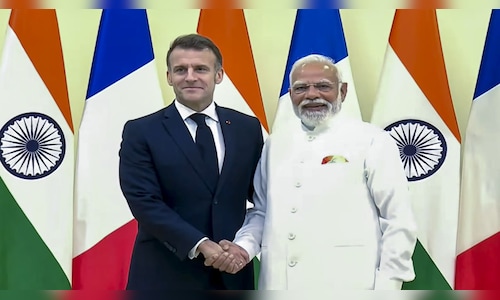
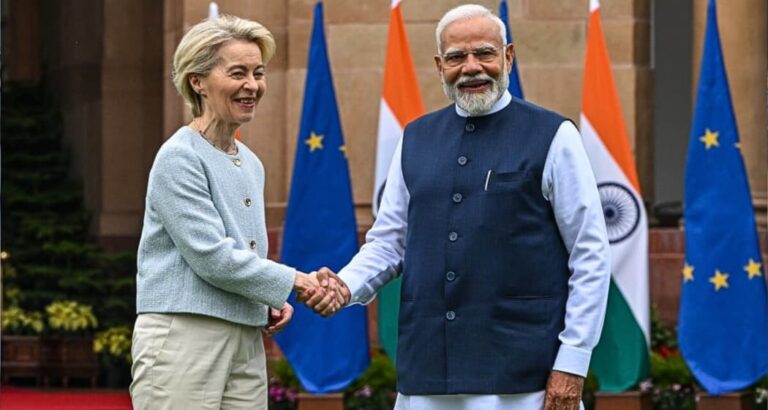
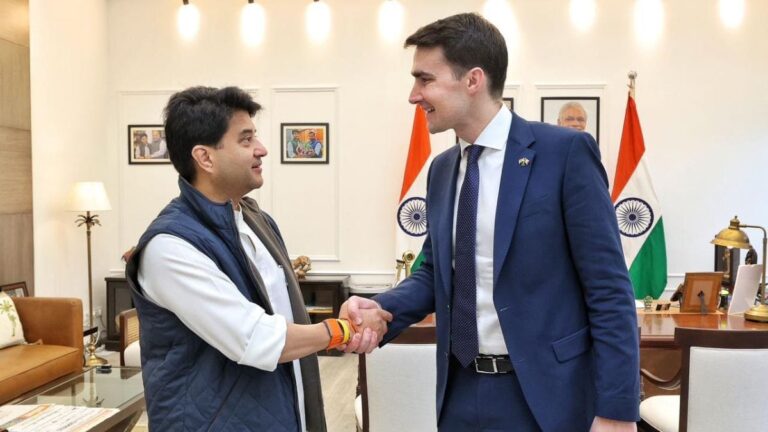
The India-EU Free Trade Agreement has been called the “mother of all deals” by both India and the EU. Part of the agreement included the Security and Defense Partnership (SDP), signed by Defense Minister Rajnath Singh and his counterpart, EU High Representative Kaja Kallas. India becomes the third Asian country, after Japan and South Korea, to conclude such an agreement with the EU. The defense deal was one of the 13 outcomes to come out of the India-EU summit.
The SDP covers a dedicated security partnership aimed at strengthening defense manufacturing, supply chains as well as joint engagement in the Indian Ocean. The EU will also post a liaison officer to the Indian Navy’s Information Fusion Center for the Indian Ocean Region in Gurugram. The center already has liaison officers from 12 partner countries, including the United States and the United Kingdom. Cooperation in the maritime domain would include joint exercises emphasizing counter-piracy operations as well as securing critical sea lanes. It is possible that joint exercises involving other services will begin at a later date.
For Europe, relying on the United States for its security is no longer an option. Trump’s insults towards the EU and its leaders have increased, mainly because Europe depends on the United States for its security as well as its defense equipment. It must create capabilities for its own defense and diversify its defense purchases if it is to remain relevant. For India, a country on active borders with two nuclear-armed adversaries, building defense capabilities through updated technology and financing must be an ongoing process. Therefore, for both, the SDP is a win-win.
The agreement specifically mentions collaboration in the areas of maritime security, cyber and space, hybrid threats, counter-terrorism, capacity building and defense industry cooperation. It also institutionalizes the annual India-EU Security and Defense Dialogue. The joint statement mentions that the two sides will consult on defense initiatives while exploring possibilities for collaboration.
In October last year, India and the United States had signed a 10-year defense agreement that would include technology sharing, maritime security and strategic industrial partnership. However, India remains hesitant to source from the US due to high costs, delays as well as the changing global landscape, where India-US relations appear to be at a standstill. India must also diversify its purchases.
Kaja Kallas rightly said: “The signing of the Security and Defense Partnership is an important step on which we can build. There is so much more we can do together in multilateral and bilateral forums to further develop defense cooperation. Rajnath Singh mentioned in his response, “The Indian defense industry can play a significant role in the EU’s ‘ReArm initiative’, especially as the EU seeks to rapidly diversify its suppliers and reduce dependency risks.
The ReArm initiative aims to create a fund of up to €800 billion for defense spending by 2030. It includes €150 billion for joint purchases to boost capabilities, reducing dependence on the United States. The EU would spend around 3.5% of its GDP on defense by 2030. The annual Indo-EU security dialogue will oversee the implementation of the agreement and collaboration.
India’s defense purchases from Europe have increased in recent years, particularly since New Delhi began reducing its reliance on Russia, largely due to delays due to the ongoing conflict, Israel’s involvement in Gaza and the unpredictability of the United States as a supplier. India also seeks Western technologies, which countries are reluctant to share.
India has already purchased 36 Rafale jets from France, 24 more are on order and it is also expected to sign a deal for 114 more jets, including manufacturing in the country. SAFRAN is partnering with DRDO/HAL to co-develop a new high thrust engine of 120 to 140 KN for the advanced medium combat aircraft. India is also close to a deal to make submarines in partnership with Germany and is already making C-295MW transport planes under a deal with Spain. Currently, the navy is purchasing heavy torpedoes from Italy.
The EU has established a roadmap for 2030 to equip itself with capabilities to counter threats from its East (Russia), while also strengthening the production of long-range weapons systems and an air shield and drones. Indian industries, including Bharat Dynamics, BEL, Garden Reach Shipbuilders, HAL, Larsen and Toubro, Tata Advanced Systems and Mahindra Defense, already have links with European industries and are well placed to partner with European companies, including investing in technology and capital. India can become a major partner of the EU in joint development and production.
Under the SDP, the Indian defense industry would also be eligible for funding under the Security Action for Europe (SAFE) funds. SAFE is the platform under which loans are provided to Member States to boost defense production and industrial capacity. This would benefit Aatmannirbhar Bharat. India increases its FDI in defense sector to 74%, which could benefit foreign investors.
The EU has exhausted its stocks of ammunition and weapons to support Ukraine in its ongoing conflict with Russia and needs an immediate restock. Indian defense manufacturers produce everything from missiles and munitions to drones, radars and armored vehicles. India already exports to a number of countries, including a few in Europe. This would now be a formal process.
However, India does not want its products to be used in the Russian-Ukrainian conflict. Operation Sindoor demonstrated the capability of Indian-made equipment. Another additional factor is the lower cost of production in India compared to the West, without compromising on quality. However, the priority must remain to successfully complete the negotiations on information security, which will form the basis of cooperation. Negotiations on this should begin immediately.
There might also be a downside. India’s defense partnership with the EU implies India’s proximity to NATO. Although this would be an advantage, it could impact relations with Russia. Furthermore, the EU would like India to move away from Russia, particularly in defense collaboration, as Moscow is its main security concern. This is where India will have to balance its ties.
Stock prices of defense manufacturers have seen a rise since the signing of the SDP. Overall, the agreement would improve the capabilities as well as technological levels of the Indian defense industry while meeting the EU’s defense needs at competitive prices. The deal is a win-win for both parties.
The author is Major General (retired)
About The Author