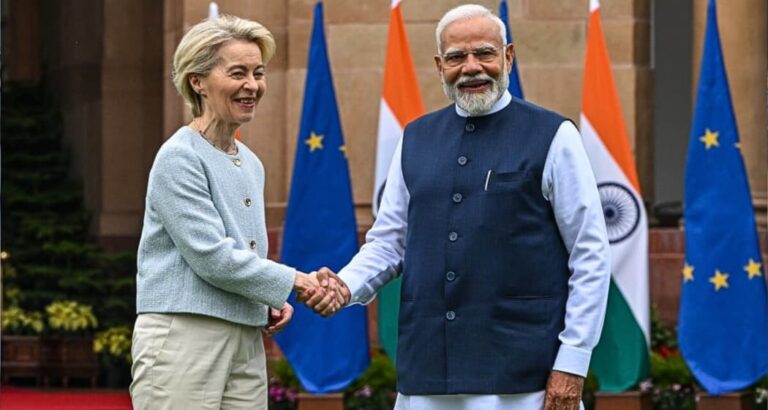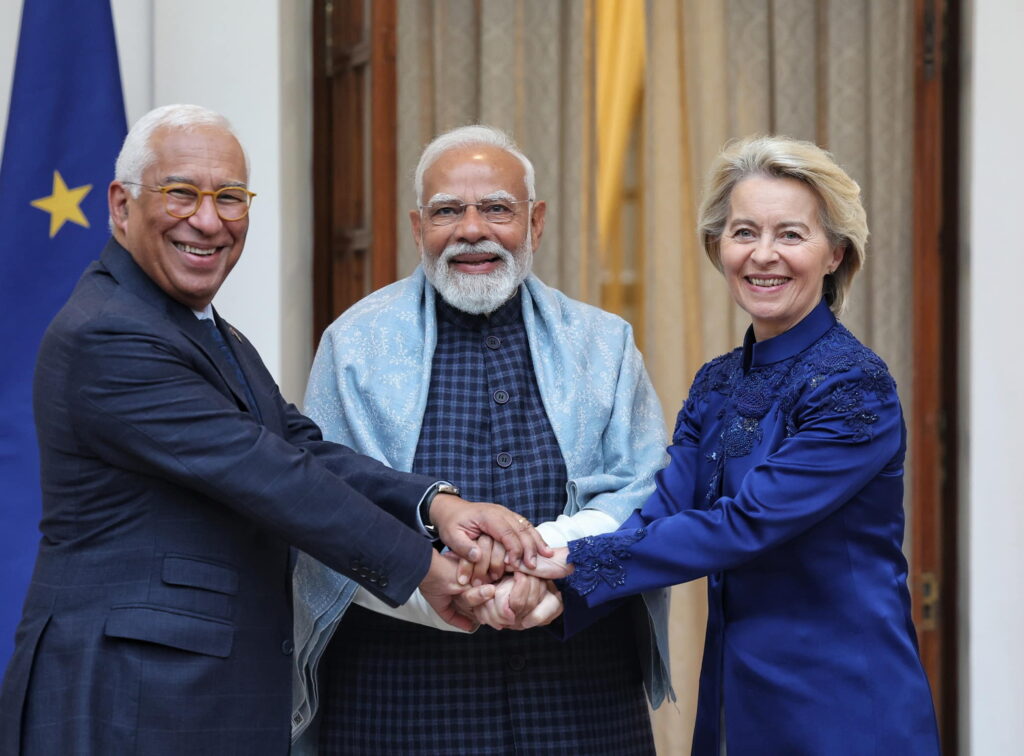
The long awaited India-European Union Free Trade Agreement presented as the “mother of all deals”, is celebrated as a triumph of market access. After nearly two decades of stalled negotiations, it brings together two billion people in a trade deal covering about a quarter of global GDP. Tariffs will drop on everything from German luxury cars to Indian textiles.
But the real meaning of this agreement lies elsewhere.
This is not just a trade deal. This is an act of geopolitical policy; one that reveals how large democratic economies are adapting to a more fractured and unstable world order.
The sudden momentum that pushed the deal across the finish line in early 2026 was driven less by economics than by geopolitics. New Delhi and Brussels found themselves exposed to increasingly unpredictable American trade policy. Under the Trump administration, India faced punitive tariffs of up to 50% on its exports to the United States, with the Trump administration portraying them as a response to India’s continued purchases of Russian oil. The European Union, meanwhile, narrowly avoided trade disputes over steel production, industrial subsidies and even Washington’s renewed interest in Greenland.
In this context, the FTA has become a strategic hedge.
The scale of the agreement is considerable. India will eliminate or reduce tariffs on 96.6% of EU exports, while the EU will do the same for 99.5% of Indian products by trade value.
For Brussels, the deal reinforces its long-standing quest for “strategic autonomy,” reducing its overreliance on the United States and China while expanding partnerships with like-minded economies. The agreement with India follows similar EU agreements with partners from Japan, Indonesia, Mexico and South America.
For India, the logic is just as clear. As the world’s fourth-largest economy, New Delhi is determined not to be trapped by dependence on a single market. The EU deal complements India’s increasingly assertive trade diplomacy, which has seen deals concluded or advanced with Australia, the United Arab Emirates, the United Kingdom, the European Free Trade Association states, Oman and New Zealand.
Rather than signaling a return to old-style trade liberalization, the India-EU FTA reflects a more pragmatic model, focused on diversification, resilience and policy flexibility. This is less an exercise in tariff reduction and more a model for stabilizing supply chains in an era of geopolitical disruption.
The scale of the agreement is considerable. India will eliminate or reduce tariffs on 96.6% of EU exports, while the EU will do the same for 99.5% of Indian products by trade value. Yet its deeper impact lies in how it could reshape Indo-Pacific supply chains.
By integrating European regulatory standards and sustainability provisions, the agreement has the potential to influence emerging standards in digital trade, intellectual property and responsible production in the region. Significant tariff reductions on chemicals, machinery and pharmaceuticals will accelerate the integration of Indian companies into European value chains, while regulatory alignment in the electronics and automotive sectors will lower barriers to higher value-added production.
Beyond goods, the agreement strengthens the infrastructure that underpins the supply chains themselves. Strengthened customs cooperation, data exchange mechanisms and simplified border procedures aim to reduce friction and improve risk management. Expanded access to services, particularly maritime transport and financial services, strengthens the logistics and financial networks that support global trade.
For regional partners such as Australia, the agreement offers a revealing case study in strategic optionality.
These economic arrangements are accompanied by a broader strategic convergence. Cooperation between India and the EU on maritime security and defense in the Indian Ocean has grown in recent years, reflecting shared concerns over China’s growing regional presence. Trade, logistics and security are increasingly intertwined.
For regional partners such as Australia, the agreement offers a revealing case study in strategic optionality. Although Canberra has its own trade agreements with India, the EU deal introduces both competition and opportunity. Notably, India’s services commitments to the EU, notably in the financial and maritime sectors, exceed those offered to any other partner, including Australia and the UK.
This is important because it shows how India is now calibrating its economic partnerships based not only on trade, but also on strategic alignment and long-term trust.
For Australian policymakers and producers, the India-EU FTA should be read as part of a broader rewriting of the rules-based system. As major players seek to “de-risk” China and the United States, they are building a more multipolar economic order, defined less by rigid blocs and more by flexible partnerships.
In this sense, the agreement offers a roadmap for states that must navigate economic security in an era of strategic competition. Cooperation, rather than isolation, appears to be the most credible response to global fragmentation.
Ultimately, the India-EU FTA reflects a world in which old trade certainties no longer apply. By linking two of the world’s largest democratic economies, it reshapes trade flows while providing a strategic counterweight to protectionist trends. In the emerging multipolar order, the most valuable currency may no longer be the dollar or the yuan, but strategic flexibility.
As history is quietly written in New Delhi and Brussels, the message is unmistakable: the world order is being reimagined, and those who favor partnership over isolation will help define its new rules.
About The Author