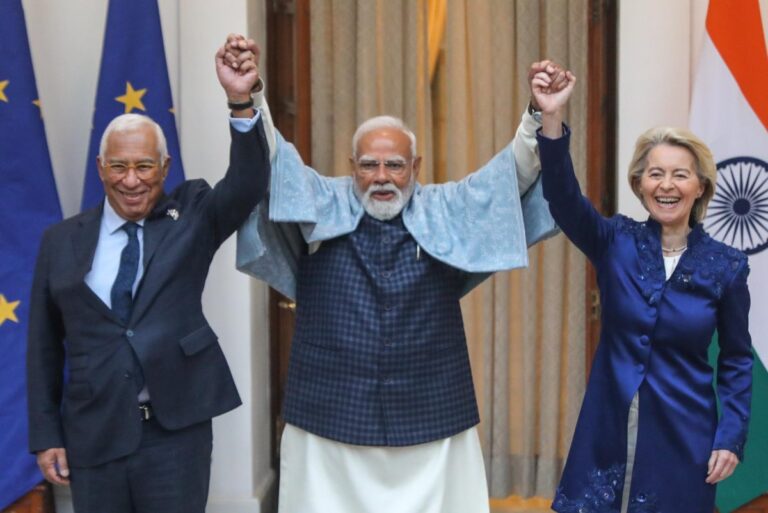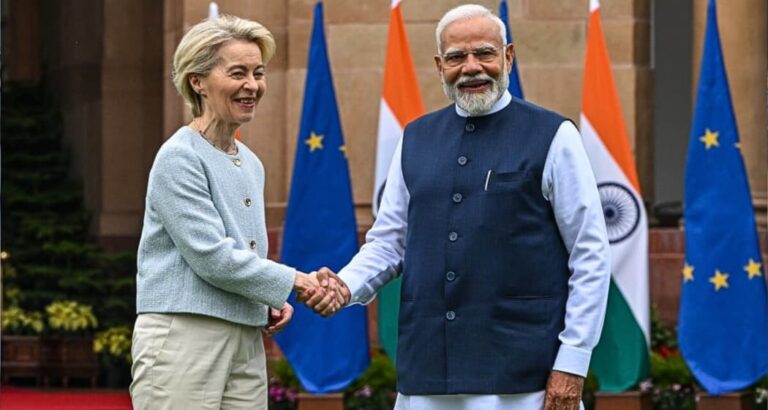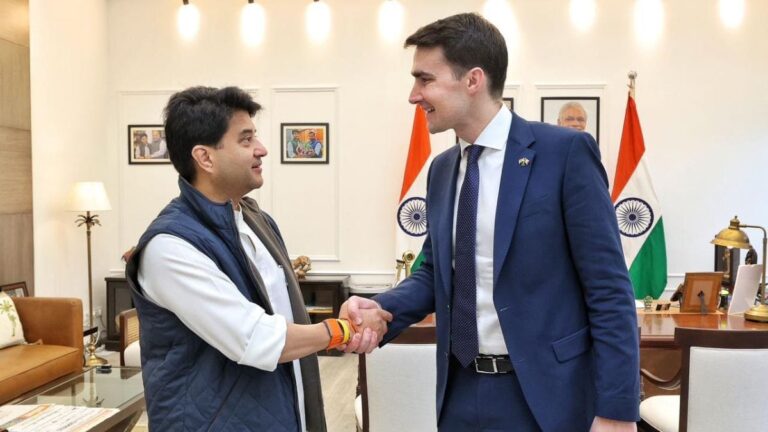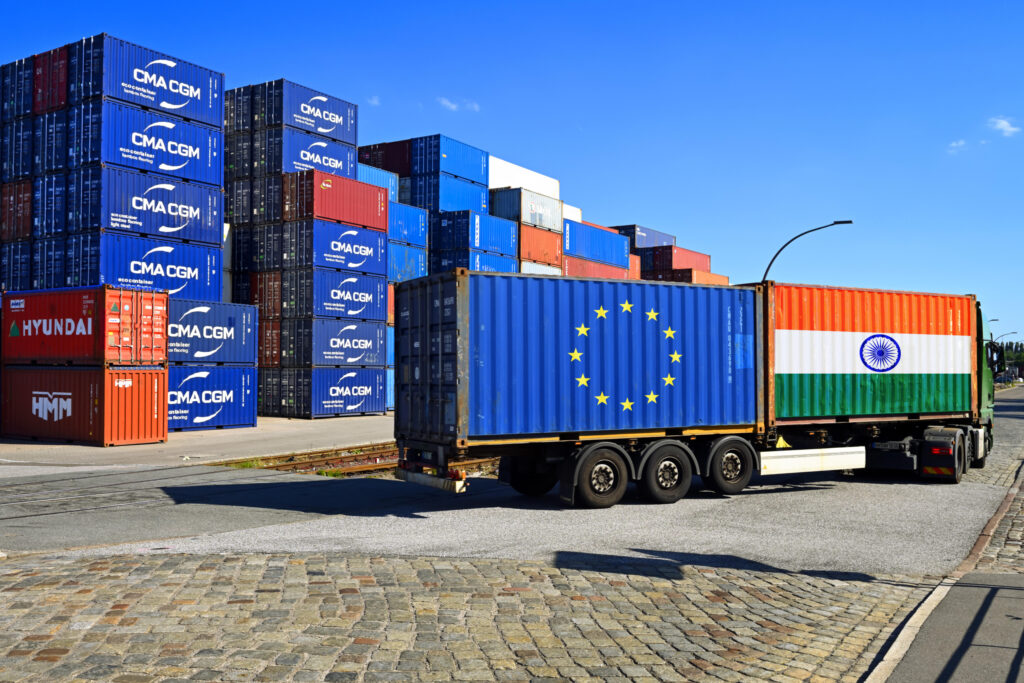
At the EU-India summit in New Delhi, European Commission President Ursula von der Leyen and Indian Prime Minister Narendra Modi. announced the conclusion of a highly anticipated trade deal that significantly reduces bilateral tariffs in many key sectors.
European sectors such as automobiles and machinery will see customs duties gradually reduced, from prohibitive rates of 110% or 40% to 10% or 0%. For India, a traditionally very protectionist countrythis is a huge and very generous liberalization commitment compared to the agreement he signed in July 2025 with Great Britain, which reflects the greater economic weight of the European Union.
Mother of all offers
Both camps have an unlikely (and reluctant) boss in US President Donald Trump. If the 20-year-long negotiations result in a meaningful deal after more than a decade of lull, the EU and India can thank Trump’s tariff hikes against New Delhi, his rapprochement with Pakistan and his continued threats against European countries – ranging from customs duties has pure and simple territorial annexation.
American hesitation helped push the EU and India to agree on a deal that seemed difficult to conclude until recently. India, faced with US tariffs, is pushing for more certainty in its trade relations, while Europe is seeking to diversify to reduce its dependence on an increasingly erratic US administration.
But even though both sides have hailed the free trade agreement as the “mother of all affairs“, at first glance, this has more rhetorical and political value than economic relevance for the EU. After all, India barely made in the top 10 of the EU’s trading partners; in 2024 the block exported more to Norway than to India, although the GDP of this Nordic country is nine times lower.
Furthermore, the phasing out of customs duties on the automotive sector will take a decade, during which EU exporters will continue to see high vehicle duties outside the agreed quotas. The agreement also excludes several products from the very protected Indian agricultural market. It will not lift customs duties on sensitive products like dairy products, cereals and poultryalthough India to reduce its prohibitive customs tariffs on alcoholic beverages and olive oil.
Furthermore, the deal will only truly benefit both signatories once other areas of friction, such as sustainability standards, have been properly resolved. Add to that the geographic distance between Europe and India, and Europeans might wonder how such a deal could actually be a game-changer for the EU, even if hopes of a doubling of bilateral trade by 2032 materialize. Really, what really makes it relevant?
Save trade and divide BRICS
In reality, this agreement goes well beyond simple bilateral trade. For Europe, this is the first step towards building a broader partnership with the fastest growing economy in the G20. The deal is key to safeguarding a global multilateral trading system riven by U.S. tariffs, Chinese export restrictions and other unilateral measures. In such a context, the best strategy is to build a broad and diverse network of partners to maintain predictable and open trade between its members. This is exactly what the EU-India trade deal does by bring 25% of the world’s population under a shared trading system.
However, the most important value of this agreement is geoeconomic: India and Brazil are the BRICS members most strongly resisting Beijing’s (and Moscow’s) attempts to turn the bloc into a bloc anti-Western alliance. Despite its looser structure and internal divisions, BRICS provides a key coordination platform for countries challenging the US-led system of global governance. Their members account for more 40% of the world’s population and 24% of world trade. By 2050, the group is planned double its GDP and surpass the G7.
While China and Russia want to establish an alternative system, India and Brazil seek to safeguard multilateralism, despite changes made to better reflect the changing global balance of power. The EU-India trade agreement is now set to become the best tool available to Brussels to consolidate its partnership with New Delhi. It could also prevent India from falling into the more anti-Western camp of China and Russia.
Rising powers are the key to Europe
The EU-India trade agreement closely follows that of Mercosur. Instead of denouncing the end of a world order from which they have benefited, Europeans are finally exploiting their commercial assets.
Europeans are faced with a rapidly aging population, a declining share of global trade and very difficult transatlantic relations. They must now look beyond their borders to consolidate their economic power.
This means building effective partnerships with emerging powers that share concerns about rules-based trade, technological disruption and economic security to establish a global network. Europe, with these actors, represents a geoeconomic center with the power to shape global affairs.
The EU-India trade agreement closely follows that of Mercosur. Instead of denouncing the end of a world order from which they benefited, Europeans are finally exploiting their commercial assets. They have started to build a new system that allows them to remain central in tomorrow’s world.
The European Council on Foreign Relations does not take a collective position. ECFR publications represent solely the opinions of their individual authors.
About The Author