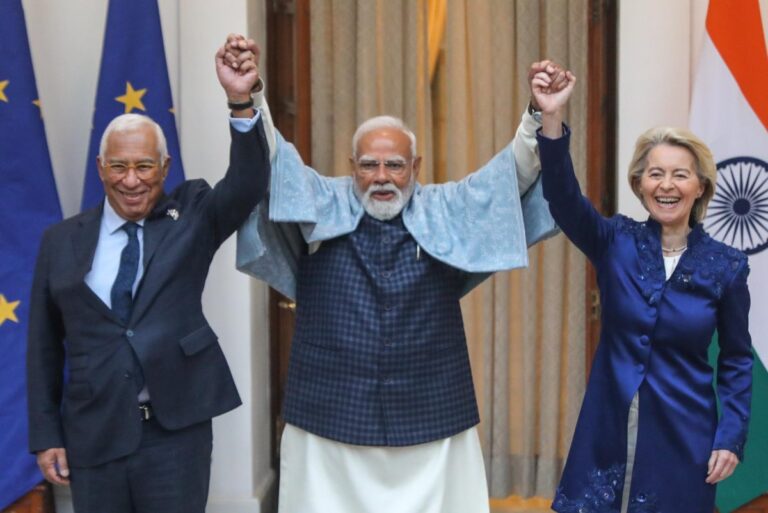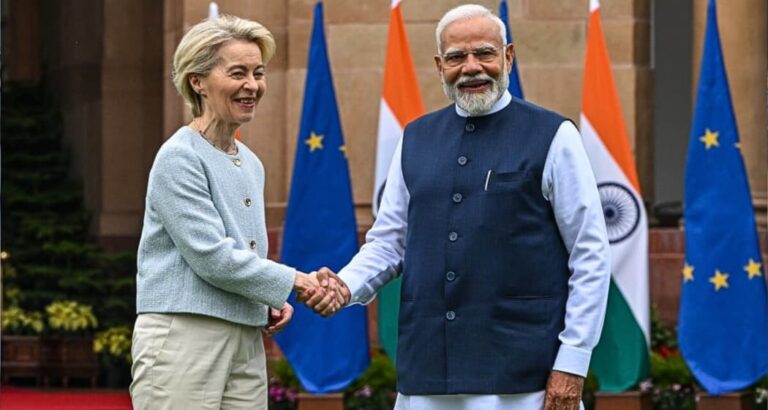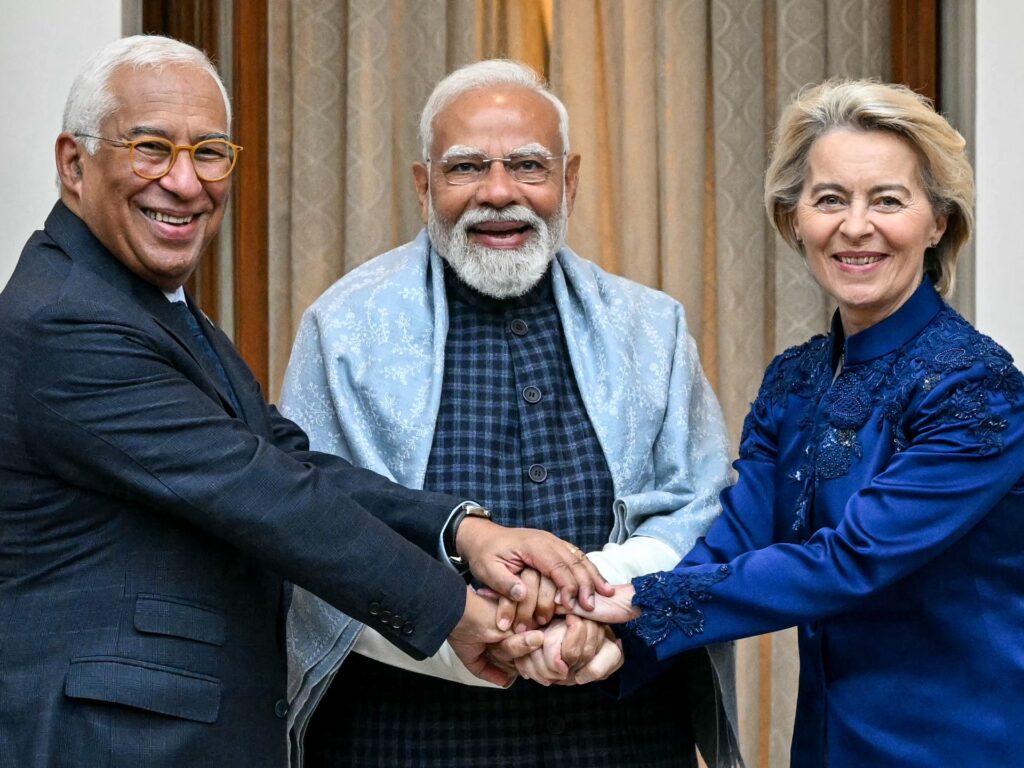
India and the European Union have agreed a sweeping trade deal creating a free trade zone of two billion people, European Commission President Ursula von der Leyen and Indian Prime Minister Narendra Modi said.
In an article on X during her visit to New Delhi on Tuesday, von der Leyen said both parties are “making history today.”
Recommended Stories
list of 4 elementsend of list
“We have concluded the mother of all deals. We have created a free trade zone of two billion people, from which both sides should benefit,” she added.
Modi said the historic deal, after nearly two decades of on-and-off negotiations, had been reached, hailing its benefits ahead of a meeting with von der Leyen and European Council President Antonio Costa.
“This agreement will bring many opportunities to the 1.4 billion Indians and the many millions of people in the EU,” he said.
The deal will cover around 25% of the world’s gross domestic product (GDP), Modi said, adding that India would get a boost in sectors such as textiles, gems and jewelry, and leather goods.
The trade deal, which EU officials say is India’s most ambitious ever, comes amid a push by Brussels and New Delhi to open new markets in the face of U.S. tariffs and Chinese export controls.
This will pave the way for India, the world’s most populous country, to open its huge protected market to free trade with the 27-nation EU, its largest trading partner.
The EU, which views India as an important market for the future, has said European companies would benefit from so-called “first-mover advantage” in the Indian market, while New Delhi sees Europe as an important potential source of technology and investment.
The formal signing of the agreement will take place “after a legal review, which is expected to last five to six months”, the Reuters news agency reported, citing an Indian government official familiar with the matter. The official said the agreement is expected to be implemented within a year.
EU exports ‘expected to double’
The EU said it expects its exports to India to double by 2032 as a result of the deal.
Bilateral trade in goods between India and the EU has already increased by almost 90% over the past decade, reaching 120 billion euros ($139 billion) in 2024, according to EU figures. Trade in services accounts for another 60 billion euros ($69 billion), according to EU data.
Under the deal, tariffs on 96.6 percent of EU goods exports to India would be eliminated or reduced, EU officials said. The deal would save up to 4 billion euros ($4.74 billion) a year in tariffs on European goods, officials said.
Among the products whose tariffs would be totally or largely eliminated were machinery, chemicals and pharmaceuticals.
Customs duties on cars would be gradually reduced to 10 percent with a quota of 250,000 vehicles per year, officials said, while EU service providers would benefit from preferential access to India in key areas such as financial and maritime services. Tariffs on EU planes and spacecraft would be removed for almost all products.
Customs duties would be reduced to 20-30 percent on EU wine, 40 percent on spirits and 50 percent on beer, while tariffs on fruit juices and processed foods would be eliminated.
“The EU is on track to achieve the highest level of access ever granted to a trading partner in the traditionally protected Indian market,” von der Leyen said on Sunday. “We will gain a significant competitive advantage in key industrial and food sectors. »
Last-minute talks on Monday focused on several sticking points, including the impact of the EU’s carbon border tax on steel, sources close to the discussions told AFP.
“A new hope”
Deepanshu Mohan, an economics professor at OP Jindal Global University near New Delhi, told Al Jazeera the deal offered “new hope” to both sides.
“This is an important agreement for the simple reason that India trades a lot with the EU,” he said. “A lot of the trade is in goods, goods that India would technically want to expand given its high tariffs with the United States. »
He said much of the trade in Indian goods was in industries that were labour-intensive and likely to create many jobs. At the same time, it offered the EU opportunities to access the Indian market, at a time when many European economies were struggling.
“This offers the EU as a region many opportunities to expand its economic relations with India. »
He said the timing of the announcement was significant, at a time when relations between Europe and the United States were at an all-time low, as tensions between New Delhi and Washington persisted over high tariffs imposed on Indian exports.
“This has happened quietly at a time when unilateralism has become… a sort of cornerstone of trade negotiations,” he said.
“Growing strategic partnership”
Negotiations on the India-EU trade deal were launched in 2007, but made little progress for many years. However, Russia’s large-scale invasion of Ukraine led to the resumption of negotiations in 2022, while US President Donald Trump’s aggressive tariff policy enabled rapid progress in the negotiations.
India and the EU also announced the launch of a security and defense partnership, similar to the partnerships the EU has with Japan and South Korea, while von der Leyen said Brussels and New Delhi would further develop their strategic partnership.
The moves come as India, which has depended on Russia for key military equipment for decades, attempts to reduce its dependence on Moscow by diversifying its imports and strengthening its domestic industrial base, while Europe does the same on Washington.
The EU-India deal comes days after Brussels signed a key deal with South American bloc Mercosur, following last year’s deals with Indonesia, Mexico and Switzerland. During the same period, New Delhi finalized pacts with the United Kingdom, New Zealand and Oman.
About The Author