The year was 2007. Steve Jobs had announced the launch of the first iPhone, the subprime mortgage crisis was raging in the United States, the EU had expanded to include Romania and Bulgaria, and India had become a multi-trillion dollar economy for the first time. It was at this time that trade negotiations between Delhi and Brussels were first initiated. But it was only this week, almost 20 years later, that a deal was signed after a final few months of unusually accelerated negotiations.
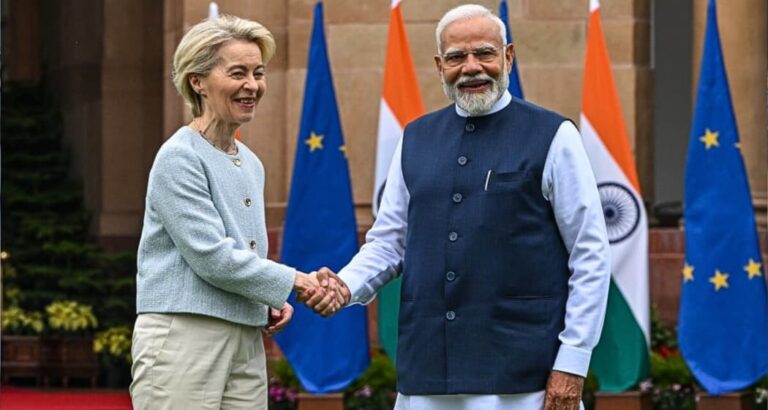
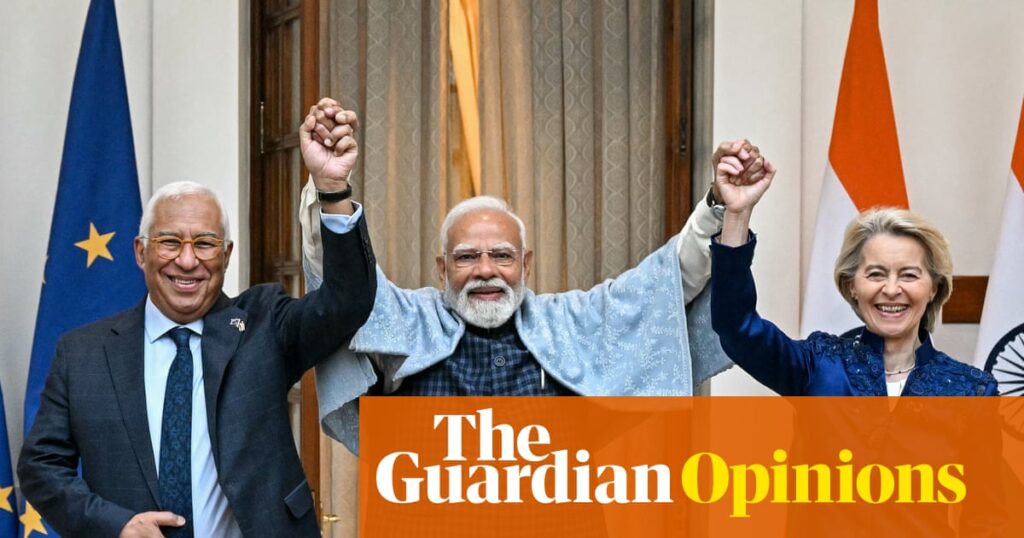
On Tuesday, European Commission President Ursula von der Leyen, European Council President António Costa and Indian Prime Minister Narendra Modi announced the “mother of all deals,” which promises to bring together around 2 billion consumers and a quarter of global GDP. THE agreement opens parts of India’s notoriously protectionist domestic market with an emphasis on the export of manufactured goods and services; in return, middle-class Indian consumers will find it cheaper to buy European cars and wine. The EU-India comprehensive agreement global strategic program its scope is actually much broader, encompassing defense and security, commitments to multilateralism, mobility and cooperation in a range of areas.
Why this sudden change of pace, after 20 years of stops and starts? The answer has everything to do with Donald Trump. The EU-India free trade agreement reveals the emerging silhouette of a post-American world order, against a backdrop of incessant threats to territorial sovereignty, punitive tariffs and the weakening of multilateral institutions.
Initial negotiations had progressed slowly over differences over cars, alcohol, agriculture and dairy – and were abandoned in 2013. They resumed in 2022 as the post-pandemic world sought to “de-risk” and reduce risks. diversify supply chains beyond China. Ironically, it was not China that saw the deal through, but the looming shadow of Trump. In December 2024, even before the inauguration of his second presidency, the American president frightened Europe by relaunching the idea of possessing Greenland. The fact that a close ally threatened territorial sovereignty gave rise to a widely shared feeling that Europe was “alone at home» amid frictions in the closely knit transatlantic relationship.
To add to the chaos, on his first day in office, Trump imposed punitive customs tariffs on America’s neighbors Canada and Mexico – a move that culminated in the “Liberation Day” taxes levied on 90 countries around the world. India has been hit with one of the highest tariff rates at 50%, with an additional 25% due to its purchases of discounted Russian oil. And more recently, the tariff weapon was used again against the EU and the UK when eight countries sent a few NATO troops to Greenland. As a result, the United States is not only perceived – as recent opinion polls show – as unreliable in Europe, but as a real threat.
Today, “de-risking” and “decoupling” are back in fashion in Europe – except the target is Trump’s America, rather than China. And what is at stake is not just supply chains, but also the strategic capacity to act against coercion. The recent decision of the French government to ban civil servants of using American video conferencing software like Zoom and promoting its local Visio platform is a good example.
The vast scope of evolution India-EU Partnership suggests a move towards greater convergence in terms of engagement with multilateral institutions and cooperation in a range of areas of security and defenseresearch, mobility and connectivity, including increased engagement in the Indo-Pacific region. As the United States withdraws from the Western Hemisphere (via the so-called Donroe Doctrine), the Indo-Pacific region, which was once the heart of US engagement in Asia, is now more open to collaboration with the EU.
The trade deal is the largest of its kind, but it is also part of a growing trend as many countries try to forge new alliances. Brussels recently concluded a trade agreement with the South American trade bloc Mercosur, with several others in preparation; India has concluded agreements with the United Kingdom and New Zealand in just the last few months. Although ratification and implementation take time, and may even face an obstacle or two (such as the delay in the EU-Mercosur agreement), this suggests an unmistakable change. The world that many outside the West dream of – of multipolarity, strategic autonomy, even dedollarization – is taking shape, at first slowly, now quickly.
A day before the EU-India summit, EU leaders were for the first time guests of honor at India’s Republic Day celebrations, invited to watch the military parade and colorful pageantry. The images that emerge are those of a world far removed from the gloom that has taken over the European mood in recent months. They projected good nature, even optimism.
The world is changing. America at first seems more and more to be America alone.
About The Author