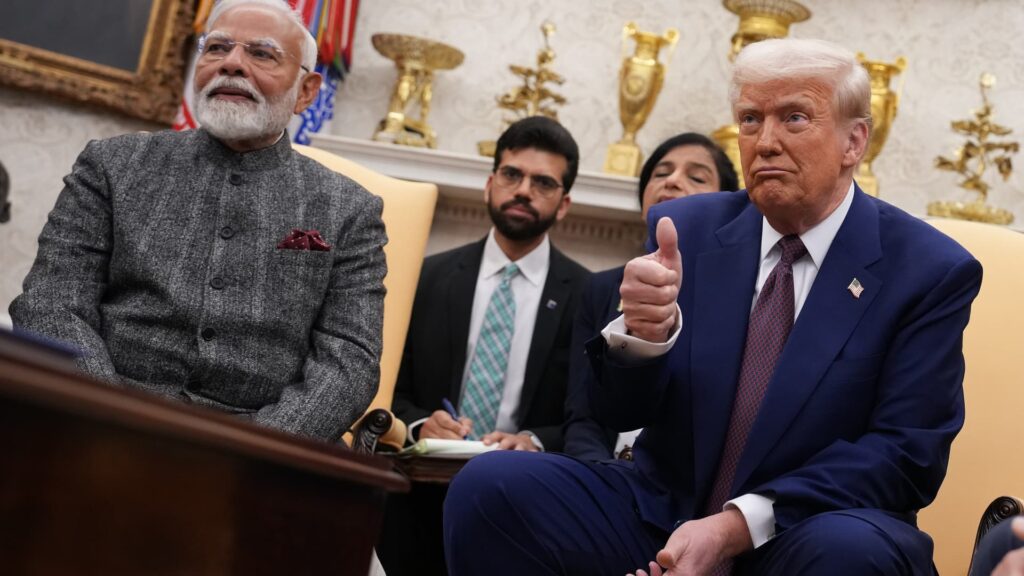
U.S. President Donald Trump and Indian Prime Minister Narendra Modi meet in the Oval Office of the White House February 13, 2025 in Washington, DC.
Andrew Harnik | Getty Images News | Getty Images
On Tuesday, India and the European Union announced a “historic” free trade agreement that would remove or reduce tariffs on more than 90% of goods traded between them.
The deal, almost two decades in the making, will see India reduce tariffs in two of its most politically sensitive sectors, agriculture and automobiles. It also comes amid a growing wave of bilateral trade deals, as countries recalibrate their supply chains and trade ties in response to Washington’s increasingly heavy-handed use of tariffs.
This broader change is already visible. Earlier this month, Canadian Prime Minister Mark Carney visited China, the first leader in that role to do so in 17 years, in a bid to expand economic partnerships with the world’s second-largest economy. British Prime Minister Keir Starmer is next expected to make a three-day trip to China, the first by a British prime minister since 2018.
Yet the India-EU deal, memorably dubbed “the mother of all deals” by European Commission President Ursula von der Leyen, has yet to clear its most unpredictable obstacle: US President Donald Trump.
Trump, who has imposed punitive tariffs on friends and foes alike, has yet to weigh in on the India-EU deal. His silence is remarkable.
In August last year, the United States imposed higher taxes on Indian goods on purchases of Indian oil from Russia, days after imposing a 25% duty on New Delhi.
With Trump’s recent escalation of rhetoric toward the EU, including threats related to Greenland, his response appears to be a lingering cloud over the “historic” deal. And that cloud darkened further when US Treasury Secretary Scott Bessent criticized the EU for striking a trade deal with India in an interview with ABC News on Sunday.
But perhaps it’s not all doom and gloom, as the United States and India are at a “very advanced stage” of finalizing a much-anticipated deal, Indian Minister of Petroleum and Natural Gas Hardeep Singh Puri told CNBC on Tuesday.
Another cloud weighing on investors’ minds is that of the US Federal Reserve, which concludes its policy meeting on Wednesday. Rates are expected to remain unchanged, but Chairman Jerome Powell’s remarks will be closely analyzed amid renewed political pressure on the central bank.
What you need to know today
Is a US-India trade deal on the cards? The two countries are “at a very advanced stage” of finalizing an agreement, Indian Minister of Petroleum and Natural Gas Hardeep Singh Puri said. told CNBC on Tuesday.
The S&P 500 closes at a record high. In the United States on Tuesday, the benchmark index hit a new all-time intraday high on the back of gains in Big Tech, ahead of key earnings from companies in the sector. The Nasdaq Composite also rose, but the Dow Jones Industrial Average fell. European stocks ended higher following the announcement of the EU-India trade deal.
A partial shutdown of the US government. That appears possible as of Saturday morning, largely because of strong Senate Democratic opposition to funding the Department of Homeland Security and other agencies, after the second recent killing of a U.S. citizen by federal agents in Minneapolis.
Anthropic Seals Funding Round Above $10 Billion Target. The AI company has closed a funding round totaling between $10 billion and $15 billion, led by Coatue and Singapore sovereign wealth fund GIC, according to sources familiar with the discussions.
(PRO) Two ways to play the energy sector. Technical and fundamental analysis of this energy ETF shows that it could break through an important resistance level and reach new all-time highs.
And finally…
Indian Prime Minister Narendra Modi (center) poses for a photo with European Commission President Ursula von der Leyen (right) and European Council President Antonio Costa in New Delhi, India, January 27, 2026.
Sajjad Hussein | Afp | Getty Images
The India-EU free trade deal would see India reduce tariffs on European automotive and agricultural products, while the EU would do the same for textiles, leather, marine products, and Indian gems and jewelry.
India is the EU’s ninth largest trading partner, accounting for 2.4% of the bloc’s total merchandise trade in 2024, far behind major partners like the United States (17.3%), China (14.6%) or the United Kingdom (10.1%). But the EU is one of India’s biggest trading partners, rivaling the United States and China.
-Priyanka Balm
About The Author