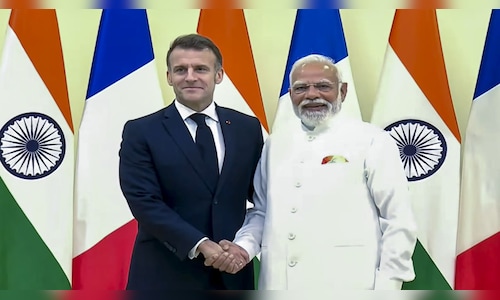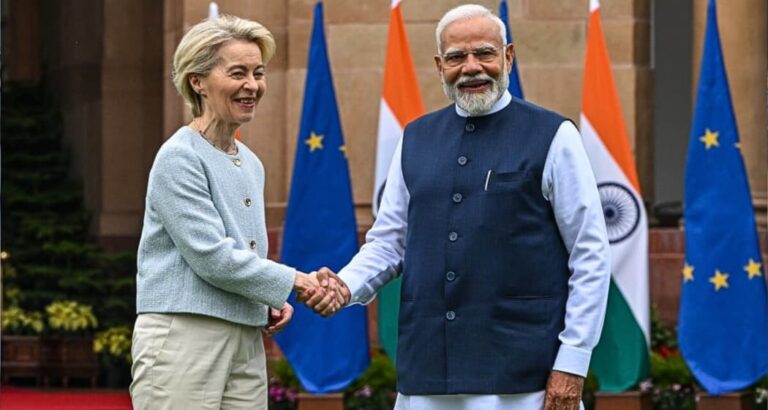
India and the European Union on Tuesday signed their first-ever Security and Defense Partnership, a new framework designed to move ties beyond dialogue and towards regular operational cooperation, particularly in areas where security challenges increasingly overlap between Europe and the Indo-Pacific.
The agreement was one of 13 finalized outcomes at the 16th India-EU summit held in the capital, at a time when both sides are reassessing their security arrangements amid growing geopolitical tensions and instability in the regions.
The main objective of the agreement is to institutionalize security engagement through an annual India-EU Security and Defense Dialogue. The partnership provides for cooperation in the areas of maritime security, defense industry and technology, cyber and hybrid threats, counter-terrorism, space security and crisis management.
According to the joint statement issued following the negotiations, both sides will consult closely on their respective defense initiatives and explore opportunities for collaboration, including industry-to-industry engagement, in accordance with their legal and policy frameworks.
Maritime safety
European Commission President Ursula von der Leyen said India and the EU would undertake joint naval exercises, with a particular focus on counter-piracy operations and safeguarding critical sea lanes.
This decision builds on recent cooperation between the Indian Navy and EU naval forces deployed in the Indian Ocean and reflects shared concerns regarding maritime security, illegal practices at sea and the security of global trade routes.
To facilitate deeper cooperation in sensitive areas, the leaders launched negotiations on an India-EU information security agreement, which will enable the exchange of classified information. Officials said this was necessary to advance collaboration in areas related to defense technology, cybersecurity and intelligence.
There are plans to establish an industry-led India-EU Defense Industry Forum, which will serve as a platform for businesses from both sides to explore joint development, innovation and supply chain resilience.
Fight against terrorism, cyber threats and hybrid threats
The India-EU joint statement calls for enhanced coordination between Indian agencies, Europol and Eurojust, as well as closer collaboration to combat organized crime and drug trafficking.
The two sides also committed to exchanging best practices in countering radicalization, financing terrorism and preventing the misuse of emerging technologies by extremist groups.
The joint statement said India and the EU share their commitment to a free, open and rules-based Indo-Pacific, based on international law and the United Nations Convention on the Law of the Sea.
They agreed to launch India-EU consultations on the Indo-Pacific region and deepen their engagement in regional forums such as the Indian Ocean Rim Association and the Indo-Pacific Oceans Initiative.
The two leaders discussed major geopolitical issues, including efforts to achieve a diplomatic resolution to the conflict in Ukraine.
The summit saw agreements to deepen collaboration in emerging and critical technologies, including the creation of EU-India innovation hubs and an EU-India startup partnership.
The leaders also agreed to begin exploratory discussions on India’s association with Horizon Europe, the EU’s research and innovation programme, which would expand opportunities for Indian researchers and technology startups.
All outcomes of the summit are anchored in the new India-EU Joint Comprehensive Strategic Agenda “Towards 2030”, which identifies security and defense as a central pillar of the partnership.

About The Author