Indian Republic Day will be brighter this year. The 77th Republic Day celebrations will be even bigger this year, as India is set to sign what is considered the “mother of all trade deals” with the European Union (EU), after almost two years of negotiations.
The India-EU Free Trade Agreement (FTA), expected to be signed next week, comes at a time when the United States, under the leadership of President Donald Trump, is upending old and established global alignments, allowing Europe to position itself as a predictable alternative to the unpredictability born from the White House.
Speaking on the trade deal at the World Economic Forum in Davos, European Commission President Ursula von der Leyen said negotiations between India and the EU were approaching an important phase and both sides were “on the cusp of a historic trade deal” that could reshape global trade and supply chains.
“And right after Davos, next weekend, I will travel to India. There is still work to do, but we are on the cusp of a historic trade deal,” von der Leyen said, adding that “some call it the mother of all deals.”
Fees #WEFDavos:
“We are on the cusp of a historic trade deal. Some call it the mother of all deals. A deal that would create a market of 2 billion people.” @vonderleyen
President @antoniocostapm & @vonderleyen will visit India from January 25 to 27. 🇪🇺🤝🇮🇳#EUIndia pic.twitter.com/JeET60BwwS
– EU in India (@EU_in_India) January 20, 2026
But what makes this trade deal so important? Here’s what you need to know.
India-EU trade deal: years in the making
If everything goes as planned and the trade deal is concluded during the Republic Day celebrations, it would be India’s 19th trade deal and one of the most important given the EU’s stance. Since 2021, India has gone on an FTA spree: it has signed deals with the United Arab Emirates, Australia, New Zealand, the EFTA bloc and the United Kingdom.
However, the road to get there has been long and winding. Negotiations on a free trade agreement between India and the EU began in 2007, with both sides initially calling it the Expanded Trade and Investment Agreement (BTIA).
Between 2007 and 2013, several rounds of negotiations took place. However, the process has been stalled due to disagreements over market access, tariffs, intellectual property rights, labor and environmental standards, and other issues.
After an interruption, negotiations were relaunched in 2022 with a renewed political will to conclude a comprehensive FTA.
The talks became more urgent after Donald Trump returned to the White House for a second term and changed his trade policies, stepping up protectionist measures and forcing trading partners to explore new markets.
Negotiations gained further momentum after von der Leyen’s visit to India last February, with Commerce Secretary Rajesh Agarwal noting last week that India had made considerable progress in its trade talks with the EU, with both sides having signed up to 20 of 24 chapters and aiming to reach an agreement before EU leaders’ visit later this month.
India-EU FTA: scale and size matter
Once concluded – hopefully next week – the India-EU FTA would be India’s largest and most complex trade deal ever, covering goods, services and trade rules across all 27 members of the EU customs union. It is precisely for this reason that Indian Commerce Minister Piyush Goyal described it as “the mother of all deals”. “I have concluded seven agreements so far. All with developed economies. This one will be the mother of them all,” he said a few days ago.
But how big is this agreement? The numbers reveal everything. Together, India and the 27-nation European Union would create a combined market of nearly two billion people. Moreover, it would represent almost 25 percent of global GDP. Currently, no other trade deal being negotiated reaches this size or economic scale.
The agreement is expected to cover goods, services, investments, technology transfer and regulatory cooperation, helping to integrate India more deeply into European supply chains while giving European businesses wider access to one of the world’s fastest-growing major economies.
Consider current trade relations between India and the EU. In 2024-25, India’s bilateral trade with the EU stood at $136.53 billion, comprising $75.85 billion in exports and $60.68 billion in imports. The EU accounts for around 17 percent of India’s total exports, while India accounts for around 9 percent of the bloc’s overseas shipments.
India-EU trade deal – win-win for both
The India-EU Free Trade Agreement will greatly benefit both parties. According to a report by the Global Trade Research Initiative (GTRI), India already enjoys relatively low average tariffs in the EU, around 3.8 percent, but key labour-intensive sectors such as textiles and clothing still face tariffs of around 10 percent. Removing them would directly benefit clothing, leather, footwear and other job-intensive and under-pressure industries globally.
Money control In a report, it is also noted that high value-added and knowledge-intensive sectors, such as pharmaceuticals and chemicals, stand to gain mainly through streamlined regulatory approvals and harmonized standards, allowing easier market access for generics, specialty drugs and chemicals.
The FTA will also give India a chance to further diversify at a time when the United States has imposed 50 percent tariffs, including 25 percent on the purchase of Russian crude.
India also did not have to compromise on sectors like agriculture and dairy, which were a red line in the past. THE Economic Times reports that the FTA would also restore competitiveness lost after GSP withdrawal and help Indian exporters cushion the impact of rising US tariffs.
On the other hand, the India-EU FTA gives the European Union access to one of the fastest growing markets in the world.
Wines, spirits and other alcoholic beverages from the EU are likely to face lower customs duties, making them more affordable for the Indian consumer. Currently, wines and spirits from the EU are subject to import duties of up to 150 to 200 percent. This could be significantly reduced under the FTA.
Additionally, European automakers, especially in the premium segment, are likely to benefit from easier access to India. European exporters of industrial machinery, electrical equipment and chemicals could also see an increase in trade as tariff and regulatory barriers are eased.
The FTA will also benefit high value-added services and intellectual property sectors, including IT, engineering, business services and telecommunications. Even specialty products such as aircraft parts, diamonds and luxury goods could find new opportunities in India.
Challenges remain
But despite all this, a few issues still need to be resolved before the deal is signed and sealed. India wants greater mobility of qualified professionals and guarantees for agriculture, particularly dairy and cereals. India also raised concerns over the EU’s border carbon adjustment mechanism, which could affect exports of steel, aluminum and cement.
Meanwhile, the EU wants deeper cuts in the auto sector – something that worries India, as it believes it would hurt domestic manufacturing and set precedents for Japan and South Korea. India is also pushing back against EU demands for TRIPS-plus protections that could raise drug costs and weaken India’s generic drugs industry.
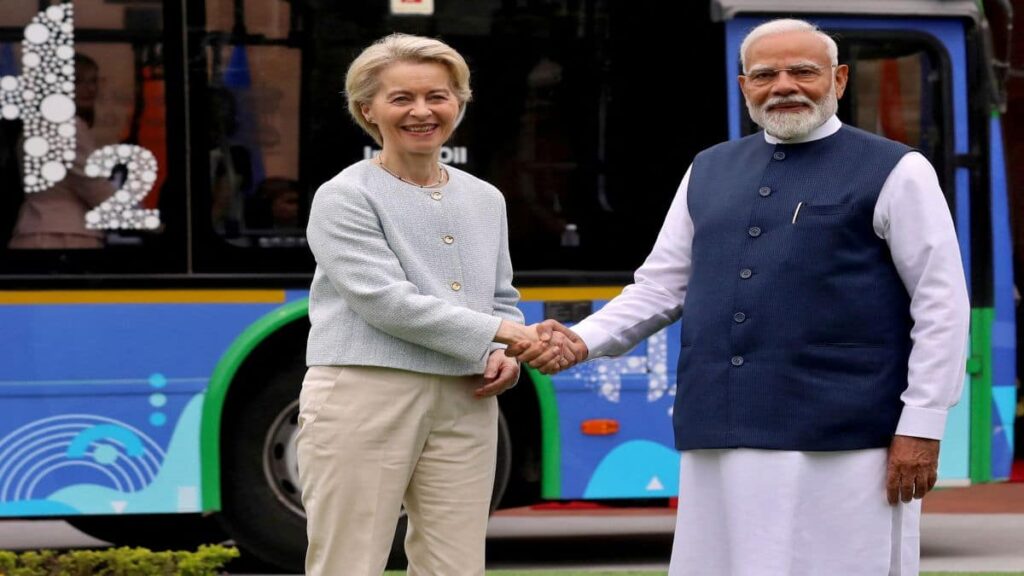
However, despite the complexities, von der Leyen’s remarks in Davos are a sign of things to come. There is widespread expectation that next week’s meeting – European Council President Antonio Luis Santos da Costa and President von der Leyen will be the chief guests at the Republic Day parade – will see India and the EU strike a game-changing deal.
With the contribution of agencies
End of article
About The Author