New Delhi: India will pursue a dozen bilateral trade talks in 2026, including free trade deals with economic powerhouses worth more than $50 trillion in combined GDP, as New Delhi steps up efforts to diversify its trade partnerships amid growing global protectionism.

After concluding three free trade agreements (FTAs) in 2025, India’s priority negotiations next year include deals with the European Union (EU), the United States and the Russia-led Eurasian Economic Union (EAEU), according to the Ministry of Trade and Industry’s year-end review.
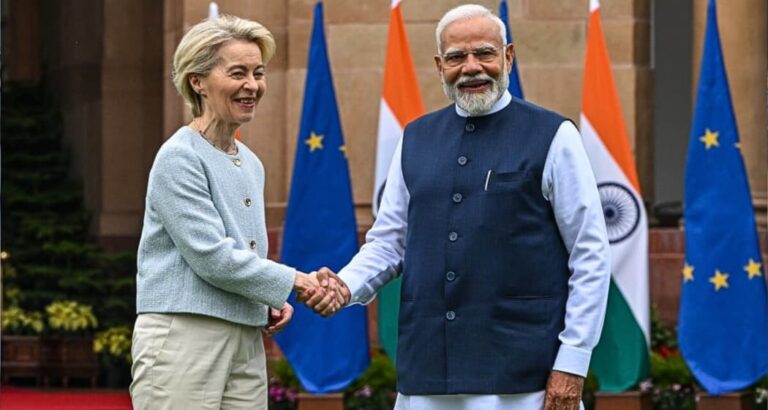
The India-EU FTA is expected to be announced in January 2026, with high-level meetings planned early this month ahead of the India-EU summit in New Delhi, a person familiar with the matter said, requesting anonymity. HT announced on December 24 that the deal was close to being finalized.
The EU, the world’s second-largest economy with a GDP of $19.99 trillion, represents a major market opportunity for Indian exporters. Negotiations for a bilateral trade agreement (BTA) between India and the United States – the largest economy with a GDP of $31.6 trillion – are also at an advanced stage.
Government officials and trade experts expect India to finalize at least three to four major FTAs in 2026.
“Bilateral trade agreements open up new opportunities in various sectors while strengthening India’s integration into global value chains,” a ministry spokesperson said, adding that the Indian economy was already witnessing the positive impact of FTAs.
Ongoing free trade negotiations with India, which will intensify in 2026, include agreements with the EAEU (a $2.4 trillion economy comprising Armenia, Belarus, Kazakhstan, Kyrgyzstan and Russia), Australia (Comprehensive Economic Cooperation Agreement), Chile, South Korea (enhanced negotiations), Peru, Sri Lanka (Economic and Technological Cooperation Agreement) and the Maldives. This also includes renegotiations with ASEAN countries (an economy worth over $4 trillion) towards an agreement on trade in goods.
This surge comes despite major headwinds. The United States imposed additional 50% tariffs on Indian goods starting in August, while Mexico significantly increased most-favored-nation import duties on all countries without bilateral trade deals. India is engaged with both countries to resolve trade issues amicably.
“Despite the imposition of high tariffs by the US in August 2025, bilateral trade negotiations have continued. Meanwhile, from a risk mitigation perspective, due to the volatility of US tariffs, India has accelerated FTA negotiations with other key jurisdictions,” consultancy Dhruva Advisors said in its year-end report on Tuesday.
Despite geopolitical upheaval and tariff barriers in major markets, India’s merchandise exports increased from $36.43 billion in January 2025 to $38.13 billion in November 2025. Exports strengthened across major product groups and global markets thanks to the resilience of Indian exporters and a trade diversification strategy, the ministry spokesperson said.
Recent FTAs increasingly include investment commitments alongside market access provisions. New Zealand has committed to investing $20 billion in India over 15 years under a deal announced on December 22. The free trade agreement between India and the European Free Trade Association (EFTA) bloc of Norway, Switzerland, Iceland and Liechtenstein, which came into effect in October, was the first to include an investment commitment of $100 billion over the next 15 years.
“The objective of FTAs with diverse economies is not limited to strengthening trade, but they become a mechanism to build trust between partners in order to attract FDI (foreign direct investment),” the ministry spokesperson said.
According to the ministry’s year-end report, gross FDI inflows into India reached $1.1 trillion between April 2000 and June 2025. The total annual FDI inflow more than doubled from $36.05 billion in 2013-14 to $80.62 billion in 2024-25.
During 2025-26 (till June), India recorded interim FDI inflows of $26.61 billion, up 17% from the previous year. In the last 11 financial years (2014-2025), India attracted $748.38 billion in FDI, an increase of 143% from the $308.38 billion received in the previous 11 years (2003-2014). Nearly 70% of the total FDI inflows of $1,071.96 billion over the last 25 years (2000-25) took place during 2014-25.
“These figures underline India’s emergence as one of the most attractive investment destinations in the world,” the ministry said.
About The Author