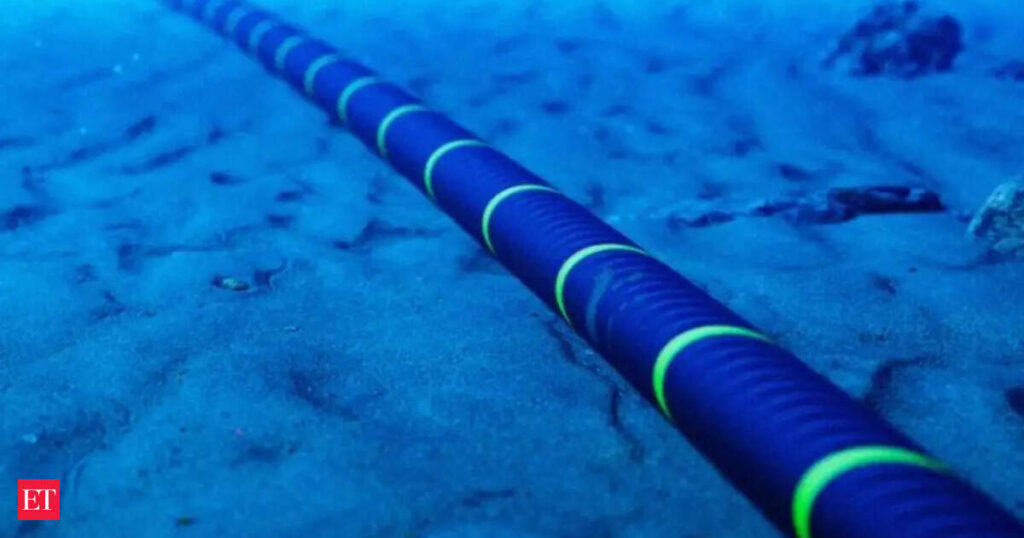
The next edition of the summit between India and the 27 countries of the European Union is scheduled to take place on January 27 in New Delhi and possible cooperation in the protection of critical underwater infrastructure is likely to feature prominently in the negotiations.
Around 70 senior military and officials from India, the EU and Indian Ocean countries will hold extensive deliberations on Friday to discuss how to secure critical underwater infrastructure, with a focus on maritime cables in the Indian Ocean region.
This meeting aims to strengthen cooperation between India, the EU and the wider Indo-Pacific region to secure critical underwater infrastructure by mapping risks, sharing best practices and proposing practical technologies and policy solutions, according to the EU.
“Data cables connect continents and states, connect islands to the continent and connect the EU and India to the rest of the world, carrying 99 percent of intercontinental internet traffic,” it says.

Data cables have become essential for commerce and digital growth across various sectors of the global economy.
However, lying unprotected on the ocean floor, physically accessible and difficult to monitor, underwater infrastructure is vulnerable to malicious activity and intentional damage, which can have significant global impacts, the EU said in a statement.
The Track 1.5 EU-India regional seminar will assess current risks and consider possible responses with a focus on regional and global cooperation.
It was jointly organized by the National Maritime Foundation (NMF) of India and the European Union and the EU security and defense project ESIWA+ (Enhancing the EU’s Security Cooperation in and with Asia and the Indo-Pacific).
With a focus on submarine cables, the workshop represents a vital step in ongoing maritime security dialogues between the EU and India, said EU envoy to India Hervé Delphin.
“Maritime cooperation is a key part of the EU-India strategic agenda. This workshop on submarine cable security and resilience reflects our common interest in developing a comprehensive approach to maritime security,” he said.
The envoy said the EU Cable Safety Action Plan provides a framework to strengthen the security and resilience of submarine cable infrastructure.
This can serve as a basis for developing more cooperation and joint strategies with key international partners like India in this area, he said.
“The EU’s regional focus on the Indian Ocean is all the more important given the growing number of initiatives between Europe, India and other regional partners, notably in the context of the India-Middle East-Europe Economic Corridor and other projects linking these geographies,” Delphin added.
Director General of the National Maritime Foundation, Vice Admiral Pradeep Chauhan (retd.), said the workshop would help further foster regional maritime dialogue and action to secure underwater infrastructure, critical to economic security and sovereignty.
He said the discussion will particularly identify vulnerabilities, highlight best practices and promote concrete solutions integrating technology, policy and cooperation.
The seminar builds on the Fourth EU-India Maritime Security Dialogue and Ministerial Meeting on Critical Maritime Infrastructure Protection, held last month in Brussels.
The EU said the protection of critical maritime infrastructure is vital for the security and prosperity of the EU and the Indo-Pacific regions.
He said protecting underwater infrastructure requires a combination of enhanced monitoring and control systems to detect threats in real time.
“It also requires strategic coordination between governments, private operators and international partners to ensure rapid response and resilience,” the EU said.
The EU plays a role in strengthening maritime security in the region, notably with its naval operations Atalanta and Aspides in the northwest Indian Ocean.
About The Author