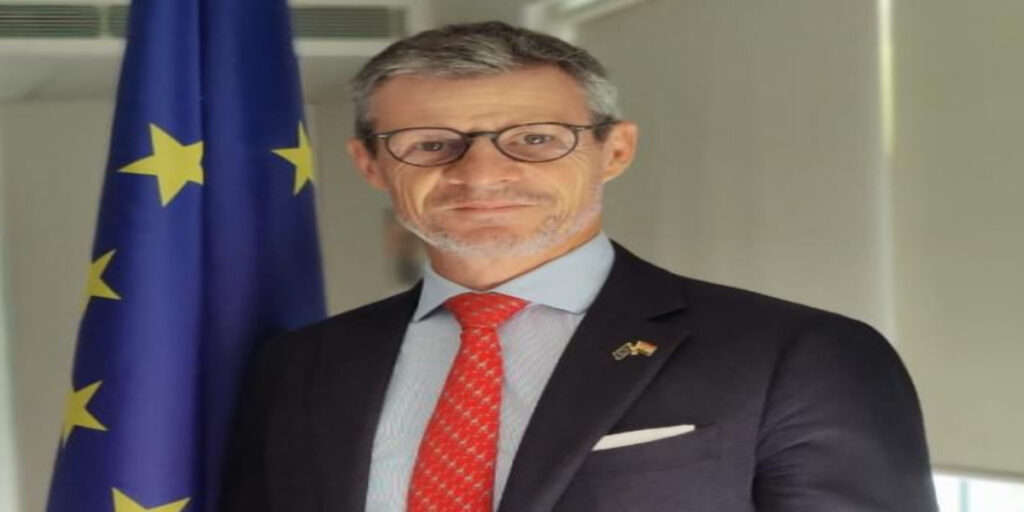

The current FTA negotiations between India and the EU are somewhat different, says Hervé Delphin, European Union (EU) Ambassador to India.
“This is not the same FTA that was ten years ago. Don’t read this through the prism of the past. I would like to call it negotiations 2.0 between the EU and India. There is a more acute sense of resilience today because of the tariff war that is going on. So I think this is an FTA that goes beyond trade,” he said during his speech at the ‘Global India Conclave 2025.”
Once concluded, the FTA will give India and Europe the opportunity to mitigate risks from the US tariff war. The India-EU FTA is based on predictability and global trade rules set out under the World Trade Organization (WTO).
“FTAs are always win-win for both partners. It’s always beneficial for both sides because bilateral trade grows, jobs grow… So we are not in a zero-sum situation,” Delphin said, adding that the EU is seeking better market access for its automobiles and steel.
The India-EU FTA negotiations were restarted in 2022 after being suspended for almost a decade. They included the launch of new negotiations for a standalone agreement on investment protection and an agreement on geographical indications.
Negotiations on this ambitious trade agreement were initially launched in June 2007.
Delphin said the two sides stopped conducting rounds of negotiations and moved to a “continuous negotiation mode” for which a high-profile delegation of trade negotiators will visit India starting this week.
Earlier this year, during European Commission President Ursula von der Leyen’s visit to India, the two sides agreed to conclude the FTA by the end of 2025, even as the Russia-Ukraine war and the US tariff war have negatively impacted the EU’s economic growth.
“As European and Indian companies want the deal to be concluded, negotiators will have no choice but to conclude a deal… We look forward to the FTA being concluded,” the envoy said.
The EU wants India to provide better market access by reducing, and in some cases eliminating, tariffs on European cars, steel, wines and spirits. Due to these demands, the FTA hit a dead end in 2013 under the UPA-led government.
The EU also wants India to speed up the signing of the two additional agreements on investment protection and geographical indication, while New Delhi has asked for more time to negotiate them.
The question of Russia
Reiterating the EU position on ongoing issues Russia-Ukraine WarAccording to the envoy, India-Russia relations have become a stumbling block between New Delhi and Brussels.
“Let’s be realistic. We have a Russian question in the India-EU question. There is no way around that. Strategically, even if we converge, there is no way we won’t align… There will be differences. But there must be an understanding of our respective strategic and security situations,” Delphin said.
The remarks came a day before Russian President Vladimir Putin’s state visit to India.
“There is an obvious aggressor. Russia is the invading neighboring country… We are at war… Russia is an aggressor. So India needs to take note of that. Although European countries will never harm India’s security interests, we also expect the same from India,” Delphin said.
Earlier this year, in September, while releasing a “new EU-India strategic agenda”, the EU’s top diplomat, Kaja Kallas, said: “If everything is not agreed, then nothing is agreed.” » She was referring to India’s growing ties with Russia, which have become an issue with Brussels.

About The Author