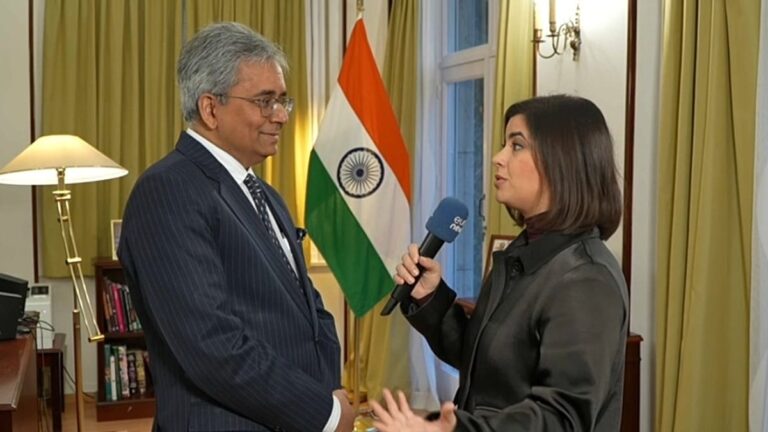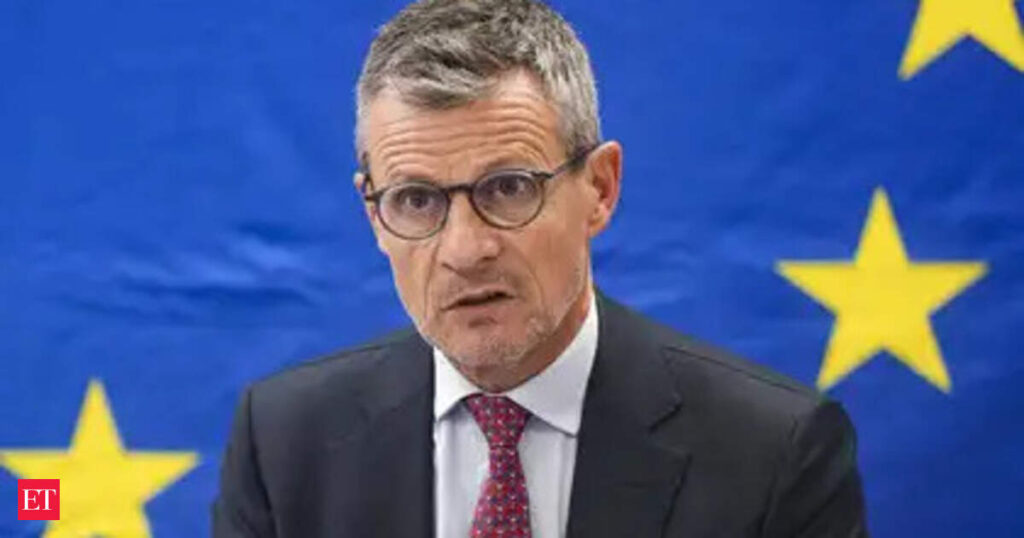
“Of the 23 chapters under discussion, 11 have already been closed. Important chapters still under negotiation include market access for cars, steel, certain aspects of services and investments and technical barriers to trade,” Ambassador Delphin said.
“There is undoubtedly a strong political commitment to conclude the FTA negotiations by the end of the year,” he added.
Hervé Delphin said a 40-member team of European negotiators would arrive in Delhi this week to resolve persistent obstacles. Current bilateral trade in goods stands at around $136 billion, making the EU India’s third largest trading partner after the US and China.
Delphin stressed that the agreement is “WTO compatible” and does not constitute a zero-sum game. “The EU and India together represent 25 percent of the world’s GDP and 25 percent of the world’s population,” he said, describing the partnership as a long-term strategic investment rather than a short-term portfolio play.

“We are investing in India’s great potential because we also see India as a key player in the future world order,” he stressed. On people-to-people ties, he revealed that Indians are the biggest beneficiaries of the EU Blue Card program for skilled workers, with around 21,000 Indian professionals benefiting from the service.
The number of Indian migrants in the EU has increased tenfold since the 1990s to reach 8,20,500 by the end of 2023, reflecting growing interdependence.
“The number of Indian migrants in the EU has increased tenfold since the 1990s. So it is now around 820,500 at the end of 2023 and I am pretty sure that if we add up the numbers for 2024 and 25 we are in the upper range. And the main drivers of this migration are employment and education,” the ambassador said.
The ambassador said India and the EU were also discussing a comprehensive framework for mobility.
Launched in 2007 as the EU-India General Trade and Investment Agreement (BTIA), negotiations broke down in 2013 over contentious issues such as tariffs on dairy products and automobiles, as well as intellectual property rights.
Reactivated in June 2022 following high-level commitments, the agreement now aims to boost bilateral trade, currently valued at around $136 billion.
About The Author