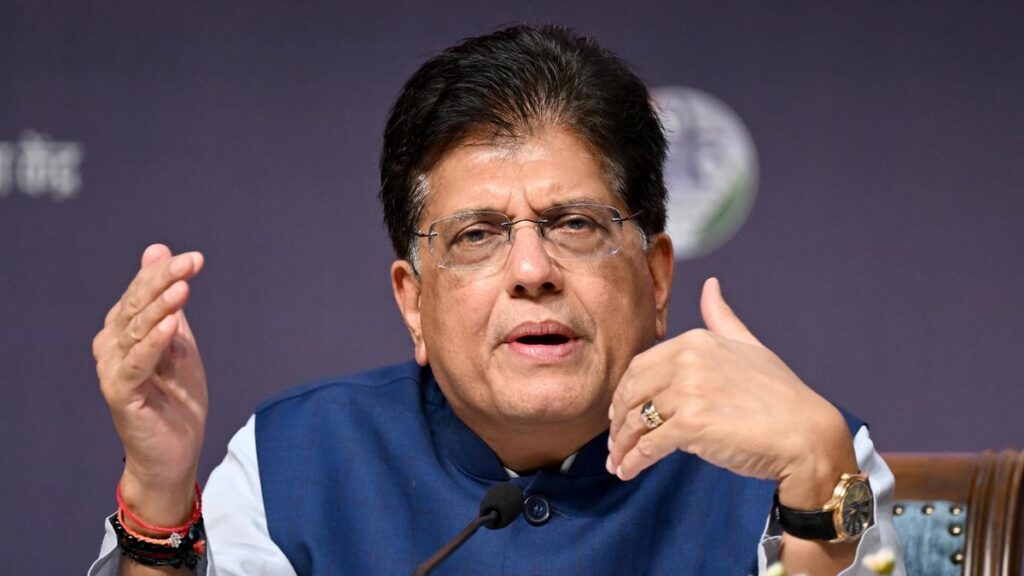
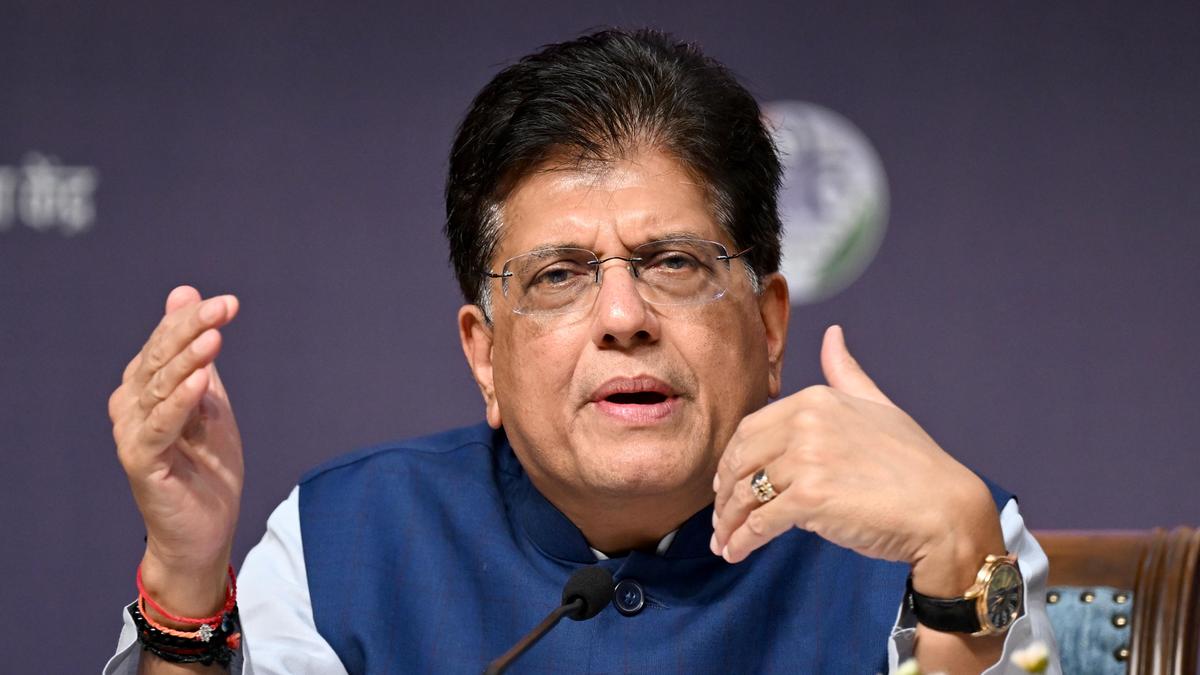
Minister of Commerce and Industry, Piyush Goyal. File | Photo credit: The Hindu
India and Israel are planning to implement their proposed Free Trade Agreement (FTA) in two phases to ensure quick benefits to the trading community of the two countries, Commerce and Industry Minister Piyush Goyal said on Sunday (November 23, 2025).
India and Israel signed terms of reference (ToR) on Thursday, November 20, 2025, to officially launch negotiations on the agreement. The terms of reference include market access for goods by eliminating tariff and non-tariff barriers, facilitating investments, simplifying customs procedures, increasing cooperation for innovation and technology transfer and relaxing standards to promote trade in services.

“We are considering doing it in two tranches. A decision will be taken when negotiations begin. Both ministers want to finalize the first phase earlier so that the business community benefits sooner,” Goyal said.
The minister is in Israel to meet with leaders and businesses to discuss ways to boost bilateral trade and investment. He leads a business delegation of 60 members.
Mr. Goyal said he and Israeli Economy and Industry Minister Nir Barkat had agreed to focus first on the low-hanging fruit in the FTA. They also decided not to address sensitive issues from either side.
The two countries, he said, could look at “how innovation and R&D can generate greater investments in their respective countries, work on joint projects where we can leverage their skills and take advantage of economies of scale in a large market like India.”
“It is entirely possible that we will get to the first phase of an FTA, so that we can reap the benefits more quickly,” Mr Goyal said.
Regarding a major metro project in Israel, the minister said Israel had just released pre-qualification documents for a $50 billion metro project in Tel Aviv. “It is 300 km of underground tunnels and it is one of the biggest projects, and they want Indian companies to bid as well,” Mr Goyal said.

“We have several players, both in the public and private sectors, who have carried out massive works. We have 23 cities installing metros in India,” Goyal said, adding that Israel would “very seriously” like India to be part of this project and “I hope Indian companies will be interested and join the bidding process.”
During 2024-25, India’s exports to Israel fell by 52% to $2.14 billion from $4.52 billion in 2023-24. Imports also fell 26.2% to $1.48 billion in the last fiscal year. Bilateral trade amounted to $3.62 billion.
India is Israel’s second largest trading partner in Asia. Although bilateral trade in goods is dominated mainly by diamonds, petroleum products and chemicals, in recent years there has been an increase in trade in areas such as electronic machinery and high-tech products, communications systems and medical equipment.
India’s major exports to Israel include pearls and precious stones, automobile diesel, chemicals and minerals, electrical machinery and equipment, plastics, textiles, clothing, base metals, transport equipment and agricultural products.
Imports include pearls and precious stones, chemicals and minerals/fertilizers, electrical machinery and equipment, petroleum oils and defense, machinery and transport equipment.
Published – November 23, 2025 at 12:23 IST
About The Author