Hello everyone. Namaskar!
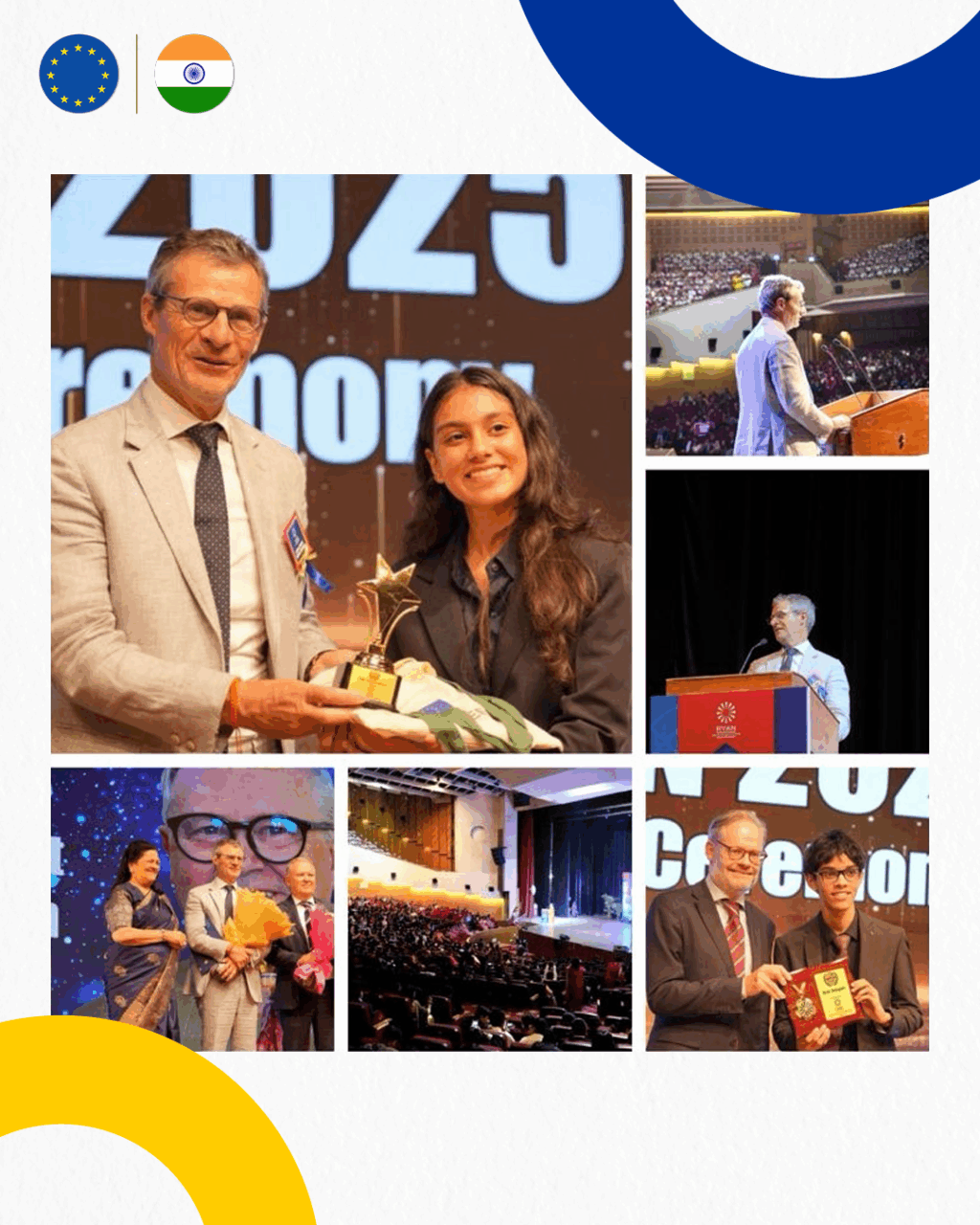
Dear Director Marwah, Dear Director Pinto, distinguished teachers, And above all…dear students of Ryan International and St. Xavier’sThanks for inviting me here!
As an academic myself who continues to teach as a visiting professor, it is a great pleasure to be with you. A very enriching experience because it is always about learning and mutual growth, through questioning, intellectual curiosity, debate and commitment.
Now you gather here for a UN Modelsrenowned for their passionate debates and engagement. I imagine many of you will be carried away by your mission!
But beyond the enthusiasm, there is something deeper, as the UN Secretary-General said in his message this year to Model United Nations: it is about believe in the power of global cooperation And let’s unite behind global solutions to global problems.
This year will mark UN@80. Unfortunately, there will be little celebration at the UNGA which begins in a few weeks in New York. There is a general weakening of the multilateral system and an attack on international law when we need it most to address global challenges. Force is not good when it leads to unilaterally imposed measures, the use of coercion or the unilateral invasion of a country.
Global cooperation and the UN multilateral system are important to the EU. We are the champions of multilateralism. It’s actually in our DNA. And I’ll explain why in a moment. As promising students, I can only wish you an excellent “Meet your own destiny.” As we all know, this phrase comes from Jawaharlal Nehru’s speech at the dawn of India’s independence. He also meant that each generation has its own chance to shape history – to fulfill its destiny. And sitting here today, you are preparing for your own moment, in your own way. Here I look at the bright future of India, driven by its talented youth: future engineers, businessmen, diplomats, leaders..
Speaking of fate…this conference could not have taken place at a more opportune time. In today’s unstable geopolitical and economic landscape, the EU and India become natural partners with strongly convergent interests and shared values. Our leaders are determined to elevate the EU-India strategic partnership and harness its immense potential.
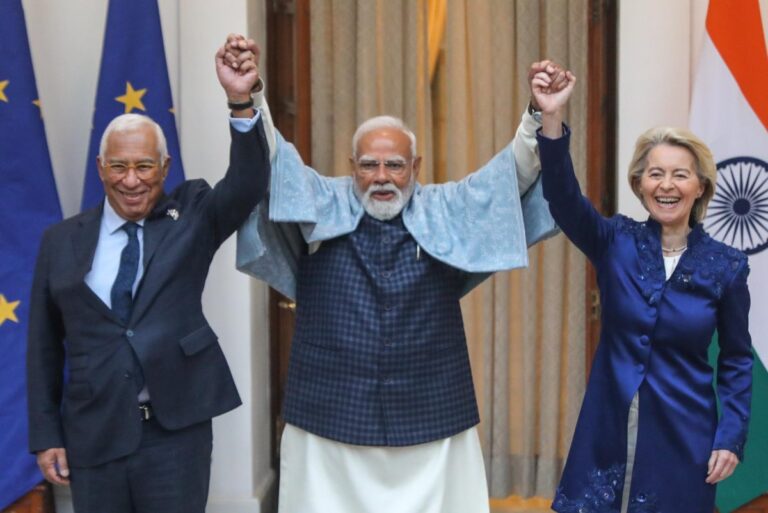
Earlier this year, the entire European Commission – President Ursula von der Leyen and her college of commissioners – came to New Delhi. This was not just a diplomatic courtesy. This speaks to the central importance of India in the European worldview. And it goes both ways.
For India, the EU is not only a key trading partner, but also a security and an ally in shaping the global conversation and governance on issues such as climate change, biodiversity, digital transformation, AI or space.
Beyond economic and diplomatic relations, peoplethrough culture, learning and exchanges truly connect India and Europe.
- Did you know that the EU and India are driven by a common currency? The European Union in diversity and Unity in the diversity of India.
- The EU consisting of 27 Member States versus India consisting of 28 States and 8 Union Territories. The EU has 24 official languages compared to 22 for India
- Both are home to different religions, traditions and cultures, they both represent the acceptance of differences as enriching qualities that strengthen society.
- Did you know that almost 900,000 Indian citizens traveled to the EU (Schengen zone) on a short-term visa last year?
- Did you know that Indian students make up the largest cohort of graduates of our Master’s level university exchange program, called Erasmus Mundus? o Did you know that the EU and India are the two largest democracies?
In short, our destinies are deeply linked. The choices we make together, whether it’s green energy, technology or education, will shape not only our two regions, but the world as a whole.
I was asked to share my views on diversity, unity and leadershipthemes that resonate strongly with both Recent European history And The plural fabric of India.
The EU experience
Let me tell you a little more about the EU. It took decades of effort, compromise and lengthy negotiations for Europe to rise from the ashes of the Second World War and become what it is today, an advanced economy and an open society.
The European Union is a unique experience in political history: it is a union of sovereign states that voluntarily pool their resources and powers to form a common legal and institutional order. There really is no other parallel in the world. We created a framework that transformed rivalry into cooperation and boundaries into bridges.
Post-war cooperation led to the creation of the European Coal and Steel Community in 1951—the very foundation of today’s EU. Belgium, Italy, Luxembourg, the Netherlands, France and Germany agreed to merge the industries that had once fueled their conflicts, guided by Robert Schumann’s bold vision of waging war between France and Germany.not only unthinkable, but materially impossible.’
The integration then took place step by step. Common markets, shared policies, economic and monetary unions, and increasingly coordinated security policies have shown that when countries choose to work together, they can achieve much more than they could alone. From the beginning, the EU has not just been about economics: it has been about politics, cooperation and common choices for the common good.
Todaythe European Union is an ean economy of more than 19,000 billion euros. We are one democracy of 450 million peopleenjoying a quality of life among the best in the world. The EU is also a world leader in clean technologies and green transitionstriving to reduce net emissions by 55% by 2030 and achieve carbon neutrality by 2050.
This experience of voluntary collaboration– where member states do not give up their sovereignty but exercise it jointly at a higher level – this is what makes the EU so innovative. It has taught us that complex challenges – whether in trade, social policy or international relations – can be resolved through dialogue, compromise and shared responsibility. This experience shaped us as…
a Union of incredible resilience and creativity, – one of the three main centers of production, innovation and technology in the world and the largest trading bloc.
a Union which remains a beacon of prosperity and stability;
a Union determined to defend its values and interests, its citizens and its security, in the face of adversity.
a Union which has no aggressive program or aspiration to domination;
a Union that promotes cooperation and global solutions with interested countries.
A Union which presents itself as a reliable, trusted partner and seeks to develop solid partnerships. In this regard, India has become an extremely important and decisive strategic partner for the EU.
We have made our own path towards the development of strategic autonomy and sovereignty, taking responsibility for our own destiny. Along the way, we have faced a series of shocks: Brexit, challenges to the transatlantic bond under the Trump administration, the COVID-19 pandemic, China’s increasingly assertive global position and Russia’s war of aggression against Ukraine. Each shock has prompted adjustment, reflection and, ultimately, greater European engagement rather than withdrawal. It is for this reason that many people around the world now look to the EU integration model as an example from which they can learn.
Let me turn to the EU and India
Part two: overview of EU-India relations
When the EU and India come together, we don’t just cooperate; we resonate. We know the power of diversity and the strength that good management of it provides.
India was among the first to establish diplomatic relations with what was then the European Economic Community in the 1960s, at the same headquarters we share today. In 2004 we decided to evolve our relationship into a “strategic partnership” and last year we celebrated its 20th anniversary.
Today we have almost 50 bilateral thematic and institutional dialogues and I will now expand on some of them.
We share the same fundamental principles and values: representative democracy, respect for the rule of law and a strong commitment to a rules-based international order which are fundamental elements of our partnership.
As strategic partners, we have a common interest in each other’s freedom, security, prosperity and sustainability. It is time that we defend this diversity and these values together, forging a mutually beneficial partnership. This is indeed an Ek Saath moment between the EU and India.
Economic and technological Economically, the EU has become India’s largest trading partner with
123.7 billion euros for the year 2023-2024, or 12.2% of India’s total trade. We are ahead of the United States and ahead of China.
India currently represents only 3% of world trade. This is not proportional to its size and potential. Relaunching our negotiations on the free trade agreement in 2022 in this case could be a game-changer.
We also cooperate in technology, bringing together two robust ecosystems, linking research, development and innovation. Environment, connectivity and sustainability
Another dimension is our Global partnership.
India is in a single position—a natural bridge between the countries of the South and the rest of the world, between the Indo-Pacific and Europe. And Europe is ready to support this vision. Through Global Gateway, our €300 billion global infrastructure initiative, we can invest in projects that strengthen energy networks, improve connectivity and drive sustainable growth, not just within India, but between India and the world.
We also have a strong partnership on climate and energy. The EIB is ready to invest 1 billion to support the development of green hydrogen in India. Security and Defense
India and the EU are increasingly cooperating in the areas of security and defense. In areas such as maritime security, cybersecurity, counter-terrorism and non-proliferation.
This covers political dialogues but also a very concrete operational level, for example in the Indian Ocean or cooperation between the Central Bureau of Investigation and Europol – its European equivalent.
About The Author