Oil on troubled waters?
Last month,President of the United States Donald Trump said THE European Union (EU) to impose high tariffs on India in retaliation for the purchase of Russian oil. Trump himself imposed 50% tariffs on Indian imports – half in a vain attempt to eliminate his trade deficit with Delhi, the other half as punishment for India’s boost to Russian war chests through oil purchases. This is as high as the tariffs imposed on China.
The EU rejected Trump’s mafia remarks ‘offer you can’t refuse‘. Rightly so. It is worth Younpackaging the thinking behind Europe’s refusal – for once – bow to pressure from the White House.
Great expectations
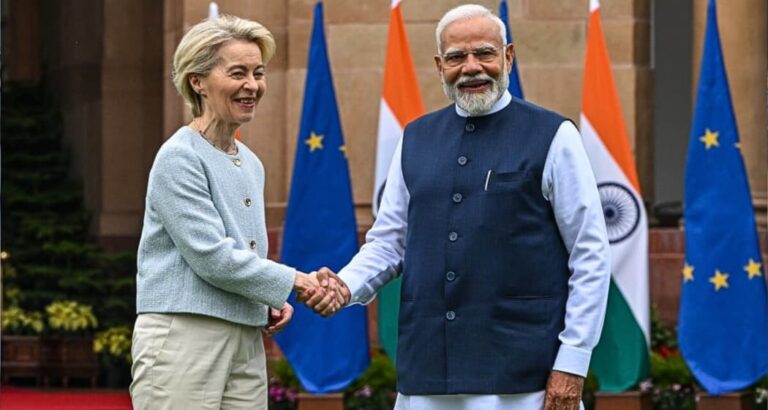
There was three good reasons. The first is that India and Europe are on the verge of concluding an ambitious Free Trade Agreement (FTA) which, after several steps and starts, has taken 17 years.P.rhyme Mr.insist Modi andEuropean Commission President Von Der Leyen agreed to conclude the work by the end of the year.One of theme the writers were involved in this negotiation as from 2011.
Against one the deterioration of the economic climate and theed to reduce excessive dependencies on the United States and ChinaEurope needs this agreement to boost its exportss and diversify
The latest India-EU strategic program includes around 60 areas of cooperation, but the The FTA is at the forefront.With A India-EU Summit expected at the beginning of next year, it is planned to finalize the FTA in advance or use the Summit as (photo) the opportunity to announce it.
Be WTO-consistent, FTAs must liberalize almost all trade – generally 90-95% commercial and tariff lines. Imposing a A 50% tariff on Indian imports as soon as the end is in sight would be both counterproductive and infringe this requirement. It’s like torpedoing a ship below the waterline as it enters port, to the applause of the crowd. bordering the quays.This would sabotage the Agreement.
For this reason alone,Europe will not do it place customs tariffs on India. Faced with the deterioration of the economic climate and the need to reduce its excessive dependence on the United States and China, Europe needs this agreement to boost its exports and diversify.
Towards the west ho!
And an India fighting against 50% rights in THE The United States also needs Europethe market more than he did. Alongside its agreements with THE udenied KUnited Kingdom And EEuropean Free Tharbor Aassociationthe EU-India agreement represents a welcome departure from the traditional anti-Westernism still visible in certain areas of Delhi.IIt istimely. However A fast–economy on the rise now fourth on a global scale, India has long remained an import–dependent on raw materials and UNcapable of improving the manufacturing sector as a proportion of GDP: far from increasing, the share of the manufacturing sector In GDP slippedbelow 13% Since 2023 at 2024.
Countries like Vietnam, Thailand, Cambodiaone or Malaysia has succeeded in encouraging multinational companies to diversifying far from China, offering a lower laboratoryYour costs, simplified tax structuresand reduced rates. On the other hand, India continues to present to investors challenges around complex regulations, bureaucratic delays, inconsistencies or unpredictable political reforms, and relatively high laboratoryYour costs. Factorshindrance competitiveness.
AIn such a period, it is even more important for India to unlock FDI flows from reliable partners.A successful EU-India FTA could channel foreign direct investment into India, thereby advancing the ‘China+1‘ strategyYes, bolstering investment, Iindustrial growth and growth of India regional competitiveeness.India’s recent FTAs with the UK and EFTA were based on the principle of opening its market in exchange for increased investment: confidence-building measures for other partners–especially the Eu.The watches is ideal for both parties reach a mutually beneficial agreement, taking into account their respective economic needs.
Iit would be hypocritical – andprobably illegalwithin the framework of the WTO – that the EU sanctions India for refining Russian crude while it itself imports similar volumes of Russian energy
The House of Russia
Second reason: the EU himself imports Russian energy. Hungary, Slovakia and other countries a few depend to a large extent on Russian oil and gas. Nearly 20% of EU gas imports are Russian.
The EU as a bloc had already predicted its end of 2026 to wean ourselves off Russian energy, a deadline that not the whole EU mbraised sstates acceptedAnd to have now pushed until 2027.IThis would be hypocritical – and probably illegal under the WTO. – that the EU sanctions India for refining Russian crude while it itself imports similar volumes of Russian energy.
The EU is increasingly criticizedfor his disregard for international rules, and its extraterritorial scope – as seen in its trade agreement with the United States, and in various environment-related import restrictions. It can do without a further questioning of its frayed multilateral references.
Satyagraha, European style?
Third, the EU has always been cautious about using commercial tools for non-commercial purposes. “Render to Caesar what is Caesar’s!” » » was the traditional cry of the Berlaymont. One of the biggest criticisms of the Trump administration is its blunt weapons.strade For political or security purposes, whethert Greenland, the Panama Canal or the customs tariffs imposed on Brazil for the imprisonment of former President Bolsonaro.The outright militarization of trade is something the EU largely hates. So much so that five years ago he introduced a still unused anti-coercion instrument –allow Europe to retaliate if countries like the United States, China or others use trade restrictions to constrain changes in Europeit’s polawful choices or behaviors.Europe will not undermine its own cause by using tariffs to force changes in Indian policy.
The EU prefers to guarantee all non-trade objectives – sustainability commitments, etc. – through cooperation and not coercion.
The outright militarization of trade is something the EU largely hates. So much so that five years ago he introduced a still unused anti-coercion instrument –allow Europe to retaliate if countries like the United States, China or others use trade restrictions to constrain changes in Europeit’s polawful choices or behaviors.Europe will not undermine its own cause by using tariffs to force changes in Indian policy.
The EU prefers to guarantee all non-trade objectives – sustainability commitments, etc. – through cooperation and not coercion. Fortunately SOSince India has made it clear that it will not sign any FTA with binding commitments on sustainabilityhuman rights, etc.. imposed through trade sanctions. This is neocolonialism.
What the EU has As part of its latest sanctions against Russia, the ban on imports of petroleum products from Nayara, India’s main refiner of Russian crude, partly owned by Russia’s Rosneft, was found to be in violation sanctions usingWWestern services for oil delivery. Although poorly received by the company and the Indian government, reactions were muted.A careful answer activated by discreet India-EU talks onRussian oil trade.
Any aggressive pressure for India ‘cut ties‘ with Russia could trigger negative reactions at the national level
Industry experts do not see the ban as a major stumbling block in EU-India relations, provided it is not unfairly extended to refiners supplying the thirsty local market. Regardless, India can reduce the Russian share of its total exports to Europe – which amount to around €19 billion per year – with refined Gulf oil or Iraqi crude.
And since Russian oil is not essential to India’s industrial needs – it is primarily used to reduce the costs of a vital product – economic pragmatism and security of supply trump political pressure. Looking at recent trends in India’s oil imports, we can safely infer that India will continue to diversify its oil imports purely for reasons of economic interest, rather than giving in to the unfair demands of any party.
Pride and prejudice
To paraphrase Jane Austen, it is a truth universally recognized that further punitive measures from Europe would be counterproductive, unnecessarily pushing India into an impasse where New Delhi is responding, reaffirming its determination to maintain good trade relations with its long-time ally Russia.
The authors suggest that Europe must recognizesand the views of the Indian electorate, which remains largely pro-Russian and has a different perspective on Moscow’s role in the war in Ukraine. As a democracy, any aggressive pressure for India ‘cut ties‘ with Russia could trigger backlash domestically, making pragmatic strategic decisions more politically costly for the current government.
Despite all the optimistic talk in Europe about the common values uniting Europe and India, India will continue to balance its relations with Russia and “Western powers” in its national interest.We urge the cthe collective West, divided within itself, has reconcile hiself in India’s multi-alignment approach,and focus on incentivessstrengthen its partnership with New Delhi rather than calling into question this fundamental principle of Indian foreign policy.
And all kinds of things will be fine
India and the EU need stable and predictable partnerships. Sstrategic wisdom lies in the maximisconvergence zones, minimizationsdivergencesand certainly not to undermine the fundamental principles of each. The era of the Great Game is long gone.
The opinions expressed in this #CriticalThinking article reflect those of the author(s) and not of Friends of Europe.
About The Author