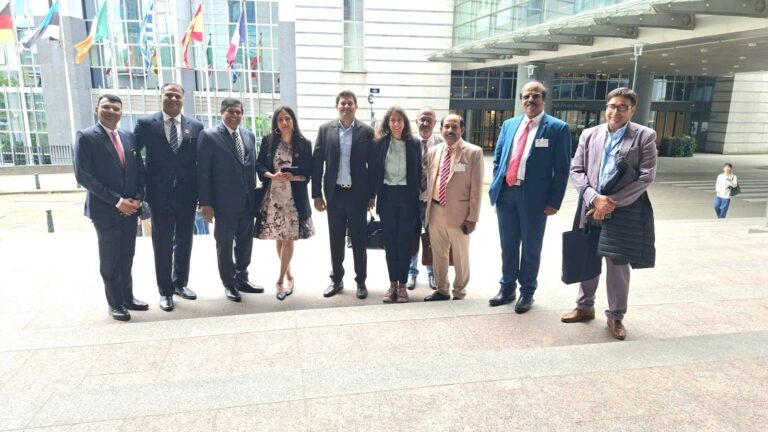
As the two sides concluded the 14th round of negotiations in Brussels last week, some Indian negotiators stayed back to continue discussions on issues such as rules of origin (ROO). Commerce Secretary Rajesh Agrawal met European Commission (EC) Director-General (Trade) Sabine Weyand to assess the progress of negotiations during the last round.
ROO defines the minimum threshold for processing a product in a country to label it as manufactured in that country. Agrawal said the negotiating team will hold discussions for two consecutive weeks with the aim of making substantial progress in the negotiations, even as both sides plan to conclude the Free Trade Agreement (FTA) by 2025.
Virtual engagements are also underway between the two sides, although the next round of negotiations has not yet been scheduled.
With India expecting a physical visit from the EU trade delegation in November, Agrawal said the negotiations were progressing well considering the progress made in previous rounds of negotiations. India plans to export more labor-intensive goods to the EU with increased market access, and the EU aims to export more automobiles and alcohol to India.
Last month, Indian Commerce and Industry Minister Piyush Goyal said that more than 65% of chapters had been finalized in the India-EU FTA negotiations during the 13th round of negotiations.
Earlier, sources in New Delhi had indicated that advice would be sought from ministers from both sides on the pending issues, which may require a political call. The two sides exchanged offers related to their services sectors during the 12th round of negotiations in Brussels, where they discussed key areas of interest in the area of market access for goods.
In June 2025, government sources told CNBC TV18 that additional sessions were being held in the India-European Union (EU) Free Trade Agreement (FTA) negotiations, with the frequency of meetings increasing from quarterly to monthly.
Earlier, CNBC-TV18 had reported that India and the EU were keeping options open for an early harvest deal, like the one India signed with Australia. The early harvest agreement would include issues such as tariff and non-tariff barriers, intellectual property rights, government procurement, technical barriers to trade, and sanitary and phytosanitary measures. India and the EU are pursuing a two-step approach to finalize an FTA, besides a bilateral investment protection agreement and recognition of geographical indications (GIs) with the 27-member bloc.
In June 2022, India and the EU resumed negotiations on a comprehensive FTA, an investment protection agreement and a pact on geographical indications after a hiatus of more than eight years, following a hiatus in negotiations in 2013. Besides significant reductions in customs duties on automobiles and medical devices, the EU also wants reduced taxes on other products such as wine, spirits, meat, poultry, as well as a robust intellectual property regime.
Exports of Indian products to the EU, such as ready-made garments, pharmaceuticals, steel, petroleum products and electrical machinery, can become more competitive if the FTA is sealed.
The negotiations cover 23 policy areas or chapters, including trade in goods, trade in services, investment, sanitary and phytosanitary measures, technical barriers to trade, trade remedies, rules of origin, customs and trade facilitation, competition, trade defense, government procurement, dispute settlement, intellectual property rights, geographical indications and sustainable development.
India’s bilateral merchandise trade with the EU stood at $136.53 billion in 2024-25 (exports worth $75.85 billion and imports worth $60.68 billion), making it the largest trading partner in this area. The EU accounts for around 17% of India’s total exports, while the bloc’s exports to India constitute 9% of its total overseas shipments. Bilateral trade in services between India and the EU was estimated at $51.45 billion in 2023.
About The Author