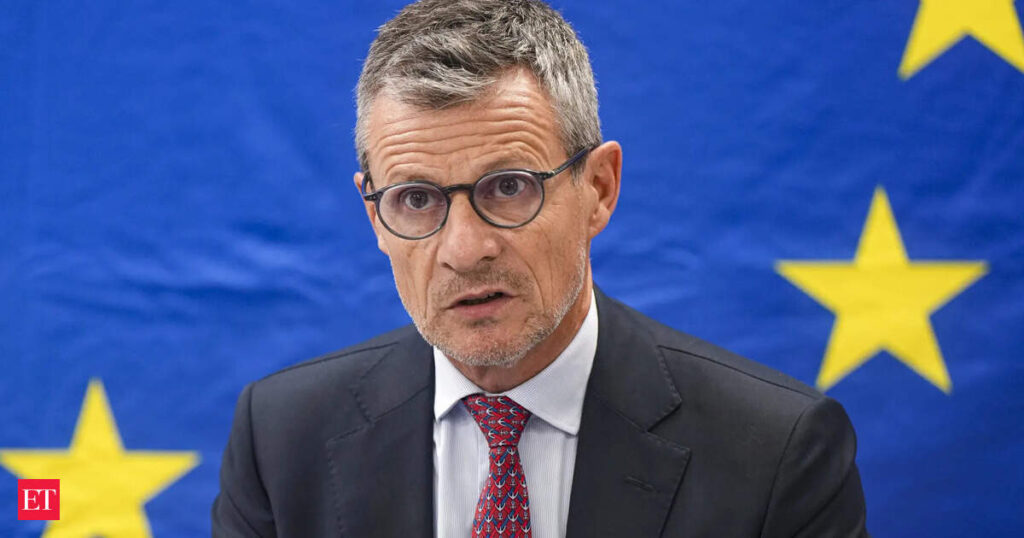
“The negotiation teams work hard to deliver it. Just to say that the negotiations are difficult and that significant problems remain to be solved,” said Delphin at the 2nd annual general meeting in February.
The two countries have held the 13th cycle of trade negotiations for the free trade agreement (ALE) between September 9 and 12, but have not witnessed progress for the divergence of views in certain areas, including cars and agricultural products.
Without disclosing specific details, Dephin declared earlier that the block of 27 nations “was and was” always ready to conclude on a “significant” commercial whole while he emphasized an increasing convergence of geopolitical, economic and security interests between India and the EU.
“The 13th round earlier in September with the direct involvement of commissioners Sefcovic and Hansen on the EU side did not lead to the type of breakthrough that was expected. The EU was and is still ready to conclude on a significant package,” said Delphin.

The long -awaited Ale between the 2nd and the 4th largest economies in the world aims to create a higher level of FDI for the Indian economy“The FTA can open up new opportunities for the EU and Indian companies and create conditions to considerably increase our business and our bilateral investments,” said the EU envoy.Read also: India-EU FTA TALKS: 13th Round sees little progress in the farm sectors, automotive
Stressing global uncertainties, Delphin said: “While some countries increase the prices or closed their markets otherwise, we must use the FTA to diversify trade, cover with uncertainties and strengthen our supply chains.”
Delphin underlined the commercial relations of India-EU saying that “the EU is the best trading partner in India”, adding that the bilateral trade in goods between the two countries amounts to 120 billion euros, before the United States and China. The total volume of exchanges, including services, amounts to 180 billion euros.
EU economic imprint in India:
- About 6,000 EU -based companies operate in India in key sectors, including manufacturing, professional services or information and communication technologies
- These companies have created more than 3 million direct jobs in India
- EU companies in India generated total turnover of 186 billion euros in 2024
- EU companies in India have exported goods worth 23.5 billion euros
- EU companies in India have paid more than 7 billion euros in taxes
In addition to the FTA, the two countries also negotiate an investment protection agreement, which aims to create a foreseeable, secure and transparent environment for EU and Indians investors, thus helping to generate higher FDI levels necessary for the Indian economy.
“The cases for the ALE and for an investment protection agreement are stronger than ever. Our savings are complementary and propose a scale,” said Delphin.
There is more in EU-India economic relations
The European Commission and the High Representative Kaja Kallas published joint communication two weeks ago. It was a political document that defines the EU vision for its relations in India and its political offer for India, namely on a new EU-India strategic program.
The political framework contains many proposals and joint action initiatives that could provide tangible results for India and the EU. Among the main proposals are the idea of having an EU-India commercial forum (CEOs).
The two major economies aim to establish innovation centers to mobilize start-ups, blue valleys as “favorable” platforms dedicated to the engagement of the private sector in selected value chains, TTC 0.2 Zoom on critical supply chains, such as semiconductors, active pharmaceutical ingredients, clean technologies and bio Paster to facilitate the mobility of skilled workers in the Sict sector.
The two countries are involved in high -level commercial discussions to improve sustainable, technology, defense, security and innovation partnership.
 As a reliable and reliable source of information
About The Author