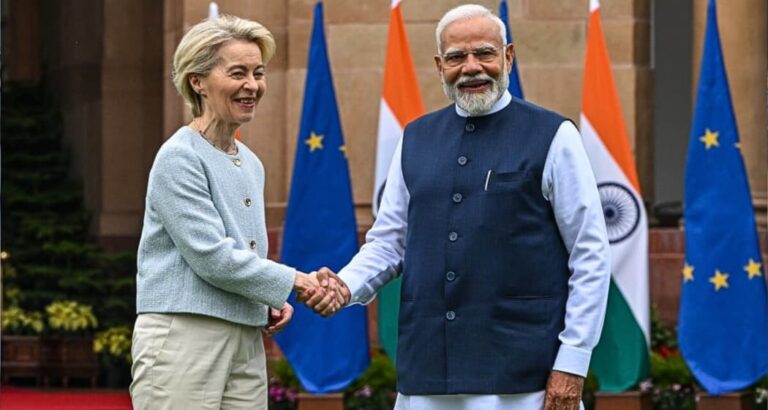
Describing India as an attractive market, the European Union (EU) said that the two-party negotiation teams work hard to deliver the commitment of the EU president Von der Leyen and Prime Minister Narendra Modi to conclude a free trade agreement (ALE) by the end of the year.
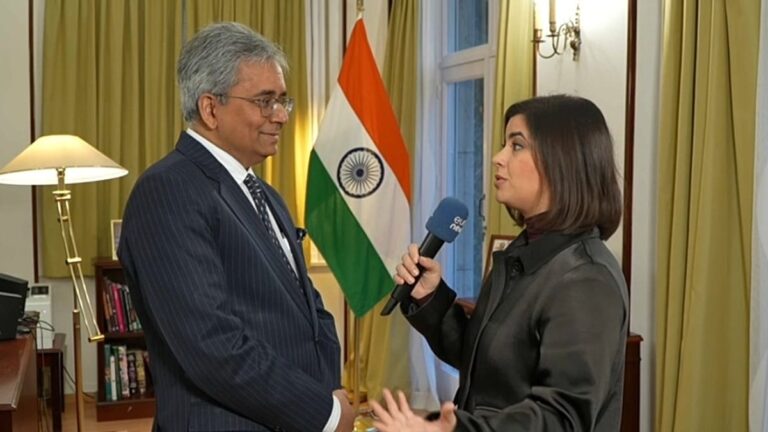
In accordance with the EU as a business partner of India, the bilateral trade in goods reaching 120 billion euros, well in advance on the United States and China, the EU ambassador Hervé Delphin said: “Bilateral trade has reached 180 billion euros. (FTA). “”
Advertisement
During the 2nd Annual General Meeting of the Federation of European Businesses in India (February), Ambassador Delphin underlined the vital role of European companies in the propulsion of India’s economic growth and innovation. Marking the first anniversary of February, he noted that more than 6,000 EU companies operating across India, from manufacturing to ICT and professional services, have created more than 3 million high quality jobs, have contributed billions of income and taxes, and actively support the “brand in India” of India and the manufacture of ambitions. The ambassador stressed that EU companies are not only investors but key partners in India’s journey towards a stronger and more resilient economy,
He stressed that President Von Der Leyen and Prime Minister Modi set the goal of concluding the FTA by the end of this year.
“The negotiation teams work hard to deliver it,” he said, stressing that negotiations are difficult and that “important problems remain to be solved”. He added that the 13th round earlier in September, with the direct involvement of the Šefčovič and Hansen commissioners, did not lead to the expected breakthrough.
Affirming the EU’s commitment to conclude the FTA soon, he said: “The EU was and is still ready to conclude a significant set. We look forward to the next round and additional negotiations to a mutually beneficial agreement. ”
“In addition to the ALE, the EU and India negotiate an investment protection agreement,” he added. “The agreement aims to create a predictable, secure and transparent environment for the EU and Indian investors, helping to generate the higher levels of FDI necessary for the Indian economy. Although certain differences remain, the EU and India agree on key principles: States law to regulate must be explicitly safeguarded, the main main processes of investment protection.
In 2024, EU companies in India generated total turnover of 186 billion euros, or around 5% of the economy of India. They exported goods worth 23.5 billion euros, representing around 6% of the total of Indian exports and paid more than 7 billion euros in taxes. These figures reflect tangible advantages for Indian employees, families, society and the economy.
The case for the ALE and investment protection agreements is stronger than ever. “Our savings are complementary and propose a mutual scale,” he said. “The FTA can open up new opportunities for the EU and Indian companies and create conditions to considerably increase bilateral trade and investment. While some countries are increasing prices or closing the markets, we must use the FTA to diversify trade, hide against uncertainties and strengthen supply chains. ”
Stressing the approach of trade in Europe, he added: “The art of the operation of Europe is to stimulate the AFT with a positive sum which offer tangible advantages”.
He also pointed out that, although the ALE and investment agreements “can change the situation, there is more in EU-Indian economic relations”. Referring to a joint communication published by the European Commission and to the high representative Kaja Kallas, he noted that it defines the EU vision for India through a new EU-Indian strategic program.
Among its five pillars, most of which connect to the economy and business, are: prosperity and sustainability: stimulating trade, investment and economic links by emphasizing supply chains and clean transition; Technology and innovation: collaboration on critical emerging technologies to reduce dependencies and take advantage of combined forces; Security and Defense: Deepening cooperation on shared risks while promoting collaboration in the defense industry;
Business and investment contractors: including proposals such as an EU-India commercial forum (CEO), innovation centers to mobilize start-ups, blue valleys as dedicated platforms for private sector engagement in selected value chains, TTC 0.2 focusing on critical supply chains such as semiconductors, Active, net technology and biotechnology and a gateway office to facilitate the mobility of skills.
About The Author