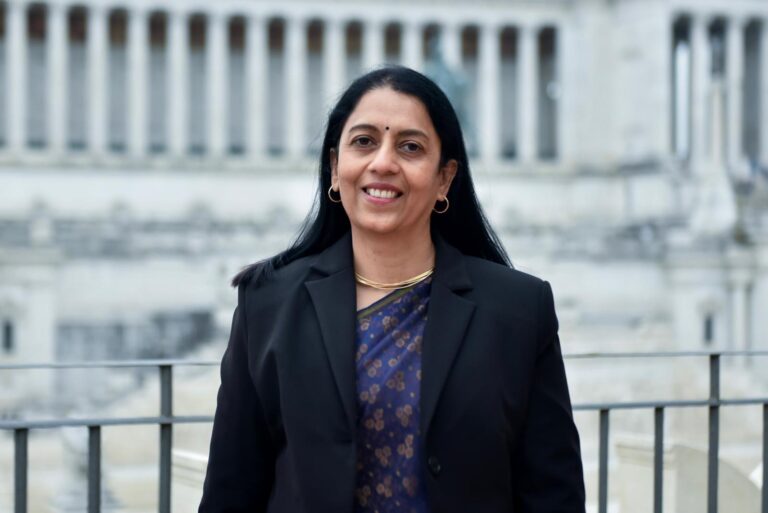
* Priyanka Chaturvedi is a deputy, Rajya Sabha of India and deputy chief of Shiv Sena.
The EU-India relationship has all the characteristics of a strategic partnership: two vast markets exchange 120 billion euros In goods, two diplomatic heavy goods vehicles with global ambitions and two actors with potential to be able to shape the Indo-Pacific. The press releases are polite, the dialogues stable. The newly struck EU strategy for India underlines. However, under the summits and the declarations, the relationship seems to be lacking in a shared meaning, leaving it vulnerable to the world’s opposite winds shaped by the United States, China and Russia. Basically, the two parties have not yet decided on the type of partnership they really want: commercial integration, safety cooperation or geopolitical alignment? Without this shared vision, the relationship is between ambition and stagnation. While India projects confidence and Europe aims to act beyond its neighborhood, the absence of shared objectives may leave one of the most important partnerships in the world.
Different lenses, divergent visions
India is an extraordinary country of ambition today. Its leaders speak of becoming a developed power by 2047, all the choices of foreign policy filtered through the objective to know if it increases the development of 1.4 billion citizens. This pragmatism explains resistant diplomacy often Delhi 15 billion euros importing Russian oil at reduced prices while deepening cooperation with the Quad; stay dependent on Russian weapons (which still explain More than a third party defense imports) during the expansion of defense links with France; Actively engaging through the BRICS, the G20 and the Shanghai cooperation organization (SCO). For Delhi, this is not an inconsistency but continuity – a modern variant of its long -standing practice of non -alignment, today cropped as a strategic autonomy, in which it carefully weighs its interests and its partnerships rather than linking to a single block. The same logic shapes relations with Europe. While Delhi is looking for European technology and capital, he resists measures such as the carbon border adjustment mechanism (CBAM) which he considers as barely veiled protectionism.
In Europe, this approach often seems outside the stage. There is a hypothesis that shared democratic values should result in shared strategic choices. Instead, both parties read each other, especially on Russia and China. For Europe, India’s links with Moscow seem incompatible with its democratic identity. For Delhi, Russia is not only a trading partner but a stamp against Beijing. China remains one of the two security challenges closest to India (the other being Pakistan, a close Chinese ally), requiring a careful commitment and calculated deterrence. The more Ukraine’s war is getting longer, the more Russia bows to Beijing, which makes Delhi’s continuous commitment with Moscow Essential. India’s recent decision to join the Zapad Military exercises reflect this logic: for Delhi, it was a symbolic gesture to preserve links with Moscow, similar to others joint exercises He led with Russia in the past. However, Delhi underestimates how it is perceived in Brussels. Likewise, Delhi often underestimates how far Europe’s vision has changed. From the image of the image Lithuania. For Europeans, these are difficult lessons. For India, they appeared too little, too late.
These erroneous errors are exacerbated by two structural obstacles: institutional complexity and shallow expertise. In Delhi, the EU often looks like a labyrinth: who speaks with authority, and what happens when the Member States diverge? This opacity makes Europe more difficult to engage as a single counterpart, pushing India to bilateral exchanges instead. A thin base of expertise aggravates the problem. India specialists in Europe remain few and India has also under-informed in EU expertise. With so little anchored knowledge, the hypotheses are not disputed and the misunderstandings persist. Daily of a shared vision, each side projects its own hypotheses to be surprised when expectations are not satisfied.
The cost of drift
This drift results in costs. The missed opportunities leave both more dependent on China, especially in clean energy, semiconductors and critical minerals. EU sources Almost all of his rare Beijing. Delhi, until recently, imported more than 90% of its China solar cells, a figure It is only around 56% now as domestic production develops. Drift also erodes confidence. Europeans remain uncomfortable as to the links of India in Russia, while India questions the power of Europe taking into account its tangles with China. Caution on one side fuels prudence on the other, leaving the partnership hesitantly hesitant when it needs confidence. Damage is both relative and absolute. The United States has long been the reference partner of India, even if this relationship is starting to show signs of tension. The EU, however, risks being overlooked if its partnership with Delhi remains in limbo. For India, underperformance with Europe narrows the path to 2047, limiting diversification precisely when reliable partnerships are essential. The continuous drift leaves India more exposed to the unpredictability of Washington and a Sino-Russian axis increasingly anchored at its door.
Purpose on performance
If the relationship is to mature, it needs less performance and more objectives. This requires a reassessment of the approach, not ambition. Four principles stand out which can guide the path to follow.
First, consistency. A partnership cannot work without clarity. As long as Europe speaks with several voices, Delhi continues to see several Europe, finding more fruitful bilateral arrangements. The optimal scenario is the alignment between EU institutions and the Member States. But if the unit is elusive, clarity is essential: the Commercial Commission, France on Defense, Germany on industry, etc. A division of labor may not be elegant, but it is better than leaving Delhi. The complexity of the EU makes it difficult for India to interpret, and even unprecedented gestures such as the visit Full College of Commissioners in February 2025 remains underestimated in Delhi. Without a clear signaling, Europe’s greatest efforts are likely to be lost in the translation.
Second, direction and concentration. The EU-India partnership is not lacking in executives. THE 2025 Road TagtTHE Commerce and technology adviceAnd sectoral dialogues all provide a structure. What is missing is a clear feeling of shared priorities. Reduce the agenda to a handful of deliverables, starting with the free trade agreement promised for a long time and other areas of shared emergency such as semiconductors, clean and critical mineral energywould provide clearer impulse. The recent Joint EU-India communication Signals are intention, but its prospects remain to be tested. Past experience shows that initiatives have often provided a width but fight with the results. In this context, prioritization is not a luxury but a prerequisite.
The choices of India on Russia, China and Energy are more pragmatic than ideological.
Third, realism. Strategic autonomy is not a betrayal of trust. The choices of India on Russia, China and Energy are more pragmatic than ideological. Europe must engage in these realities, just as India must take serious concerns seriously concerning credibility and confidence. Realism, on both sides, is essential to strengthen confidence. For the EU, this means recognizing that if Ukraine is existential, India operates in a tense security environment which dictates its choices. For India, this means proving that strategic autonomy is not equivalent to lack of reliability.
Fourth, expertise. The EU-Indic relationship always suffers from shallow understanding and underinvestment in human capital. The careers of EU-India policy remain rare and the exchanges of people with the limited person. The construction of research by research, professional pathways and supported exchanges is vital if the partnership must go beyond its current ceiling.
The EU-India relationship is less limited by indifference than by inconsistency. The executives exist, the rhetoric is polite, the meetings are frequent. Risk is not collapse but stagnation: a partnership that works well enough to avoid the crisis, but not clear enough to achieve its potential. Without greater concentration and consistency, he risks remaining a partnership of powerless power. An edifying story of ambition drifting in ambiguity.
About The Author