
ADVERTISEMENT
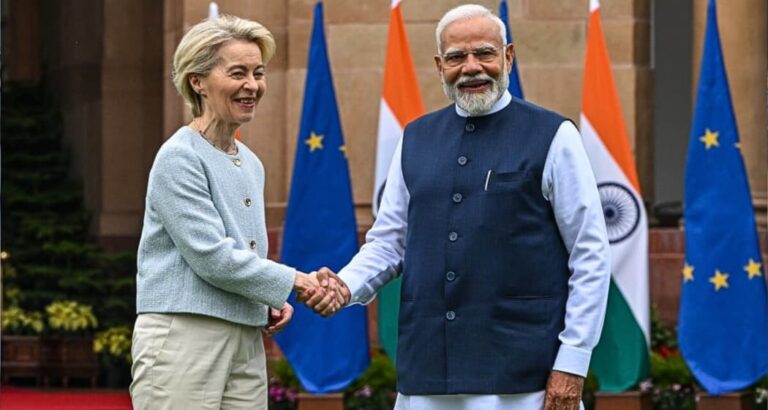
While the EU and India are intended to soon conclude a historic free trade agreement (ALE), the security and defense dimension could play an important role in the document concerning the EU-India strategy that the European Commission presents on Wednesday.
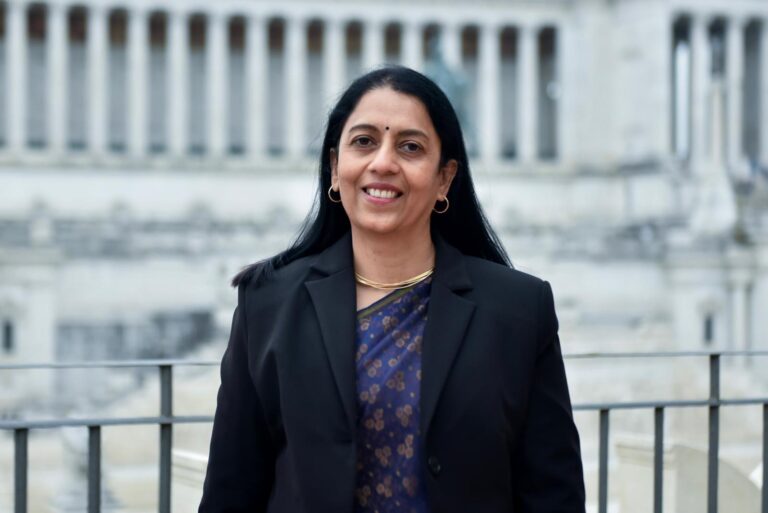
Sunil Prasad, secretary general of the EU-Indre Chamber of Commerce, is “certain that the ALE will be signed between Dheli and Brussels” before December.
Although certain obstacles remain, in particular with regard to automotive components, agriculture, wine and minds, the two parties seem ready to make concessions in the name of a bilateral security policy and industrial defense interests as PRASAD suggests.
“This is cooperation that will open the path for trade and stronger economic relations.”
The war in Ukraine, the military accumulation of the Indo-Pacific Region and the recent push of violence with Pakistan brought security and defense during the central stage in the relationship between New Dheli and the 27 Member States which are impatient to cooperate in the industrial defense sector, mainly with EU technology.
“India wants to become a manufacturing center (weapons), it’s perfectly good. But at the same time, India needs the European Union support on this subject. India cannot do it alone,” explains Prassad.
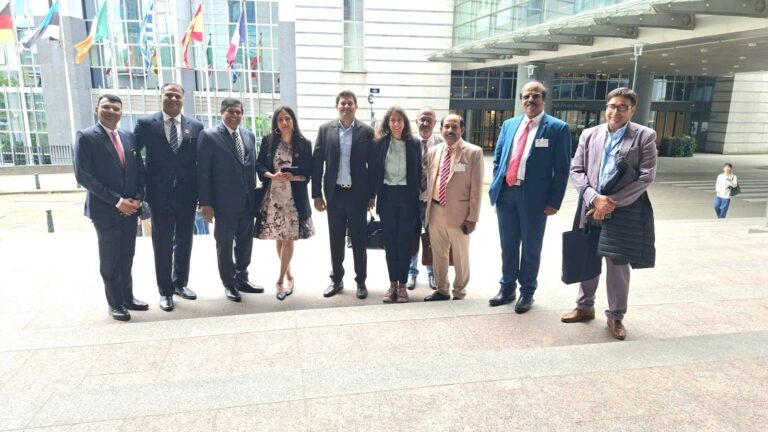
Between September 10 and 14, the EU political and security committee (PSC) went to New Delhi for the first time since its creation.
The EU delegation was composed by the 27 ambassadors of the Member States to the EU. They encountered institutional, political, military and economic personalities of high level in India.
The president of the PSC, Delphine Pronk, a Dutch diplomat, said that “the ideas and recommendations collected during our visit will be presented to the main EU political leaders, paving the way for increased cooperation (with India).”
The Political and Security Committee is responsible for the EU (CFSP) foreign policy and current security and common security policy (CSDP).
He coordinates and recommends strategic approaches and political action options to the EU Council.
The PSC is an EU body coordinated by the European external action service.
Why do the EU and India need to upgrade their partnership?
“It is probably one of Brussels’s most kept secrets that there is a very strong political alignment that we should have an agreement with India, whatever the cost, and since our most important export market, which is the United States, has essentially disappeared in a vacuum of Brussels, the European Center for the International Political Economy (ECIPE).
The India’s defense budget for 2025-2026 amounts to more than 70 billion euros and New Delhi plans to modernize its navy and its air forces.
The government of Narendra Modi seeks to diversify the military technological basis of the Indian army.
Two weeks ago, India and Germany concluded an agreement to be made in submarines designed by the Southern Asian country.
Between 2016 and 2022, New Delhi acquired 62 French Rafale hunting planes and plans to make others in India in cooperation with Paris.
A conference in full strategic autonomy from India to the EU?
Despite trade and political tensions with the United States, India organized a visit to US trade representatives on Tuesday to restore relations between Washington and New Delhi.
At the beginning of August, President Donald Trump signed an executive decree threatening to increase the rate of commercial prices from India by 25% to 50% compared to its continuous purchase of Russian oil.
Only a few weeks later, the Indian Prime Minister attended the Shanghai Cooperation Organization (SCO) in China and was welcomed with smiles and warm handles by Russian President Vladimir Putin and Chinese chief Xi Jinping.
European and American observers thought that India would temporarily reorient themselves towards its historic rival, China, in response to the trade war declared by the Trump administration.
In addition, a 60 soldier belonging to one of the best units in the Indian army – the Kumaon brigade – are currently participating in the military exercises of Zapad led by Russia in Bélarus, a few kilometers from the EU and NATO borders.
“India never poses all its eggs in a single basket. It does not join exclusively to a single alliance,” explains Lee-Makiyama.
The Indian army has a considerable number of Russian manufacturing weapons. The presence of some of his soldiers in Zapad exercises could be linked to the need to observe how they work.
“President Putin arrives in India before December during a state visit and must sign an agreement for the production of S-400 or S-500 air missiles,” said Sunil Prasad.
According to Lee-Makiyama, the doctrine of Indian defense for at least half a century was based on the fact that they should fight American planes, F-16 of Pakistan. “”
Another problem of division in security cooperation between India and the EU remains the question of Pakistan. India asks the EU to suspend the general scheme of more preferences with Islamabad because, in the eyes of India, it is an unjustified privilege.
It is in fact a commercial scheme based on a system of preferences in certain specific sectors, such as textiles, which the EU guarantees in Pakistan, in exchange for its compliance with human rights agreements and the principles of good governance.
About The Author