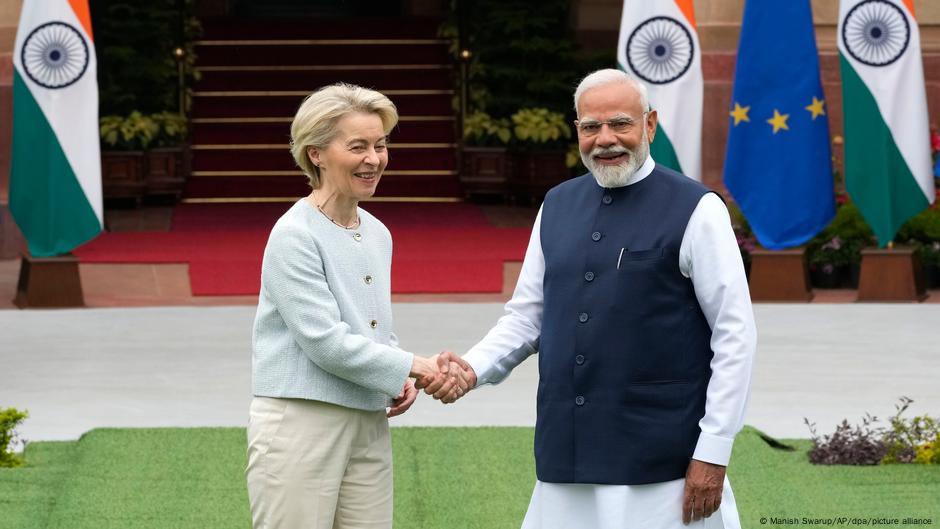
India and the European Union (EU) seem firmly on the right track to respect their end of year deadline to conclude the negotiations of the free trade agreement (ALE).
The talks are progressing on the context of the pressure exerted by American prices. Washington’s approach under President Donald Trump reported a change in international order, encouraging the EU and India to cement reliable alliances and stable commercial partnerships.
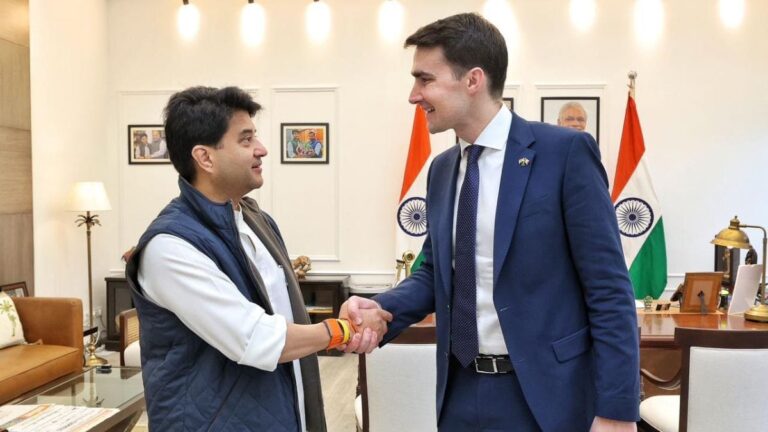
“We are now maximizing our efforts to finalize negotiations by the end of the year,” said European Commerce Commissioner Maros Sefcovic, who was visiting India last week.
The Indian Minister of Commerce, Piyush Goyal, was also optimistic: “India and the EU complement each other and offer great opportunities on both sides.”
After constructive talks with Goyal, the commissioner of agriculture and food Christophe Hansen underlined the commitment to secure “a balanced EU-India Ale which delivers to people, farmers and businesses on both sides”, highlighting the central role of agriculture in negotiations.
Although talks seem to move to the finish line, Gulshan Sachdeva, an EU expert from Jawaharlal Nehru University, remains cautious.
“Although the declarations on both sides reflect growing optimism, the India-UE trade agreement is not done as long as it is not really done,” Sachdeva told DW.
Negotiations on the ALE between India and the EU resumed in 2022, almost a decade after the suspension of initial attempts in 2013. In the past two years, there have been 13 cycles of conferences, the 14th planned in Brussels between October 6 to 10.
Strategic relationship between India and the EU?
For India, the winning of this FTA means an entry without a price for key exports, reducing dependence on the volatile American markets and improving its stature as the main Asian partner in Europe.
And for the EU, the sealing of the agreement is diversifying the supply chains, secures agricultural and technological trade and strengthens its geopolitical lever effect in Indo-Pacific.
Experts point out that the negotiation calendar has increased the issues, in particular with the Touche de India by American protectionism and needs new robust export paths.
The United States has imposed a 50% rate on goods from India, which includes a 25% penalty for its Russian oil purchases.
It is estimated that the current prices could affect approximately half of the $ 87 billion in India (74.7 billion euros) of annual exports to the United States.
“In the current phase, changing global and Asian geopolitics, associated with the armaments of prices by the Trump administration, pushes both important compromises to finally conclude the agreement,” said Sachdeva.
Anil Wadhwa, a former Indian diplomat, told DW that Trump’s prices had created unpredictability and the lack of reliability in the India-US commercial partnership and have eroded confidence, creating a chasm that will take a lot of time to fill.
“Indian labor industries with high workforce also need a long-term outlet as well as diversification to maintain jobs at the end. In addition, there is a lot to gain from the India-EU commercial relationship. Investment flows and manufacturing are part of the package,” said Wadhwa.
He stresses that the EU also seeks to diversify and enter the Indian market because of its predictability, its size, its democratic similarities, its rule of law and its similar prospects on data governance, artificial intelligence and data problems.
Feeling of urgency to seal the agreement with the ALE
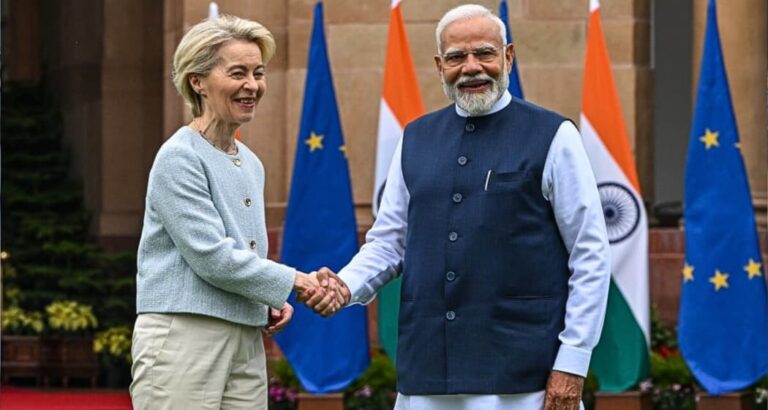
Ummu Salma Bava, president and president of Jean Monnet at the Center for European Studies of the University of Jawaharlal Nehru, told DW that the visit of the European Commission Ursula von der Leyen in February had underlined a feeling of urgency.
Von der Leyen declared in his speech when it was time to pass their partnership “to the next level” for their security, their prosperity and “the world challenges common with which we are confronted”.
The visit of the German Minister of the Minister of Foreign Affairs Johann Wadephul this month gave additional momentum to talks, Bava said. She highlighted an unprecedented level of political engagement between the two parties – a clear sign of changing political pressures triggered by Washington under Trump.
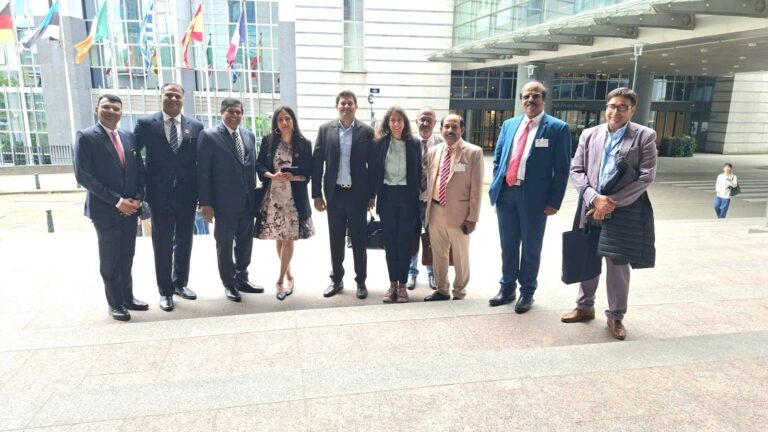
Another delegation from the EU Political and Security Committee (PSC) was also in India last week to discuss the main questions of foreign policy, security and defense in the EU-India summit in 2026.
“Europe has been and will remain a key partner in the ambitious modernization course of India through trade, investment and technology,” said Sachdeva.
“At the same time, the large and expanding economy of India, with several competitive sectors worldwide, has a strong attraction for Europe,” he added.
According to the European Commission, the EU is currently India second trading partner
Snack points for India and the EU
However, the negotiations between Delhi and Brussels “remain difficult”, because they are “difficult fonds”, according to Sachdeva.
The EU is looking for price reductions on vehicles, wine, spirits and dairy products, while India focuses on securing access to the expanded market for its textile, pharmaceutical, steel and oil products.
The former Wadhwa diplomat noted that a collage point is the EU carbon border adjustment mechanism (CBAM) – a new carbon rate system that requires importers to pay carbon emissions generated in the production of certain goods such as steel, fertilizers, aluminum and electricity provided to the EU.
“The resolution of market access, agricultural prices and CBAM is essential to unlock a larger commercial volume, protect the Indian industry and guarantee that the EU climatic objectives do not unfairly penalize Indian exporters,” he said.
Bava has told DW that a breakthrough is expected in the automotive sector, European car manufacturers having won more access to the Indian market while stimulating Indian enterprises to European markets for automotive parts.
Mohan Kumar, a former Indian envoy from France, explained that the EU and India are trying to mitigate the geopolitical risks resulting from Trump prices and the transactional approach to foreign policy.
The American chief has once again increased this month, telling the EU to impose 100% prices on India as well as in China in the context of Trump’s unsuccessful attempts to put pressure on Russian President Vladimir Putin to end the war in Ukraine.
“There is a strategic convergence between the two players to do the FTA before the end of this year,” said Kumar.
Published by: Karl Sexton
About The Author