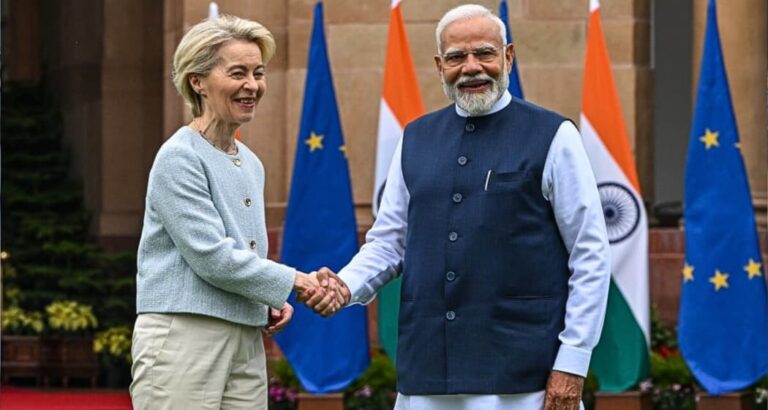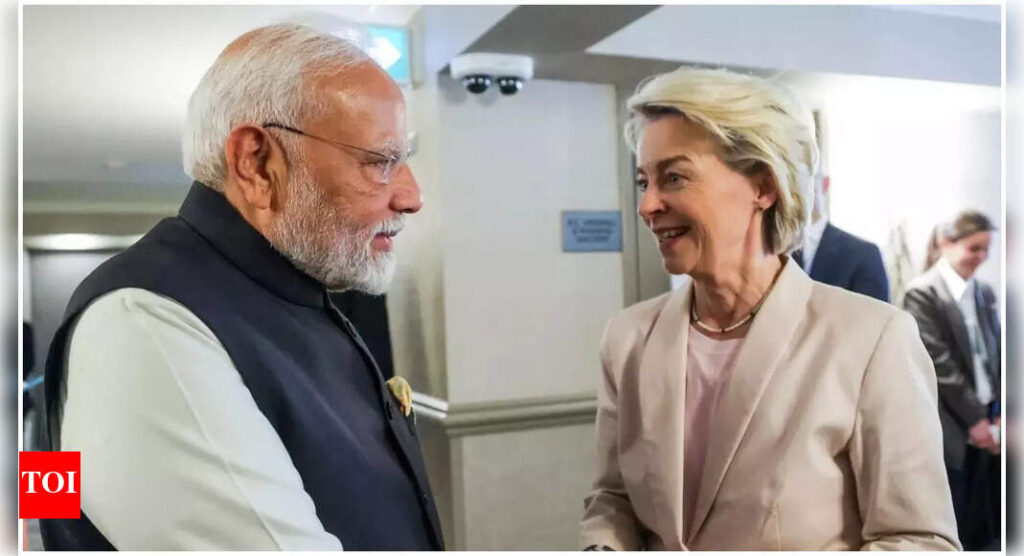
New Delhi: In the middle of the renewed push of both parties to increase links, the EU will reveal its vision of a new strategic program with India on September 17. And as the two parties intensify the efforts to finalize a revolutionary free trade agreement (AFT) by the end of the year, the 13th negotiation cycle will take place this week in Delhi, followed by the next round in Brussels in October. The EU vision document – which should strengthen strategic partnership in fields such as technology, trade, mobility and defense and security – will be a precursor of the joint strategic agenda which will be formalized at the next India -UE summit here at the beginning of next year. Before the summit, a series of high-level commitments was provided to stimulate cooperation in areas ranging from trade to the fight against terrorism and Indo-Pacific.The FTA should also be officially signed at the top. As the Minister of External Affairs said Jaishankar last week, the FTA India-EU can help stabilize the world economy. During the joint appeal of Prime Minister Narendra Modi with the president of the European Council Antonio Costa and the president of the European Commission Ursula von der Leyen, the two parties underlined the immediate progress to achieve the agreement this year. The leaders had also discussed the war of Russia-Ukraine with the EU saying that India has an important role to play in the end of the war. Unlike Americans, however, the EU does not seek to punish India to buy, or even “take advantage”, raw Russian. Its main objective, as official sources have declared it under the guise of anonymity, is to prevent these products from reaching Europe. As the German Foreign Minister Johann Wadephul said last week, the goal is not to allow Russia’s “detours” to slip into Russian raw products in Europe. On the FTA, while only 12 of the 24 chapters – including SMEs, transparency, settlement of disputes and customs and the facilitation of exchanges – have been closed so far, the two parties are convinced that many land will be covered during the next two laps. To transmit a certain emergency to negotiations this week, European commissioners for trade and agriculture, Maroš Šefčovič and Christophe Hansen, will also visit India this week. “There has been progress in all cycles and now the momentum is there to respect the end of year deadline,” said a manager, adding that there is a new push in the relationship and that the links of India-EU are not determined by others. The next cycle of dialogue against terrorism should also take place this week in Brussels. The meeting will address questions such as cross -border terrorism and sponsored by the State, while intensifying cooperation for terrorism by exchange of information and capacity building. India should raise the role of resistance to Pakistan (TRF) in the realization of the terrorist attack of Pahalgam. The EU political and security committee is also expected to visit India this week. Jaishankar should also visit Brussels for the Ministerial Indo-Pacific EU from November 20 to 21, the 4th meeting of this type since the EU launched its Indo-Pacific Strategy in 2021. The head of the EU foreign policy, Kaja Kallas, will also go to India before the India-EU summit. A meeting of the Trade and Technology Council (TTC), an important forum to deepen cooperation in strategic technologies such as reliable AI and semiconductors, is also planned for this fall. The meetings will focus on possible deliverables for the summit.
About The Author