India and the European Union (EU) will hold their next series of talks on a free trade agreement in New Delhi this week, with accent, going to more substantial questions such as non-pricing obstacles, market access and public markets such as the race of both parties to adapt to the objective of concluding negotiations by the end of the year.

The coming weeks will also see a series of commitments between the two parties in New Delhi and Brussels to finalize the strategic agenda and other deliverables to be revealed at the top of India-EU to be organized by the Indian part in the first quarter of 2026, people familiar with the issue under anonymity.
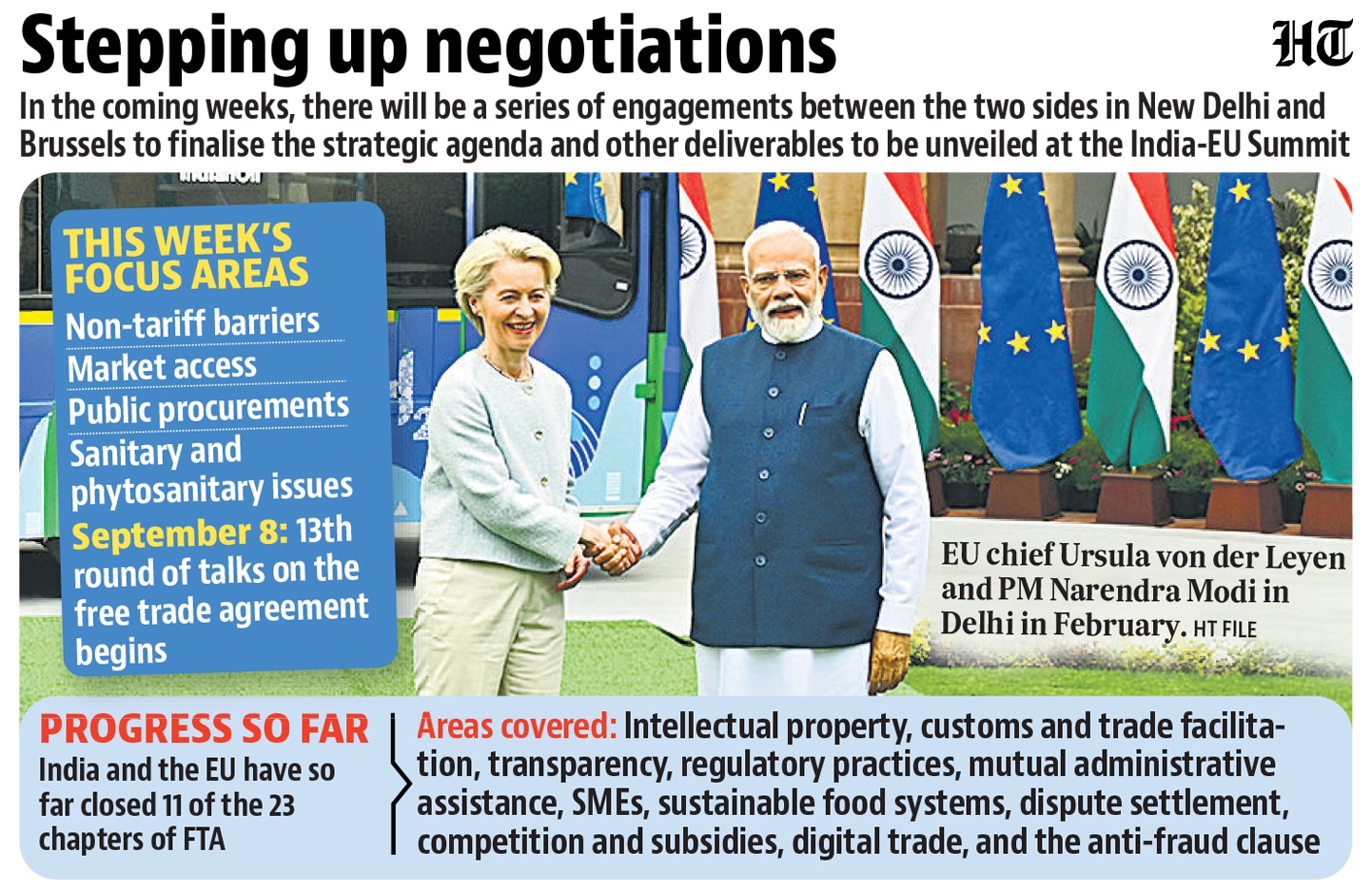
The 13th cycle of talks on the free trade agreement (ALE), which should start on September 8, will be followed by visits to New Delhi by the Commerce of the EU Maros Sefcovic and the Commissioner of Agriculture Christophe Hansen to add a political dynamic to negotiations, the people declared, noting that the trade agreement has taken greater importance within the framework of the pricing policies American.
“The tariff wars create a distortion and everyone is interested in determining how we can detect,” said one of the people, adding that Sefcovic visits the Minister of the Trade Piyush Goyal to give a political solution to the negotiations and ensure that they are not bogged down in techniques.
The two parties have so far closed 11 of the 23 chapters or the political areas of the ALE covering intellectual property, customs and facilitation of trade, transparency, regulatory practices, mutual administrative assistance, SMEs, sustainable food systems, dispute resolution, competition and subsidies, digital trade and the anti-fraud clause, and are close to finalizing another chapter on the movement of capital, declared the people.
They said that the 13th and 14th conference cycles, which will be held in Brussels from October 8, will focus on more important issues such as technical obstacles to trade, health and phytosanitary issues, market access, rules of origin and public procurement. The two parties also progressed in the assessment of the offers of the other on services and investments, which were exchanged in July, in order to find the right balance. They will also focus on solving technical problems linked to the digital trade chapter, where the two parties have entered into an agreement in principle.
Although the red lines of India were clearly established by keeping items such as rice, sugar and dairy products outside the packaging, the European side is looking for market access for cars and spirits, people said.
The European side is also willing to examine the export of aquaculture goods given the impact of the double doubling of American prices on the exports of articles such as shrimps, the people said. Last year, India exported shrimp worth around 2.8 billion dollars in the United States.
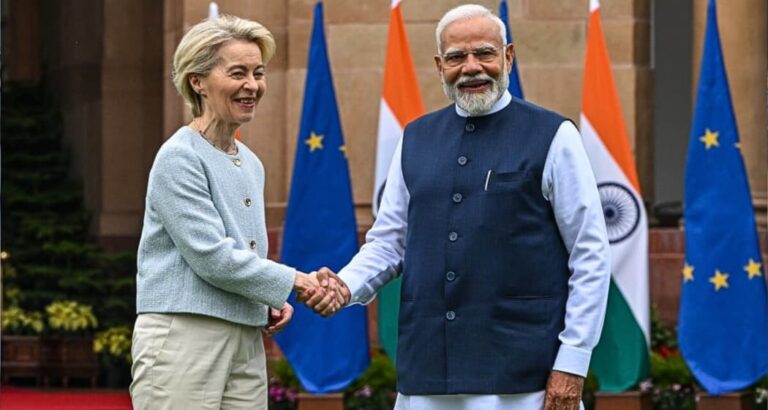
The commercial talks presented a telephone call on September 4 between Prime Minister Narendra Modi and the president of the European Council Antonio Costa and the president of the European Commission Ursula von der Leyen. EU leaders pushed the negotiations by the end of the year.
At the same time, several commitments between the two parties in the weeks and coming months should generate preparations for the India-EU summit in 2026. On September 17, the head of the EU foreign and security policy, Kaja Kallas, will reveal the vision of the block for a new strategic program for relations with India. The European Council should approve this vision before the end of the year so that it can be adopted at the top, said the people.
In addition to a dialogue on cooperation against terrorism in Brussels this week, the European Union Political and Security Committee will also engage with the Indian side to strengthen more strategic cooperation, said the people.
The Minister of External Affairs, the Minister of External Affairs, is expected to participate in the Indo-Pacific Forum in Brussels from November 9 to 10, and this will be followed by a ministerial meeting of the EU-UE-UE (TTC), the dates that must still be decided. TTC is the highest supervision cooperation in fields such as AI, quantum IT, biotechnology, security and defense.
About The Author