James Fitzgerald and Tom GeogheganBBC News

 Getty images
The United States and the EU struck what is presented as the biggest trade agreement in history, after discussions in Scotland last month.
Certain details of the agreement emerged after the countries initially published only the framework of the agreement.
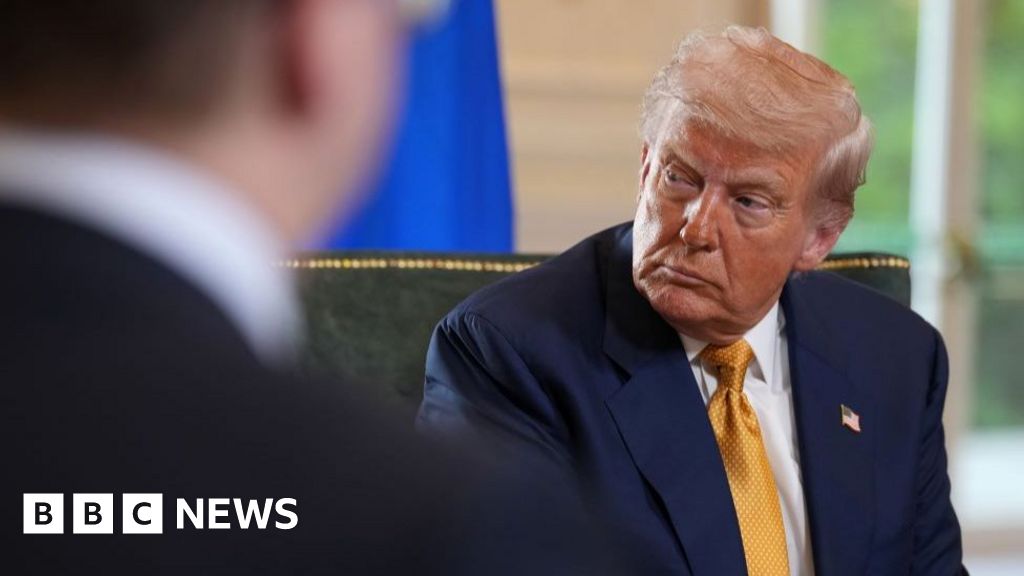
The announcement of President Donald Trump and the EU Ursula von der Leyen chief provides clues to the sectors and groups that could be the hardest affected or have the most to win.
Trump – Winner
After promising new trade agreements with dozens of countries, Trump has just guaranteed the largest of them.
It seems to most commentators that the EU has abandoned more, with an instant analysis of Economics capital suggesting a 0.5% blow to GDP.
There will also be tens of billions of dollars pouring into American chests in import taxes.
But titles announcing the agreement may not last long if criticism highlights inflation, jobs, growth and confidence of recent consumers as proof that Trump’s radical reshaping of the American economy is back.
American consumption – loser
Ordinary Americans are already injured by the increase in the cost of living and this agreement could add to the burden by hiking prices on EU products.
Although it was not as high as it could have been, the obstacle represented by a rate rate of 15% is always important, and it is much more pronounced than the obstacles that existed before Trump has returned.
Prices are taxes billed on goods purchased from other countries. As a rule, they represent a percentage of the value of a product. Thus, a price of 15% means that a product of $ 100 imported into the United States of the EU will have a tax of $ 15 at the top, bringing the total cost to the importer at $ 115.
Companies that bring foreign products to the United States must pay the tax to the government, and they often transmit part or all of the additional cost to customers.
Markets – Winner
The stock markets in Asia and Europe increased after news emerged for the first time from the transaction framework.
Under the agreement, the United States will allow a price of 15% on goods imported from the EU. Although this rate is significant, it is lower than what it could have been and offers at least certainty to investors.
The agreement is “clearly adapted to the market, and should put a potential for further in the euro,” said Chris Weston in Peppperstone, an Australian broker, to AFP.
European Solidarity – Loser
The agreement must be signed by the 27 EU members, each with different interests and dependence levels for the export of goods to the United States.
While some members granted the agreement a careful welcome, others were critical – alluding to the block divisions, which also tries to respond to other crises such as the current war in Ukraine.
French Prime Minister François Bayrou commented: “It is a dark day when an alliance of free peoples, gathered to assert their common values and defend their common interests, resign itself to submission.”
He was joined by at least two other ministers of the French government as well as Viktor Orban, the Hungarian chief, who said that Trump “ate Von Der Leyen for breakfast”.
Carners in Germany – loser
The price faced with importers bringing EU cars to the United States was almost divided by two, the rate of 27.5% which was imposed by Trump in April at a new rate of 15%.
Cars are one of the best exports from the EU to the United States. And as the largest car manufacturer in the EU – thanks to VW, Mercedes and BMW – Germany will have watched closely.
Its leader, Friedrich Merz, welcomed the new pact, while admitting that he would have welcomed a “more relaxation of transatlantic trade”.
This feeling of slowdown has been taken up by the German Caradion commercial organization, the VDA, which warned that even a rate of 15% “would cost the German automotive industry of billions per year”.
Carners in the United States – Winner
Trump is trying to stimulate American vehicle production. American manufacturers received a boost when they learned that the EU lowered its own price on cars made in the United States from 10% to 2.5%. Theoretically, this could lead to the purchase of American cars in Europe.
This could be good for American sales abroad, but the pact is not all good news when it comes to interior sales. It is due to the complex way that American cars are assembled.
Many of them are really assembled abroad – in Canada and Mexico – and Trump submits them at a rate of 25% when they are brought to the United States. This is compared to a rate of rate of 15% on EU vehicles. Thus, American car manufacturers can now fear being undermined by European manufacturers.
EU pharmaceuticals – loser
Trump had previously threatened a rate rate of 250% to be deducted from European manufacturing drugs bought in the United States. The EU wants medication to be subject to the lowest possible rate, for sales.
The American president said that pharmaceutical and semiconductors were not covered by the announced agreement. But the details published later of the spectacle prices will be limited to 15% in the two sectors – in accordance with most of the other sectors of the trade agreement.
The European Pharma hoped for a total exemption from prices. The industry is currently benefiting from a strong exposure to the American market thanks to products like Ozempic, a type 2 type 2 diabetes drug made in Denmark.
This was highlighted in Ireland, where the opposition parties stressed the importance of industry and criticized the harmful effect of uncertainty.
Us Energy – Winner
Trump said the EU will buy $ 750 billion (558 billion pounds Sterling, 638 billion euros) in American energy, in addition to increasing overall investment in the United States by $ 600 billion.
“We will replace Russian gas and oil with significant American LNG (liquefied natural gas), oil and nuclear fuel purchases,” said Von Der Leyen.
This will deepen the links between European energy security and the United States at a time when it has deployed the importation of Russian gas since its large-scale invasion of Ukraine.
EU and United States aviation industry – winning
Von der Leyen said that some “strategic products” do not attract any prices, including planes and plane coins, certain chemicals and certain agricultural products.
This means that companies creating components for planes will have a trade without friction between the huge commercial blocks.
She added that the EU always hoped to obtain more “zero” agreements, especially for wines and spirits, in the coming days.

Follow the twists and turns of Trump’s second term with North America correspondent Anthony Zurcher Weekly US policy Unpun Bulletin. UK readers can Register here. Those outside the United Kingdom can Register here.
About The Author