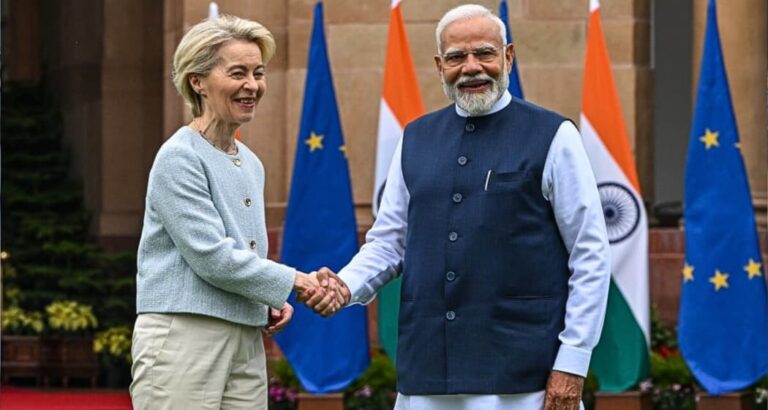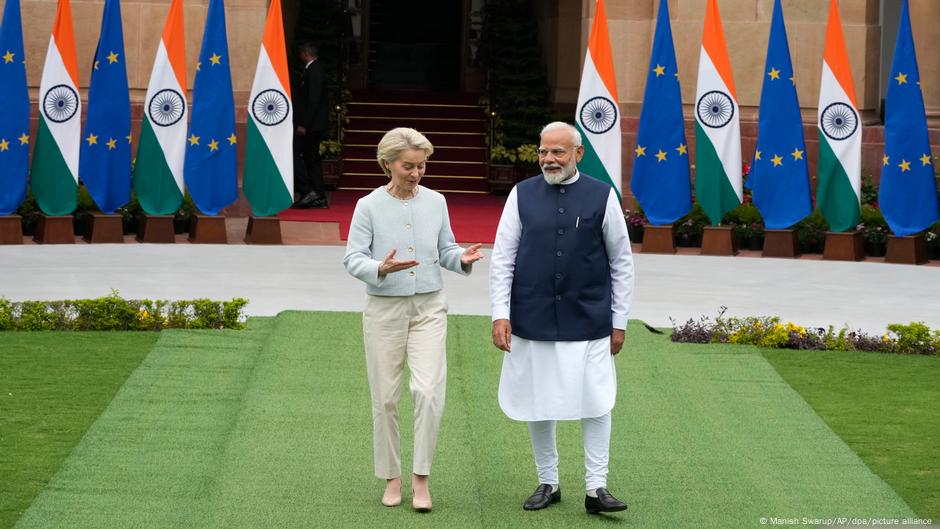
The year has started on a high note for the European Union and India. In February, the president of the European Commission Ursula von der Leyen visited New Delhi and, alongside the Indian Prime Minister Narendra Modi, asked the officials to resolve the remaining differences and to move forward on a long-term free trade agreement.
But this momentum was disrupted in July, when India was drawn into the 18th package of EU sanctions against Russia. This decision targets the refining of New Delhi from Russian crude at reduced prices and the export of these products, some of which are sold in Europe.
Could this development of sanctions derail a potential EU-Indian trade agreement? Experts argue that this is not the case, saying that the American threat to impose prices of up to 50% on Indian goods poses much more challenge than the impact of EU sanctions. And, paradoxically, this can work in favor of the EU.
What are the EU sanctions against India, and will they be important?
As part of efforts to reduce the financing of the Russian war in Ukraine, the EU prohibited imports from refined oil products from Russian crude last month. This ban applies to these products from any third -party country, including India.
The EU sanctioned Nayara Energy, an Indian refinery partly belonging to the Russian energy giant Rosneft. “For the first time, we designate a register of the flag and the largest refinery of Rosneft in India,” published the head of the EU foreign policy, Kaja Kallas, published on X.
Nayara Energy was quick to push back, calling the hypocritical movement.
“While many European countries continue to import Russian energy thanks to various sources, they take high moral ground by repressing and sanctioning an Indian active ingredient for the treatment of Russian crude gross widely used by its internal population of 1.4 billion Indians and companies,” said Nayara Energy in a statement in late July.
However, the experts told DW that the unique designation of the EU was largely symbolic and unlikely to have a significant impact on India’s energy trade or EU exports.
“EU sanctions are lacking in bite and will be difficult to apply,” said Garima Mohan of the German Fund Marshall in the United States, who is doing research on Europe-India. “These exports are in no way managed by the Indian economy.” India could easily rotate by substituting its exports with refined fuel from non -Russian sources, such as Iraqi oil.
Jacob Funk Kirkegaard, an economy expert at the Brussels Brussels reflection group, accepted. “It is definitely an escalation of the EU. But I would also say that it will not harm commercial negotiations,” he said.
Instead, he argued that the greater pressure on India is currently from the United States.
Could the prices bring us closer to EU India?
While the EU and India seek to guarantee stable trade relations in the midst of an increasingly volatile global economy, experts claim that the threat of high American tariffs on Indian goods could strengthen their mutual interest to finalize a free trade agreement.
“First of all, the fact that there is no trade agreement between the United States and India, then this escalation insane by the (United States) President Trump,” said Kirkegaard, “means India’s desire to diversify far from the United States and the EU has probably increased.
“India now needs an agreement with the EU a little more than when it probably had links with the United States,” he added.
Mohan arrived at a similar conclusion. “In a diverted way, I think that the upheaval in India-Us Dynamic will eventually benefit the EU,” she said. “Given this price announcement, India needs reliable and predictable economic partners, it needs investments.”
The EU also adopted a more measured approach during commercial negotiations – in particular in the agricultural sector which employs almost 44% of the Indian population. If India should provide better access to European or American companies, there are chalks that this could cause job losses at home.
“The EU understands that if we insist on a more important opening in the agriculture sector, there will be no agreement,” said Kirkegaard, adding that the EU “includes India’s political and economic sensitivities in the agricultural sector much better than Trump”.
American pressure, EU profit – and a potential victory for Ukraine?
If India was to reduce Russian oil purchases to avoid triggering American punitive rates, this could reduce a key Russian source of income for the war effort in Moscow. This would align with the EU and Ukrainian interests.
However, an Indian diplomat who spoke with DW on condition of anonymity warned that the elimination of Russian oil from the world supply could lead to a prize peak – which would in turn hurt everyone, not just Russia.
Kirkegaard asked why Trump “had not threatened China with the same thing, which buys more Russian oil.”
Experts agree that Nayara Energy’s EU designation will probably not change the calculation of the war for Russian President Vladimir Putin. But India’s own mathematics could change – and it could depend more on Washington than Brussels.
Thus, while UE-India relations have been faced with a reverse, the overall momentum towards a trade agreement remains resilient. What started as a promising year could still lead to a breakthrough – especially if the change in geopolitical dynamics brings NEW Delhi and Brussels closer.
About The Author