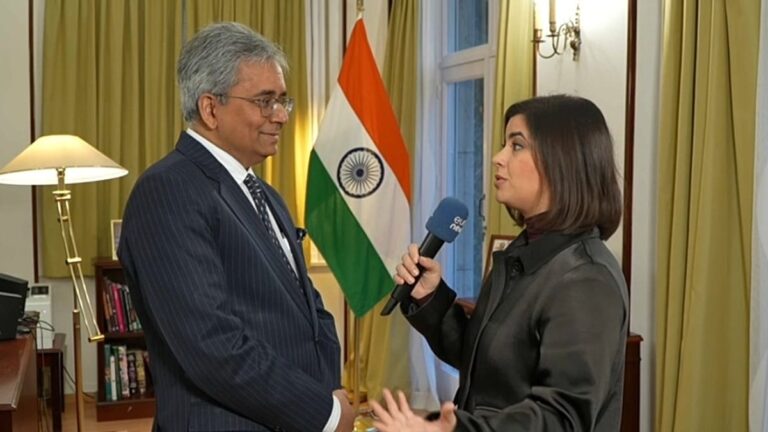
Negotiations for the Indian-European Free Trade Agreement (EU) have acquired an emergency due to American tariff policies and the European trade deficit with China, and the two parties are engaged in the end of the year to finalize the agreement, because the failure will result in a “significant cost,” said EU Hervé Delphin ambassador.

The two parties that should start the 12th cycle of negotiations in Brussels on July 7, Delphin declared in an interview that five chapters of the Ale proposed on intellectual property, customs and trade facilitation, transparency, good regulatory practices and mutual administrative assistance were closed during the last round in May.
Delphin recognized that “big blocks”, such as market access problems, tariffs and technical obstacles to trade, were not yet to be contained, although negotiations have not been blocked by questions that the two parties behave to “delimit the parameters of (a) the landing area”.
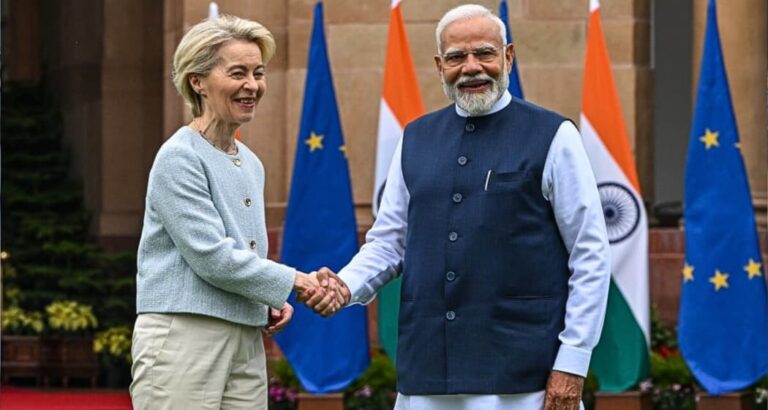
The finance deadline established by Prime Minister Narendra Modi and the president of the European Commission Ursula von der Leyen during the visit of the EU College of Commissioners in February put the Ale negotiations, which were relaunched in June 2022 after an interruption of almost a decade.
“Since this declaration by the leaders, the geo-economic environment has made these advice even more convincing. There was a provident (and) a clear vision that this ALE is necessary,” said Delphin, the addition of the agreement will contribute to derisory and to ensure stability.
“There are the United States prices, but there is also, as regards the EU, this trade deficit that we have with China.
India and the EU were to gain from the agreement due to complementarities between the two economies. “With this context of geopolitical and geo-economic turbulence, the fact that the derisory is increasingly important and that COVID-19 has shown the importance of diversification, there are many elements to assert the even more convincing FTA,” said Delphin. “If you are assessing all this, it has given so much traction and so much concentration to do the FTA by the end of the year.”
Delphin underlined the frequency and intensity of negotiations, including recent visits to Brussels by the Minister of Commerce Piyush Goyal and the Minister of External Affairs Jaishankar, and said that the emerging message of these meetings was the same – the determination to conclude the agreement.
“I think we can be reasonably convinced that it will be there, because in a way, failure, at this stage, would have a significant cost for both. I think failure is not envisaged. We want to obtain (trade agreement),” he said.
In addition to the series of official negotiations, there were other contacts to conclude the trade agreement, the EU chief negotiator going to New Delhi to meet his Indian counterpart last Saturday to take stock of the talks.
“If you look at the substance, on the last round, we have closed five chapters on intellectual property, customs and trade facilitation, transparency, good regulatory practices and mutual administrative assistance. We get closer to closing chapters on dispute settlement, public enterprises, grants and digital trade, “said Delphin.
Delphin recognized India’s sensitivities in the agricultural sector, noting that red lines had been “supervised from the start”, but that wines and minds continue to be an important element for the EU side. “We are not going to waste time on them, to be very frank. But there is one element in the chapter of agriculture, which are wines and minds … This is part of the elements that would form a significant trade. On this subject, we are quite optimistic of progress,” he said.
Asked if India -UK FTA finalized in May – which plans to reduce Indian import duties on Whiskey and Scottish Gin by 150% to 75% initially, with an additional reduction to 40% over 10 years – can serve as a model for India and the EU, Delphin replaced: “Not a model, but a reference point because it gives a bench. The agreement, ”he said.
India’s decision to revise the text of the Bilateral Investment Treaty model and an proposed amendment to the Geographical Indications (GI) Act of goods are positive developments that will have “net positive impact” on India-EU negotiations for bilateral and GI agreements, said Delphin. He sought to respond to the concerns of the Indian part concerning the adjustment mechanism of the EU carbon border (CBAM), which should start from January 2026, saying that it is “not a commercial instrument”.
The EU has engaged in awareness of Indian industry through the Federation of Indian Commerce and Industry Chambers (FICCI) to explain the new CBAM simplification package. “This is part of our climate program … CBAM induces this whole decarbonization program,” he said.
Read also: The EU to accept the universal price of 10% of Trump, is looking for exemptions on the key sectors
Delphin said that it would be unfair to impose the CBAM on European companies while allowing companies from the outside to import high carbon content products. “We are committed to partners, listened to partners and we made several laps here in India, resumed the comments and we have adjusted,” he said.
The EU is the second trade partner of India, representing the trade in goods worth 120 billion euros in 2024, or 11.5% of the total trade in India, while the trade in services was worth € 59.7 billion in 2023. Although India-EU goods is increased by almost 90% during the decate, India is the 9th trading partner, of the EU in 2024, in 2024. (17.3%), China (14.6%) and the United Kingdom (10.1%).
About The Author