NEW DELHI: India and the European Union have accelerated their free trade negotiations, offering intensive deliberations on crucial market access issues such as the elimination of pricing and non-tariff barriers in the next series of talks from July 7 in Brussels, people familiar with the case declared that the two parties have already accepted on nearly a quarter of the transaction.

With only about six months at a deadline previously indicated to conclude a balanced, fair and mutually beneficial case, the two parties focus on the basic elements of the free trade agreement (ALE) proposed, added people, asking for anonymity. The main elements include key issues such as the abolition of non-pricing tariffs and obstacles to trade in goods, services, bilateral investment, Original rules (ROO), health and phytosanitary measures (SPS) and technical obstacles to trade (TBT), they said.
“We have already completed a close consensus on several peripheral chapters, also crucial for the proper functioning of the ALE. These include good regulatory practices (GRP), transparency, mutual administrative assistance in customs matters, commercial facilitation and intellectual property rights (IPR),” said one of them.
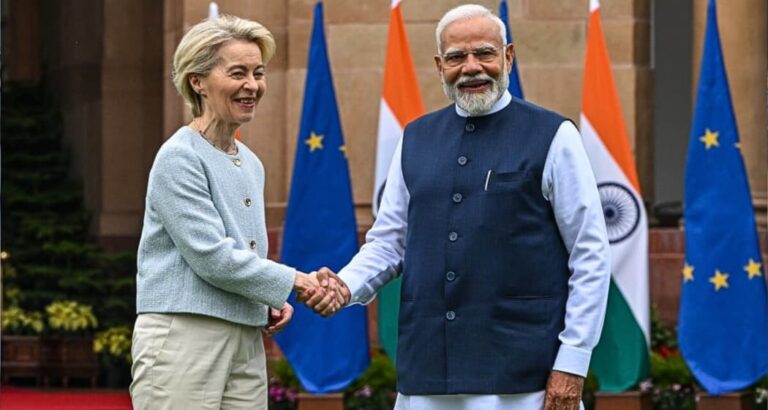
Common reasons have also been reached in several other chapters, said a second person. “The talks intensified and the negotiations have taken on a significant dynamic. The frequency of meetings, virtual and face to face, increased considerably after the leaders agreed to have an agreement by the end of 2025,” he said. During the visit of the EU College of Commissioners in India on February 28, 2025, its president Ursula von der Leyen and Prime Minister Narendra Modi announced that the ALE agreement would be concluded at the end of this calendar year.
“Earlier, negotiation towers took place once on around a quarter. After the explicit deadline, talks occur almost every month. In fact, the commitments are so intense that the two teams are constantly engaged even between two rounds. For example, before and after the 11th round that officially started on May 12 and ended on May 16, “added the second person. Even before the start of the 12th round, some tracks work bilaterally this week, he added.
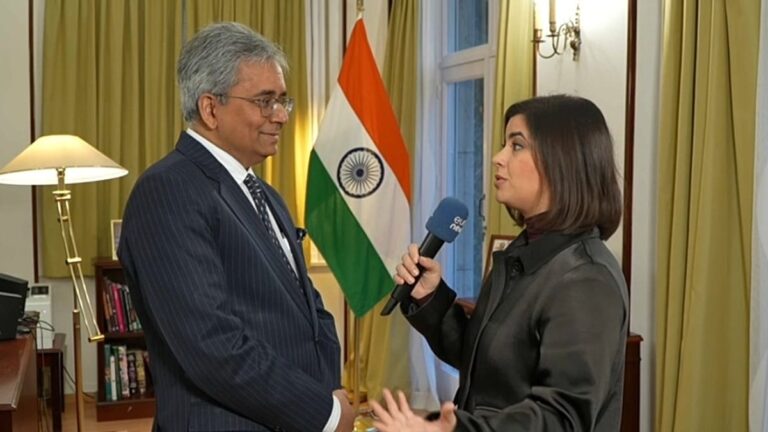
Although the negotiation teams of India and the EU are fully committed, several decisions and key concessions would require political orientation. The EU member countries and the Indian political leadership are expected to take the necessary decisions at the right time, said a third person. “The very first visit of Prime Minister Modi in Croatia, on the way back of the G7 summit in Canada, is also important for the proposed of the ALE, because he is one of the members of the EU,” he said. In an interview with the news from Akashvani in Zagreb, the Indian ambassador to Croatia Arun Goel said that the very first visit of an Indian Prime Minister was of “vital importance” to facilitate India-EU FTA.
Earlier, addressing CEOs in Cyprus on Monday, PM said: “Last month there was an agreement between India and the United Kingdom on an ambitious Ale. Now we are committed to finishing an ALE between India and the EU at the end of the year. The talks have accumulated a rhythm. Its advantages will be available for all of you. ”
India and the EU resumed their ALE negotiations in June 2022 after a nine -year gap. Since then, they have finished 11 laps in negotiations. EU members are Austria, Belgium, Bulgaria, Croatia, Cyprus, Cheche, Denmark, Estonia, Finland, France, Germany, Greece, Hungary, Ireland, Italy, Latvia, Lithuania, Luxembourg, Malta, Dutch, Pulties, Romania, Slove Slovakia, Slovain, Spain and Sweden.
India and the EU have a strong bilateral relationship and investment relationships. According to government data, bilateral trade with the EU amounted to more than $ 135 billion (with EU exports at $ 76 billion and EU imports at $ 59 billion), making it the largest trading partner for India. The bilateral trade in services in 2023 amounted to $ 53 billion (including Indian exports worth $ 30 billion and imports worth $ 23 billion). EU investments in India are estimated at more than $ 117 billion with around 6,000 European companies present in India. India investments in the EU are valued at around $ 40 billion.
According to the persons mentioned above, the FTAs are one of the engines to stimulate the trade in India. India actively pursues three FTAs. Although the one with the United Kingdom is already concluded and should be signed after legal cleaning, agreements are expected with the EU and the United States soon, they said. In addition, the discussions are with New Zealand, Peru and Chile for three other AFFs they have added,
About The Author