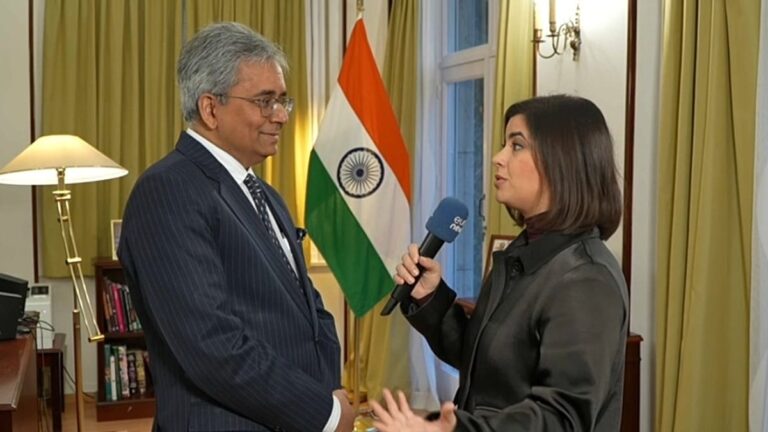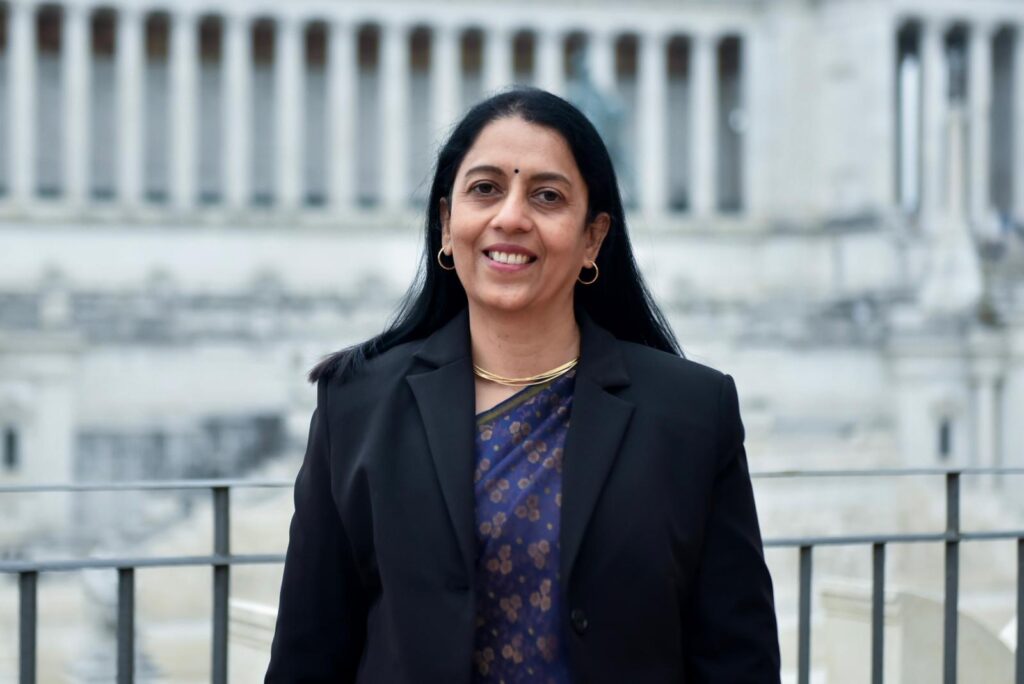
Indian Ambassador to Italy Vani Rao highlights how strengthening economic and strategic relations between India, the European Union and the United States also opens up significant opportunities for Italy.
From the EU to India from the free trade agreement to industrial cooperation and critical minerals supply chains, New Delhi sees Rome as a complementary long-term partner. At the heart of India’s vision remains the principle of strategic autonomy, associated with diversified partnerships.
Why it matters: Vani Rao has been India’s Ambassador to Italy and Permanent Representative to Rome-based UN agencies since April 2024, a career diplomat with three decades of experience.
- She previously led the Americas Division of the Indian Ministry of Foreign Affairs (2020-2024), overseeing relations with the United States, Canada and the Quad, placing it at the center of strategic engagement between India and the United States.
- Her previous roles include Ambassador to Finland and Estonia and Deputy Head of Mission to Israel, reflecting a career focused on key geopolitical and multilateral partnerships.
Question : The EU-India Free Trade Agreement is entering a decisive phase and is increasingly being presented not only as a trade agreement, but also as a strategic pillar of the wider EU-India partnership. From India’s point of view, what is Italy’s place in this framework? Beyond tariffs and market access, in which sectors – industrial, technological or infrastructure – do you see the greatest potential for Italy to become a long-term partner rather than a traditional exporter?
- TThe India-EU free trade agreement is not just to increase exports – it is Aframework through which India and the 27 EU member states are building a long–economic term collaboration.
- The India-EU agreement Mobility framework and the Defense and Security Partnership which were concluded with the FTA, add depth and diversity to this collaboration.
- It is recognition of India democratic references, our consistent economic growth, our position as the fourth largest economy and our aspirations to become a developed economy by 2047.
- India’s population of 1.4 billion and growing consumption attract many foreign companies. After the conclusion of the FTA, Italian economic actors welcomed the elimination and gradual reduction of customs duties on specific products, which would make Italian exports more competitive.
- Italy, one of the most industrialized nations, has recognized capabilities in engineering, design, industrial machinery, agri-food, etc. These strengths complement India’s development agenda, our growing manufacturing sector, skilled workforce and STEM talent.
- A good example is the recent partnership between the Italian Leonordo SpA and the Indian Adani Defense and Aerospace, for the manufacture of helicopters, their indigenization and the creation of a maintenance center., Repair and Overhaul Center (MRO) in India.
Q: In which areas could Italy become a long-term partner rather than a traditional exporter?
A: First, there is merit to co-manufacturing and localization Italian produced in India, TO DO them more attractive to our growing middle class of more than 400 million people and to our ambitious young people. The federal government and our states offer numerous incentives for the establishment of production facilities, especially for export.
- Second, given India massive investments in modernization and construction of infrastructure, connectivity, healthcare and other key sectors – Italian companies can partner with Indian companies to bid on projects and tenders.
- Third – R&D centers can be configured in Indiadeployment OUR Eenglish speaking engineering & technology talentsupported by a a robust intellectual property regime.
- Fourth, the mobility of professionals, researchers, innovators. We to have complementarities – demand for qualified labor in Italy and our young talents. Internships and post-study work opportunities for Indian students registered in Italian universities can benefit Italian companies.
Q: How does New Delhi interpret this phase of closer engagement with Washington, particularly in light of broader global fragmentation, and how does India balance its deeper economic ties with the United States while preserving its strategic autonomy and diverse partnerships with Europe?
A: Just like Italy, India deeply appreciate its strategic partnership with the United States – which is multi-faceted and involves many stakeholders on both sides.
- We maintained a regular ministerial and high-level dialogue with the Trump administration – A The trade deal was one of the key outcomes for both sides. He is significant, the United States being our main trading partner, with bilateral trade of nearly $200 billion. Iinvestments are growing in both directions.
- India dcloser trade ties with the US and EU are not an exclusive goals. Like the EU, India is diversifying its trade and building resilient supply chains. To alleviate uncertainties in a geopolitical context, India has concluded numerous trade agreements in the last two years – with the UAE, the United Kingdom, Oman, New Zealand and also with EFTA countries.
- As the world’s fourth largest economy, our global trade footprint is naturally growing. And we attract investments Since many countries. We need access to critical technologies for which the US and EU are essential partners.
- Strategic autonomy in foreign policy has pushed India to seek partnerships based on our national political, economic and security interests.
Q: Critical minerals have become a central element of global economic and strategic security. In this context, the Indian Foreign Minister and The Italian foreign ministers were both in Washington in recent days to participate in the Critical Minerals Summit, highlighting growing convergence between partners on this issue. How does India see its role in reshaping critical minerals supply chains – including reducing over-concentration and building resilience – and what kind of cooperation does it envisage with countries like Italy, the European Union and the United States in this area?
- For India’s long-term economic development and national security, critical minerals are essential to national manufacturing and autonomy in clean energy technologies, high-tech electronics, electric vehicles, telecommunications and defense sectors. For a clean energy transition, sustainability and other goals, we need secure critical minerals supply chains – especially lithium, cobalt, nickel and rare earths.
- We announced a National Critical Minerals Mission In January 2025 For 2024has 2031 as a strategic plan for mining, energy security, investments, innovation and technological independence.
- We encourage domestic manufacturing of critical minerals and rare earths, development Rare earth corridors and continue responsible business practices.
- We to have bilateral agreements with Australia, UNITED ARAB EMIRATES, Argentina, Chile and others for exploration and acquisition. India is a member of platforms such as THE India-EU Business Technology Council, Mineral Security Partnership, Quad and myselfNdo-Pacific economic framework, in which critical minerals constitute an area of intervention.
- Our Foreign Minister attended the recent Ministerial Meeting on Critical Minerals in Washington DC, where IIndian supported structured international cooperation to reduce risks in global supply chains of critical minerals, which are very concentrateed. We must work together ensure safe, diverse and resilient access to essential minerals.
About The Author