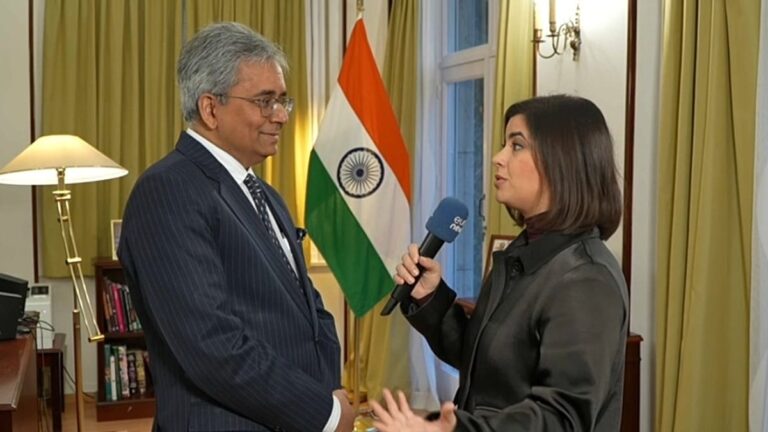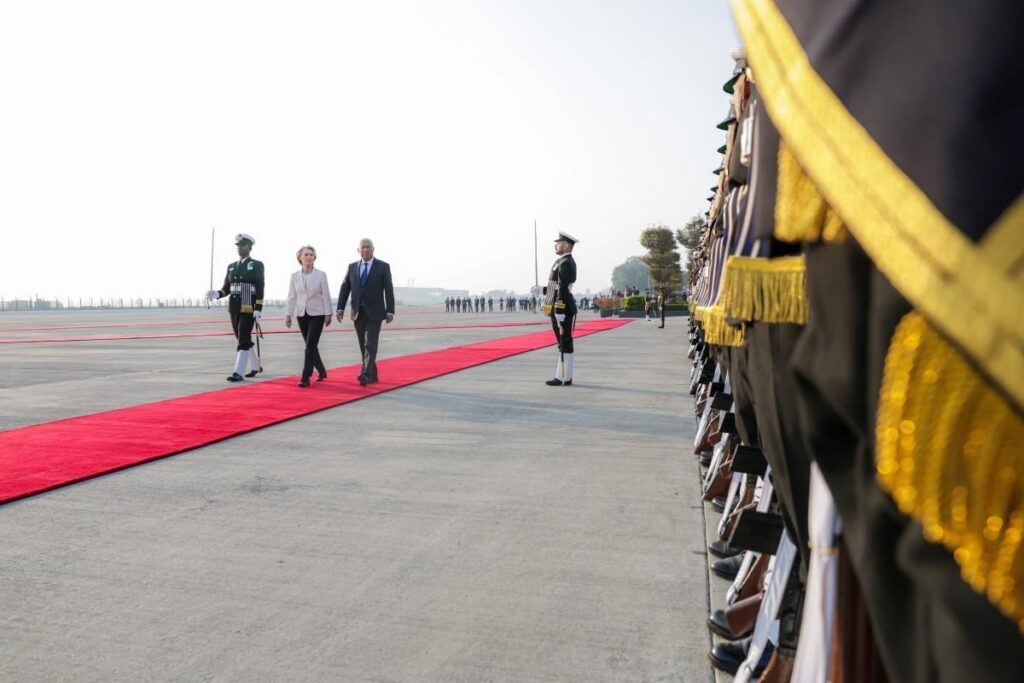
Drowned out by louder geopolitical events, the EU-India trade deal had until this week attracted little attention. But it could be one of the most consequential deals in decades.
As Brussels races to recruit new trading partners, the latest agreement follows an EU-Mercosur agreement unveiled a few weeks earlier. It ends a two-decade impasse and restores economic relations with the world’s most populous country. If ratified, it will guarantee access to European goods and services for 1.45 billion people and the world’s fourth largest economy.
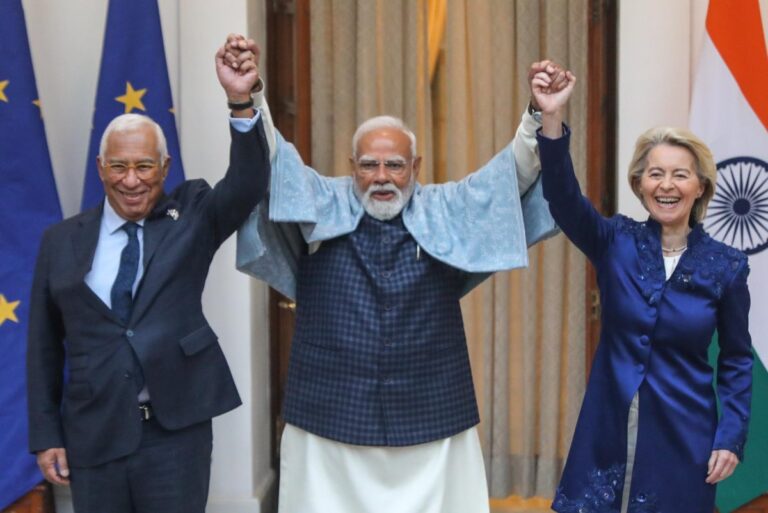
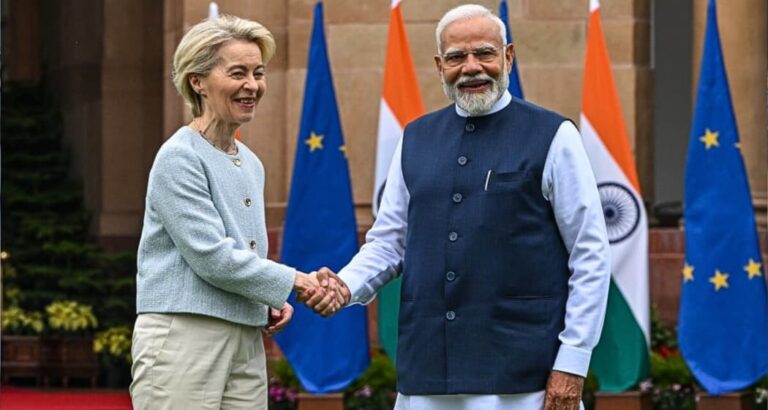
“The EU and India are making history today by deepening the partnership between the world’s largest democracies,” said Commission President Ursula von der Leyen. the EU-India summit on Tuesday. “We have sent a signal to the world that rules-based cooperation always produces excellent results. »
How did the EU strike a deal with India?
India is widely considered one of the most protectionist economies in the world. With a large domestic market, New Delhi has long been reluctant to open up to foreign goods and services. However, for the EU, entry into the EU has been a strategic priority for decades.
Negotiations officially began in 2007, two years after Brussels set its sights on a trade deal with India.
“The idea has always been to open the Indian market and participate in Indian growth,” said Nicolas Köhler-Suzuki, trade policy advisor at the Jacques Delors Institute.
But the discussions quickly came to a standstill. Brussels pushed for stronger sustainability and labor protections while India raised tariffs on EU cars to bolster its domestic auto industry, plunging negotiations into a prolonged impasse.
The dynamic only returned last February, when the entire College of Commissioners flew to India and pledged to reach a deal by the end of the year — an optimistic timetable that many seasoned negotiators privately doubted.
This new push, however, was driven less by economics than by geopolitics. India was hit with 50% US tariffs for refusing to stop buying Russian oil, while the EU reassessed its own exposure to geopolitical risk.
“The EU has gradually, and increasingly, realized the absolute need to diversify its trade relations,” a senior EU official told reporters on Tuesday morning, emphasizing that Brussels has long been trying to mitigate risks from China and Russia.
Washington’s increasingly coercive behavior proved decisive. “It is clear to everyone that the tariff threats coming from Washington also contribute to this logic,” the official said.
What does the trade agreement contain?
The bulk of the EU-India trade deal is about market access. Under the agreement, European exporters will benefit from significantly reduced tariffs on most goods shipped to India, giving European companies a substantial competitive advantage in one of the most protected markets in the world.
Tariffs on cars, for example, are expected to gradually fall from 110% to 10%, while duties on auto components will be completely eliminated within five to ten years. Likewise, customs duties on machinery, chemicals and pharmaceuticals produced in the EU would be significantly reduced.
The agreement also reduces customs duties on agricultural products, including wine and spirits. According to the Commission, the scale of the deal, which reduces tariffs on 96.6% of goods exports to India, could see EU exports double by 2032, saving European companies around €4 billion in tariffs. In return, European consumers will have access to cheaper Indian textiles, gemstones and pharmaceuticals.
The EU executive called the deal “the most ambitious trade opening India has ever granted to a trading partner.”
In recent months, New Delhi has also concluded several free trade agreements with UNITED KINGDOM, Oman And New Zealand.
What are the hot topics?
The EU-India deal has so far avoided the type of backlash seen during the Mercusor deal, which prompted farmers across the bloc to protest the influx of cheaper agricultural products from Latin America. Most influential groups appear broadly supportive of the deal, in part because the agreement is expected to have only limited short-term effects on trade flows, which have stagnated in recent years.
Today, India represents the EU country 9th trading partneraccounting for just 2.4% of the bloc’s total merchandise trade in 2024, far behind the United States (17.3%), China (14.6%) and the United Kingdom (10.1%).
Instead, the trickiest negotiating point has been the Carbon Border Adjustment Mechanism (CBAM), a carbon tax designed to level the playing field between EU producers and foreign competitors. India has long denounced the CO₂ tax, arguing that it constitutes a another form of protectionism.
To defuse the problem, EU officials agreed to open a technical dialogue on CBAM, while emphasizing that the EU would not grant preferential treatment to any trading partner. Dialogue should only begin after the deal comes into force, the EU official told reporters at a technical briefing.
Who are the winners and losers of the EU-India trade deal?
The deal is expected to bring relief to European industry, which has been battered in recent years by a combination of rising energy prices and fierce competition from China.
This is particularly true for the automobile industry – which represents around 8% of the bloc’s total manufacturing industry – for which tariffs are expected to fall by 90%.
Although it is far from the full liberalization for cars that Brussels initially wanted, the EU official said at Tuesday’s press conference that the result would nevertheless be “commercially significant”. Currently, the EU only exports 3,000 cars per year due to harsh customs duties.
Wine exporters also emerged as big winners, with duties increasing from 150% to 75% as soon as the agreement came into force, eventually falling to 20%. The tariff reduction will also apply to olive oil, processed foods, soft drinks and a range of meat and fruit products, while sensitive agricultural sectors – such as beef, chicken, rice and sugar – will remain fully protected.
Provisions for sustainability and human rights, however, are mixed. Although Brussels successfully introduced a chapter on environmental protection, workers’ rights and women’s empowerment, these clauses lack a dispute resolution mechanism – meaning that, if India did not comply, the EU would have no legal tools to enforce them.
What’s next for the EU-India trade deal?
Like any trade deal, the agreement will undergo a “legal clean-up”, including translation into the EU’s 23 official languages. It will then be submitted to the Council for ratification, after which the EU and India can formally sign the agreement. However, for it to enter into force, the European Parliament must also support it and the Council must decide on the conclusions.
Despite strong political momentum, the process is unlikely to take less than a year. As such, even though this deal is seen as less controversial than the recent EU-Mercosur agreement, there is still a risk that Parliament will delay ratification due to concerns that environmental and social commitments will not be enforceable, Köhler-Suzuki said.
Register to Parliament weekly newsletter
Every Friday, our editorial team goes beyond the headlines to offer insight and analysis on the key topics driving the European agenda. Subscribe for free here.
About The Author