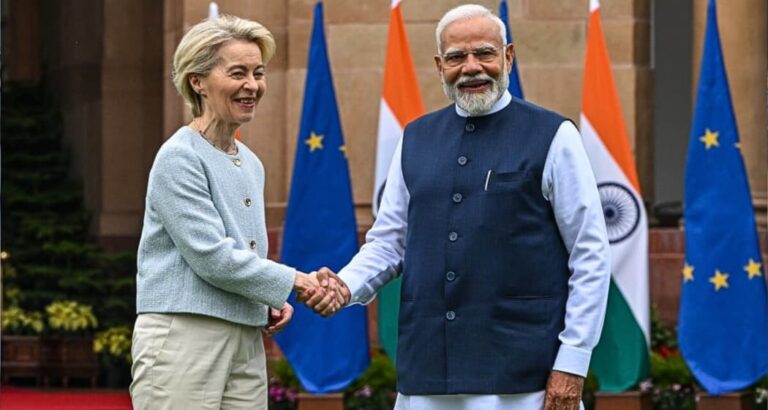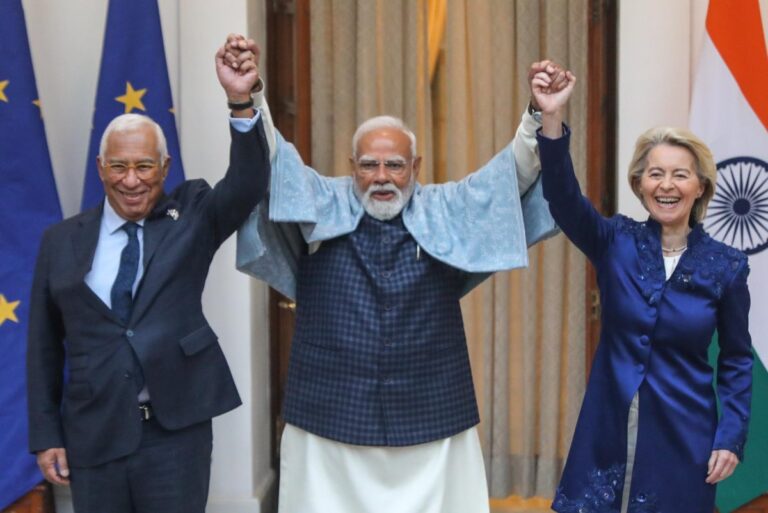
Indian Prime Minister Narendra Modi (center) poses for a photo with European Commission President Ursula von der Leyen (right) and European Council President Antonio Costa before their meeting at Hyderabad House in New Delhi on January 27, 2026.
Sajjad Hussein | Afp | Getty Images
A landmark trade deal between the European Union and India has been hailed as a major breakthrough for Europe’s biggest carmakers, even as analysts have flagged competition concerns in one of the world’s fastest-growing markets.
The EU and India signed on Tuesday what European Commission President Ursula von der Leyen and Indian Prime Minister Narendra Modi called a “mother of all affairs“.
Long wait agreementwhich comes as both sides seek to strengthen ties amid US tensions, includes a reduction in tariffs on imports of EU-made cars from 110% to 10%, as part of a quota of 250,000 vehicles per year.
It is the biggest-ever opening of India’s previously restricted automotive market to European original equipment manufacturers, with German engineering association VDMA describing it as a “day of celebration of export-oriented mechanical engineering”.
The European Stoxx Automobiles and Parts index, however, traded down 1.1% following this news, with Volkswagen, BMW and that of France Renault all reduced by around 1% during the afternoon deals.
Michael Field, chief equity strategist at Morningstar, said that in an increasingly volatile environment, any international trade deal is good news.
“The fact that automobiles are one of the EU’s largest exports to India means this deal could be a welcome boost for the European auto industry,” Field told CNBC via email.
“The Indian auto market is heavily dominated by domestic players, which will be difficult to disrupt, but this gives European automakers a fighting chance,” he added.
The deal could also open a new market for European luxury carmakers, such as Germany’s Porsche, with “more affordable” prices for the middle classes, Field said.
“An essential oxygen”
European automakers, which have faced crises on several fronts in recent months, are set to benefit from tariff cuts in India that no other trading partner of Delhi has enjoyed.
Certainly, India represents the world’s third-largest market for passenger cars and auto industry groups expect tax cuts, particularly for small vehicles, to significantly boost the country’s market in 2026.
Thilo Brodtmann, executive director of Germany’s VDMA, said the EU-India trade deal will give European manufacturers a much-needed competitive boost, describing the Indian auto market as one of the most dynamic in the world and one of the most strategically important.
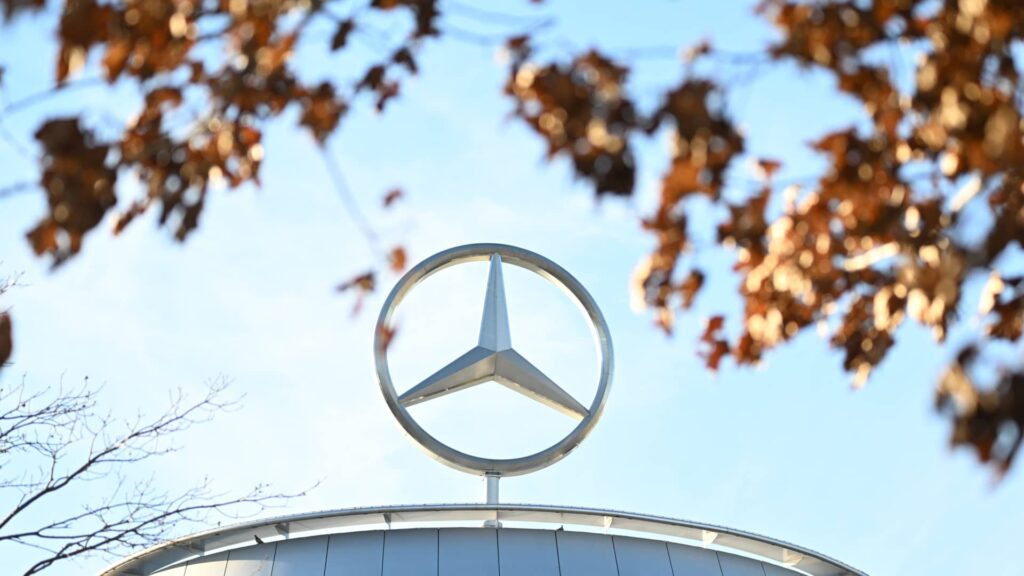
The Mercedes star, the brand logo of the car manufacturer Mercedes-Benz, rotates on a building of a Mercedes-Benz car dealership.
Alliance in pictures | Alliance in pictures | Getty Images
“Export-oriented mechanical and industrial engineering needs rules-based trade, just as it needs air to breathe. The India-EU free trade agreement brings much-needed oxygen to a world increasingly dominated by trade conflicts,” Brodtmann said in a statement.
“The EU has kept its promises. With this agreement, Europe is sending a clear signal in favor of rules-based trade and against the law of the jungle,” he added.
“A boon for European car manufacturers”
Eugene Hsiao, head of China equity strategy and China auto at Macquarie Capital, said the deal appears to show greater willingness across regions to open markets and work together, noting that the agreement will be positive for both the EU and India.
“We all know the geopolitical events of the last week and I think if you’re the EU or India, you’re looking to diversify. That’s the first thing and that’s probably the main reason why they would do something like that at this point,” Hsiao told CNBC on Tuesday.
“Particularly on the automotive side, because automotive is a very large market and India is a growing market, you can see that the Europeans would be very interested in having access to that. And historically, my understanding is that India has been relatively restrictive, so having that available is a boon for European automakers,” he added.
About The Author