Putting the EU-India FTA in perspective
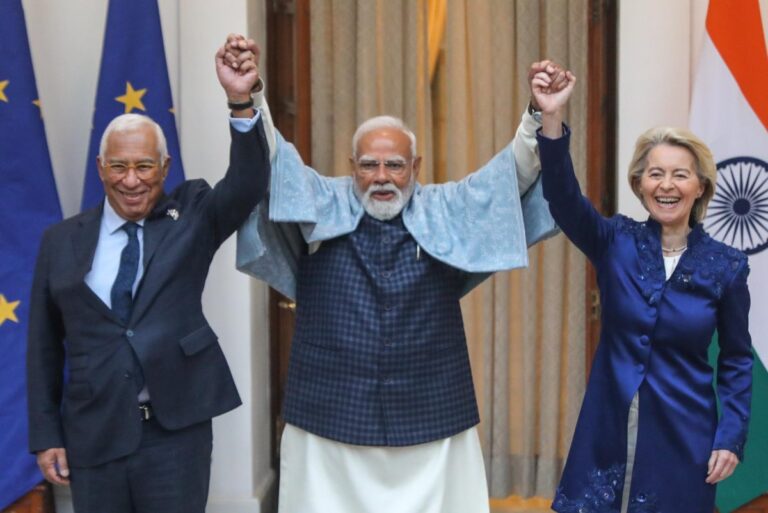
So what facilitated such a productive outcome after years of delays? Ursula von der Leyen’s visit to India with the entire College of Commissioners in February 2025 was a significant trigger. This resonated within the New Delhi establishment and reinforced the EU’s message that it was prepared to “lead by example” when it came to becoming a true strategic partner of India. This suited the EU all the more at a time when securitization and transactionalism were taking precedence over normative and liberal considerations. Brussels has learned the hard way the need to diversify and consolidate new partnerships in an increasingly coercive economic and commercial landscape. Uncertainty in relations with the current US administration, a former long-time ally, has certainly helped the EU move out of its comfort zone.
New Delhi has proven to be very adept at this amid its history of non-alignment and current multi-alignment. the sudden turnaround of the Trump administration with Imposition of 50 percent customs duty In August 2025 came as an unexpected blow. Soon after the public announcement of the India-EU FTA, the United States and India announced their own framework for an interim agreement, dubbed a “political Band-Aid deal.” The agreement would allegedly reduce US tariffs on Indian exports from 50 to 18 percent. It further contains a commitment by India to purchase 500 billion USD (425 billion EUR) worth of American goods and services over the next five yearsas well as an explicit promise to stop buying Russian oil – notably by Indian Oil, Bharat Petroleum and Reliance Industries – and turn to imports of Venezuelan oil. The intricacies of this particular agreement are worth analyzing elsewhere. This illustrates the extent to which India integrates trade agreements as part of its risk reduction toolkit.
New Delhi has shown hyperactive engagement in trade negotiations these last two years. In 2025 alone, India concluded new trade agreements with the United Kingdom, Oman And New Zealandwhile he was in negotiations to sign 12 other new agreementsincluding the now concluded India-EU FTA. Australia, Canada, Chile, Peru, Sri Lanka, Mercosur and the Eurasian Economic Union (EAEU) are next on the list. The New Delhi Business Handbook. The EU, for its part, is known for its dexterity and influence in trade negotiations, which explains 15.8 percent of global trade in 2024, thus reaffirming its leadership as the world’s largest trader of services and second largest trader of goods after China in 2024.
The EU-India trade deal has been commonly referred to as “the mother of all deals”, something even passport control officers in India currently acknowledge upon arrival of EU citizens! Its scope is indeed magnificent, encompassing nearly 2 billion people. However, when zooming in, while the EU was India’s largest trading partner for goods in 2024, India is only the EU’s 9th trading partnerfar behind the United States, China or the United Kingdom. Furthermore, the EU has a 2 percent goods export quota to India compared to 10 percent for Chinaas EU-India trade expert Nikolas Köhler-Suzuki pointed out. The Netherlands, Belgium, Italy, France and Spain make the top ten EU exporting countries in India in 2023-2024, while Germany and Ireland top the list of top 10 importers among EU countries. Yet Switzerland is the only European country among suppliers of India’s main merchandise imports, with China, Russia and the United Arab Emirates top the listin this particular order, during the first quarters of 2024 and 2025.
About The Author