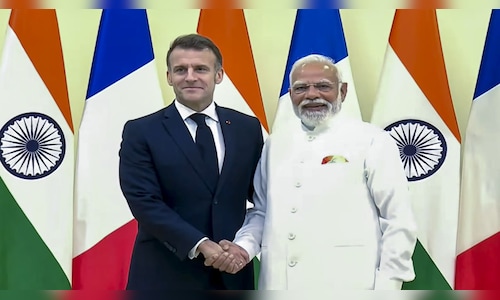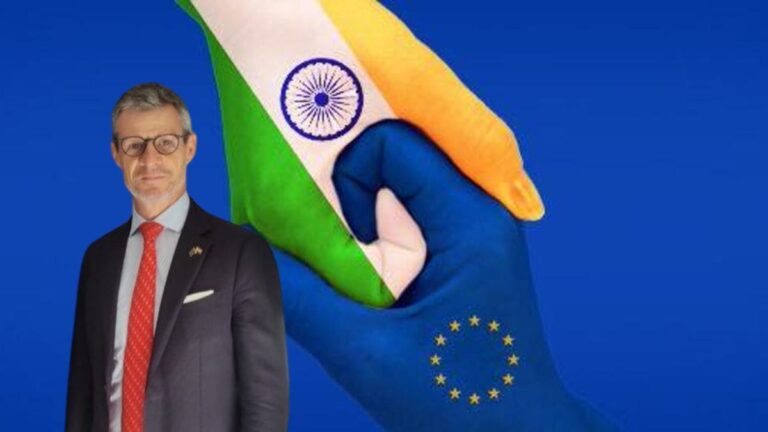
In January 2026, the European Union and India signed a free trade agreement (FTA). It covers almost all imports and exports between India and the EU common market. The tedious negotiations had lasted 20 years. Customs duties on 97% of goods will be reduced or eliminated. This will save 4 billion euros per year in customs duties. This will make Indian products more competitive in the EU.
The EU is a major export market for India. Unlike other countries like China and the United States, the EU is a reliable trading partner. China and India fought militarily only a few years ago and a full-scale war cannot be ruled out. Under Trump, the United States has been erratic and imposed tariffs on India. The Russian economy is in long-term decline, and trade with Russia attracts U.S. sanctions. With the EU, such difficulties will not exist.
The EU has 27 member states. However, the EU Common Market also includes countries that are not part of the EU, such as Switzerland and Norway, as well as several microstates such as Monaco, Liechtenstein and Andorra.
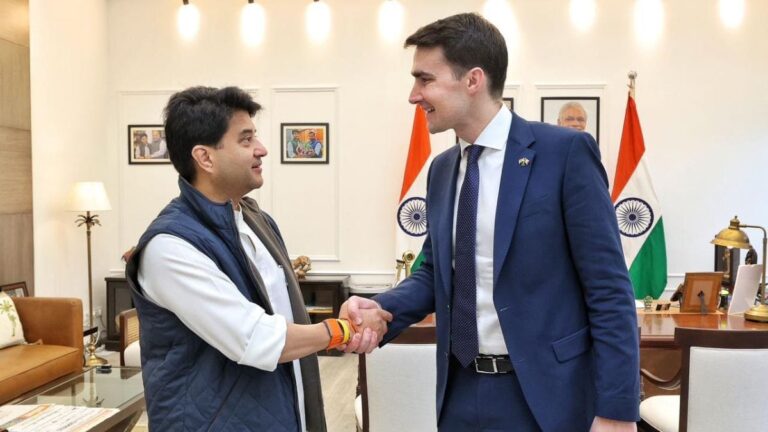
A summit between India and the EU took place in New Delhi. The goal was to make trade as seamless as possible by allowing as many of each partner’s goods and services as possible to be sold to the other. Both India and the EU needed to be assured that goods and services sold by the other complied with their health and safety regulations. They aligned regulations where possible.
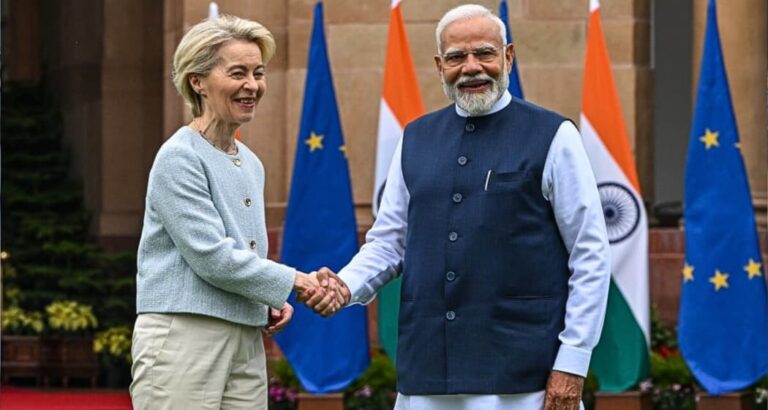
The President of the European Commission, Ursula von der Leyen, was on site in Delhi.
Leaders from both sides hailed the deal as a major breakthrough. It is believed that this will significantly boost trade and enrich both. Leaders spoke of symbiosis. It is almost certain that the Indian Council of Ministers will approve it. The FTA also requires approval by the Council of the European Union and ratification by the European Parliament. The Council of the European Union is made up of the prime ministers of the 27 EU states.
Reaching a deal with the EU is always tricky because its 27 member states are theoretically independent. Certain issues can be vetoed by a single member state. Malta, with a population of 500,000, could veto a decision agreed by the other 26 member states totaling 450 million inhabitants. EU member states have different identities. Some products are important to some member states, such as France’s wine exports, which are unimportant to Finland because it does not produce wine. The automobile industry is vital for Germany but is of no importance to Luxembourg, which does not manufacture cars. German automakers are keen to sell more in India and are emphasizing the need to reduce import taxes.
Negotiating within the EU is as complex as negotiating with others. It’s like herding cats. The EU’s strategy in negotiations is to drag things out as long as possible to wear down the other side and even force it to submit.
The UK left the EU in 2020. It is also not part of the EU Common Market. The UK’s exit from the EU makes the deal easier for India. Without the involvement of the British, we cannot think that India would capitulate to the former colonial metropolis. In any case, India has done very little trade with the UK in recent years. Belgium, with a population of just 10 million, trades more with India than the UK, with 70 million.
In 2007, the EU and the Indian government began negotiations for a trade agreement. At that time, the United Kingdom was still a member state of the EU. The negotiations collapsed after six years due to lack of progress in the areas of intellectual property, regulation and market access. We will have to wait until 2022 for negotiations to resume.
The India-EU FTA creates a free trade zone of nearly 2 billion people. It will represent around 25% of the global economy. It will therefore be much larger than the American economy. Free trade does not take effect instantly. Tariffs are gradually being phased out.
Only about 8% of Indians have a middle-class standard of living by European standards. But that still represents 130 million people. This is a very lucrative market for EU exporters.
The Vice-President of the European Commission, Kaja Kallas, played a key role in the negotiations. She explicitly linked trade to security cooperation. The EU is worried about Russia and China. Although India maintains cordial relations with Russia, its relations with China are often tense. The EU sees India as a delightfully democratic country in a region marked by authoritarianism.
Russia borders several EU countries: Finland, Poland, Latvia, Lithuania and Estonia. The latter three were all Soviet republics and they are worried about Russian irredentism.
The EU was unhappy with India’s participation in Russia’s Zapad 2025 military exercises. President Putin was granted a state visit to India in 2025, the supreme expression of friendship between sovereign states. Even though the EU disagrees with Indian foreign policy, it does not dispute India’s absolute independence or its right to formulate its own foreign policy.
There are those in the EU who say: “India is not our friend”. They say that getting closer to India is naive. They note that India is the largest single market for Russian weapons. Indian refineries have been buying huge quantities of Russian oil since 2022.
The answer to this argument is that the EU cannot force India to abandon Russia. The EU must convince India by offering more attractive offers. By purchasing Russian oil at a discount, India was pursuing its national interest. India should be persuaded not to do so. Russian military technology is at least a generation behind anything the EU makes. The inferiority of Russian military technology has been proven time and again in Ukraine. Therefore, EU defense manufacturers can convince India to buy their products if they offer low prices.
China is the world’s second largest economy, but it is at a standstill. Before 2008, China consistently posted double-digit annual GDP growth. It is now estimated at 3%. Additionally, China’s population is aging. It is facing a deadly demographic spiral. Some in the EU believe that China will become a less and less important economy. By 2100, China will still be a major economy, but not in second place: rather in fourth. Therefore, it is wise to forge friendly trade relations with India, which is booming.
There will be losers in this deal, both in India and in the EU. Indian premium automakers are worried about competition from European automakers. In the EU, farmers fear being undercut by cheap Indian food products. EU textile companies claim they will go bankrupt because the EU will be flooded with Indian textiles and the EU simply cannot make clothes as cheaply as India.
The EU also wants India to do more in the fight against climate change. India releases a lot of carbon to fuel its growing industry and provide electricity to its growing population. Climate change knows no borders and India’s carbon emissions impact the EU. The EU has cleaned its air and significantly reduced its carbon emissions. This is partly because the EU has fewer and fewer factories and relies on service industries. Plus, the EU is mostly rich and can afford to switch to expensive, clean energy. India says it must prioritize economic growth to lift its people out of poverty, just as Europe did during the industrial revolution. Only when India has abolished poverty can it afford to worry about climate change. This FTA will help India achieve both objectives.
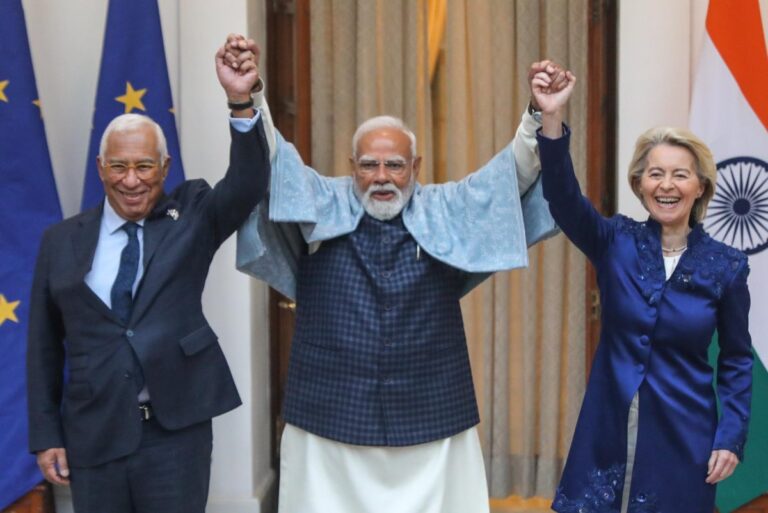
The FTA was signed at Hyderabad House. Prime Minister Modi was present. The President of the European Council was present: Antonio Costa. Costa and von der Leyen had been the chief guests at India’s Republic Day parade the day before. Costa is Portuguese and tactfully avoided mentioning the conflict between Portugal and India over Goa in 1961.
Narendra Modi was obviously very satisfied with what he accomplished. The EU and India also signed a security and defense partnership. This involves promoting cooperation in anti-piracy operations in the Indian Ocean; fight against terrorism, acquisition of defense equipment and cyber defense.
A codicil of the FTA was a mobility and migration agreement. The EU has more than 2 million people of Indian origin. Most of them are European citizens. India does not allow dual nationality. Shashi Tharoor is among those who believe India should allow it. India wants its citizens to be allowed to immigrate to the EU, where they can get a well-paying job, send money to India and push those countries to be more pro-Indian. Moreover, they sometimes perfect their virtuosities and return to India for the benefit of India.
The EU has low fertility and needs Indian workers in all sectors. European universities also want Indian students who pay high tuition fees. Trump’s xenophobia has discouraged people from studying in the United States. There are many EU countries where you can study exclusively in English: Ireland, Malta and Cyprus were all part of the British Empire. In the Netherlands, Norway, Denmark, Finland and Sweden, 90% of the population speaks English. Even Germany, Belgium, Italy, France and the Czech Republic have universities that offer degrees in English.
When it comes to FTA, Pakistan is crying over its president. The EU has not offered any such trade deal to Pakistan. Many Indian products that will now face low or no tariffs will compete directly with Pakistani exports to the EU, such as rice and leather goods.
About The Author