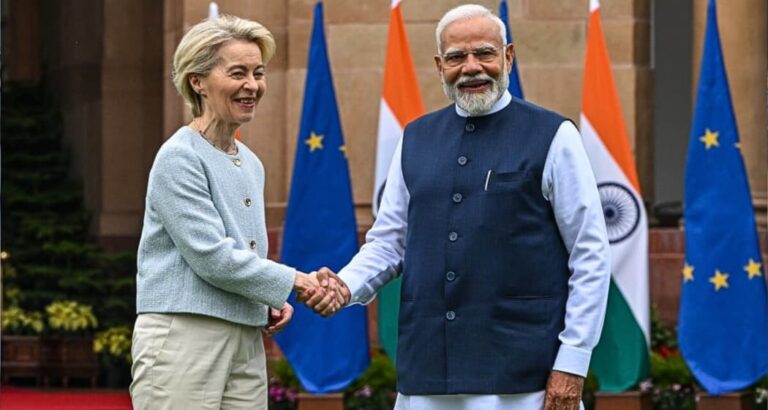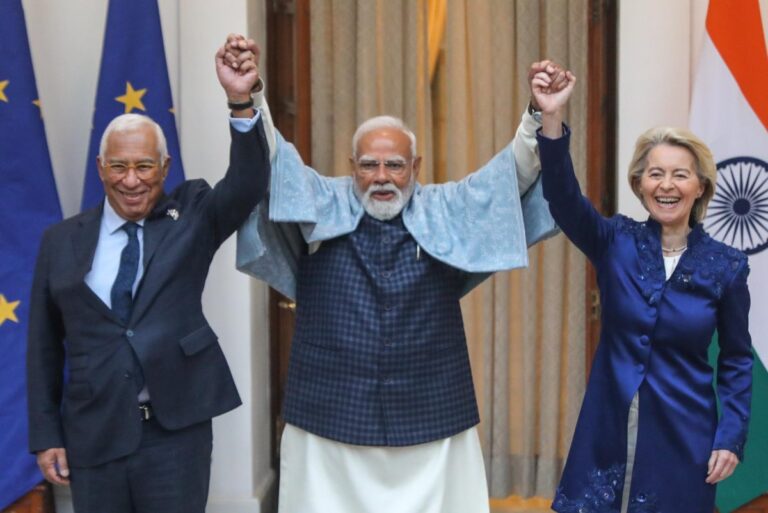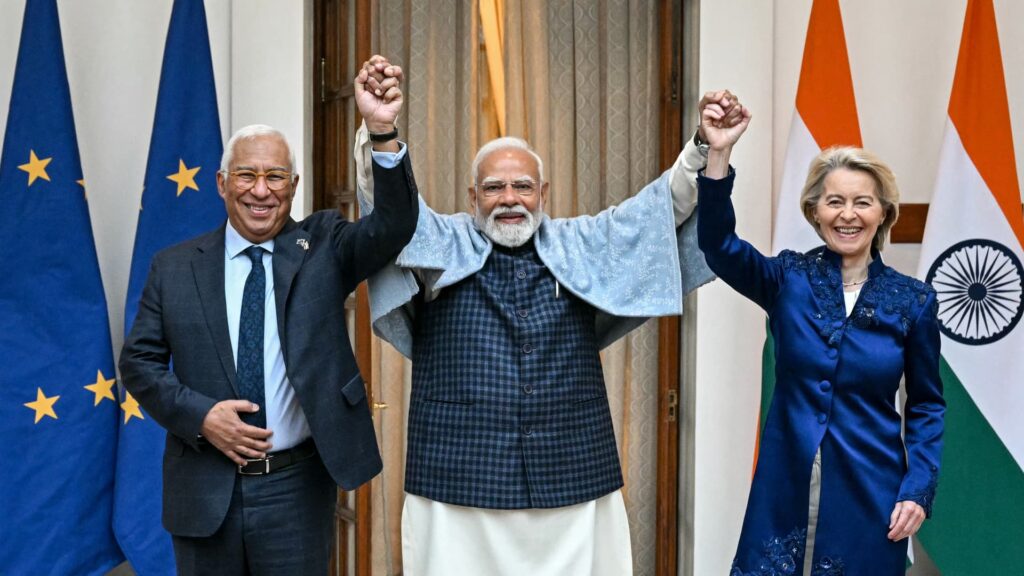
Indian Prime Minister Narendra Modi (center) poses for a photo with European Commission President Ursula von der Leyen (right) and European Council President Antonio Costa in New Delhi, India, January 27, 2026.
Sajjad Hussein | Afp | Getty Images
India and the European Union have finalized a trade deal that would remove or reduce tariffs on more than 90% of goods traded between the two.
The free trade deal would see India cut tariffs on European automotive and agricultural products, while the EU would do the same on textiles, leather, marine products, and Indian gems and jewelry.
Many of these Indian exports have been affected by the imposition of 50% tariffs by the United States.
“We have created a free trade zone of 2 billion people, with economic benefits for both sides,” said European Commission President Ursula von der Leyen. She added that the agreement sends “a signal to the world that rules-based cooperation always produces excellent results.”
This “historic” agreement comes at a time when New Delhi is facing US tariffs head-on and is looking for alternative markets for its exports. The EU’s long-standing trade ties with the United States, its largest trading partner, have been tested amid President Donald Trump’s efforts to annex Greenland.
Indian Commerce and Industry Minister Piyush Goyal told a news conference on Tuesday that he expected the agreement to come into force in 2026.
India is the EU’s ninth largest trading partner, accounting for 2.4% of the bloc’s total merchandise trade in 2024, far behind major partners like the United States (17.3%), China (14.6%) or the United Kingdom (10.1%). But the EU is one of India’s biggest trading partners, rivaling the United States and China.
“The mother of all transactions”
Von der Leyen called it the “mother of all transactions.”
The agreement would be reduce Indian customs duties on European products amount to around 4 billion euros ($4.7 billion) per year, the European Commission said in a statement.
The deal, which the EU says will help it double its exports to India by 2032, will cut tariffs on more than 90% of EU exports to India, such as automobiles, machinery, agri-food products, chemicals and aircraft.
“India will grant the EU tariff reductions that none of its other trading partners have received, significantly improving market access for EU exports,” the European Commission said.
A freight train carrying cargo containers travels along a railway track in Ajmer on August 26, 2025.
Himanshu Sharma | Afp | Getty Images
New Delhi has defied experts’ expectations by proposing to ease tariffs on sectors such as automobiles and agriculture, which are particularly sensitive to levies.
India plans to cut tariffs on European cars »gradually” from 110% to 10% and abolish customs duties on auto parts after five to ten years. Major European automakers in India include Renault, Volkswagen, BMW and Mercedes.
New Delhi has also almost eliminated customs duties of up to 44% on machinery, 22% on chemicals and 11% on pharmaceuticals.
The deal also reduced or eliminated high tariffs on agricultural products exported from Europe such as wine and olive oil. It also protects Europe’s agricultural sectors of beef, chicken meat, rice and sugar from imports from India.
“Under this agreement, European wines, spirits, beers, olive oils, confectionery and other products will benefit from preferential access to the rapidly growing Indian market,” said Christophe Hansen, European Commissioner for Agriculture and Food.
Indian auto stocks hit
In India, shares of major automakers and liquor companies plunged on news of the deal.
Shares of the Japanese automaker Maruti Suzuki ended down 1.5%, while those of the Korean company Hyundai Motor India closed down 3.6%. Indian automobile companies Tata Engines And Mahindra and Mahindra ended down 1.3% and 4.2%, respectively.
The Indian government said the deal would give Indian consumers access to high-tech automobiles and greater competition.
“Reciprocal access to the EU market will also open opportunities for automobiles manufactured in India to access the EU market,” he said.
Similarly, shares of India-based liquor companies also fell. Shares of wine producer Sula Vineyards fell 4.1% while Heineken AGUnited Breweries, owned by ., and United Spirits, owned by Diageo, fell more than 2%.

The trade deal would lift taxes on Indian sectors that have been hit by the 50% US tariffs and provide New Delhi with “preferential access to European markets” for more than 90% of its traded goods.
Textiles, clothing, marine products, leather, footwear, chemicals, plastics, sporting goods, toys, gems and jewelry will not be subject to any customs duties once the free trade agreement comes into force, India’s commerce ministry said in a statement accompanying the announcement.
These goods from these “key labor-intensive sectors” represent $33 billion in exports. Before the deal, the EU taxed them at rates between 4% and 26%.
“This is expected to strengthen the competitiveness of Indian exports in these sectors, which are currently under strain due to rising US tariffs,” said Sonal Varma, chief economist for India and Asia ex-Japan, at Nomura.
Job creation in India
The EU-India trade deal could create six or seven million jobs in the textile sector alone, Goyal said at Tuesday’s press conference, adding that the sector was the second largest employer in India after agriculture.
India and the EU will establish a framework allowing temporary entry and stay of professionals, including business visitors, intra-company transferees, contractual service providers and independent professionals.
India’s IT services, professional services and education services sector is “well-positioned” to benefit from the mobility provisions, Nomura’s Varma said.
In fiscal 2025, India’s bilateral merchandise trade with the EU stood at Rs 11.5 trillion (US$ 136.54 billion), according to a statement from the Indian Commerce Ministry. New Delhi’s exports to Europe stood at $75.85 billion and imports at $60.68 billion, he said.
About The Author