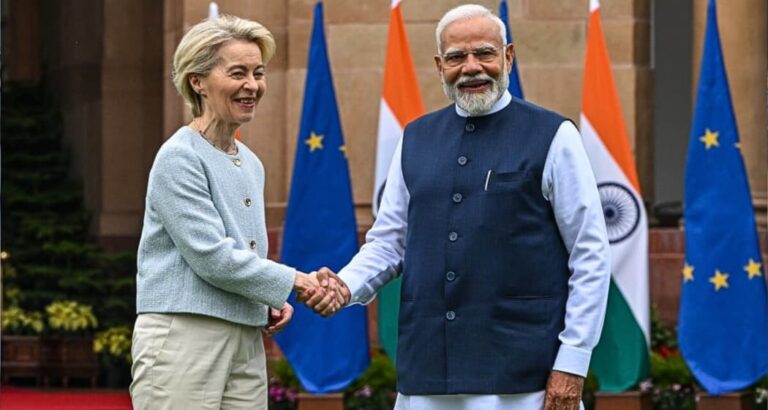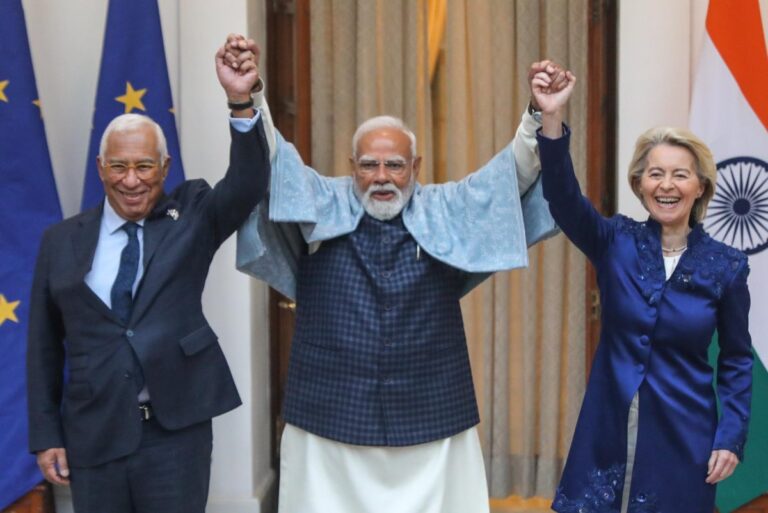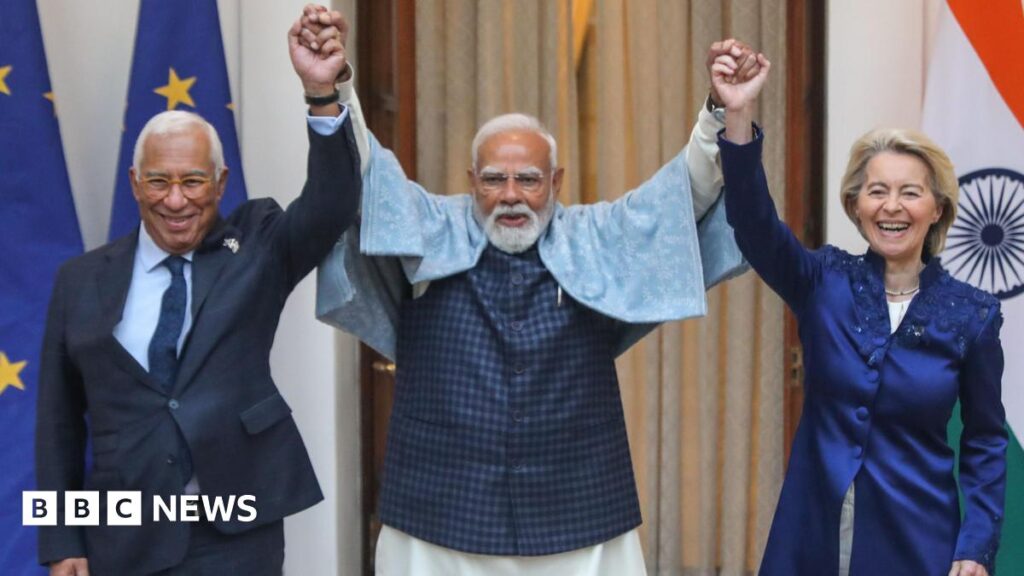
The deal with the European Union could help labor-intensive sectors in India, such as shrimp farming, textiles, gems and jewelry, which have been hit hard by U.S. tariffs, experts say.
But some analysts also predict challenges, particularly in terms of compliance with European regulations and standards. “The EU has very strict regulations, for example on the environment. It is one of the leaders in terms of carbon compensation mechanisms,” explains economist Mitali Nikore.
She says India’s manufacturing sector “may not be fully prepared” for this situation and it is essential that it takes steps to address this issue.
“It’s an opportunity more than a challenge,” she says.
For the EU, the deal aims to provide some certainty, even security, at a time of economic coercion and global turmoil.
Germany and France are expected to be among the biggest beneficiaries, even if it is not the “hugely ambitious” version of a trade deal once envisioned, said Andrew Small, director for Asia at the European Council on Foreign Relations.
However, he says, the deal is seen as a building block rather than a final destination, as the EU seeks to harness a massive, fast-growing economy.
“This is really seen as a foundation of what is possible for the bilateral relationship.”
The official signing will likely only take place later this year, after the deal has been approved by the European Parliament and member states.
This could raise some concerns after another major EU trade deal with the Mercosur bloc of South American countries was recently derailed in the European Parliament.
However, the India deal is seen as less controversial because it “touches on sensitive issues on both sides,” Small says.
Alongside the trade deal, India and the European Union are also holding separate negotiations on security and defense cooperation, as well as climate action.
On Tuesday, Indian Defense Minister Rajnath Singh said he discussed a range of bilateral security and defense issues with European Commission Vice-President Kaja Kallas, including opportunities to integrate supply chains to build reliable defense ecosystems and develop future-ready capabilities.
The two sides are working on a proposed security and defense partnership covering areas such as maritime security, cyber threats and defense dialogue, Reuters news agency reported.
The EU is India’s largest trading partner for goods, with bilateral trade in goods, external reaching $136 billion (£99.4 billion) in 2024-25, almost doubling in a decade.
Negotiations for a deal began in 2007, but stalled in 2013 due to market access barriers and regulatory requirements. Discussions were formally resumed in July 2022.
Trump’s tariffs have proven to be a “useful tailwind in the home stretch” to move the deal forward, a European diplomat told the BBC.
Over the past seven months, India has signed major trade deals with the United Kingdom, Oman and New Zealand, and a 2024 agreement signed with the four European Free Trade Association countries (Switzerland, Norway, Iceland and Liechtenstein) came into effect last year. It signed a trade agreement with Australia in 2022.
Follow BBC News India on Instagram, external, YouTube,, external Twitter, external And Facebook, external.
About The Author