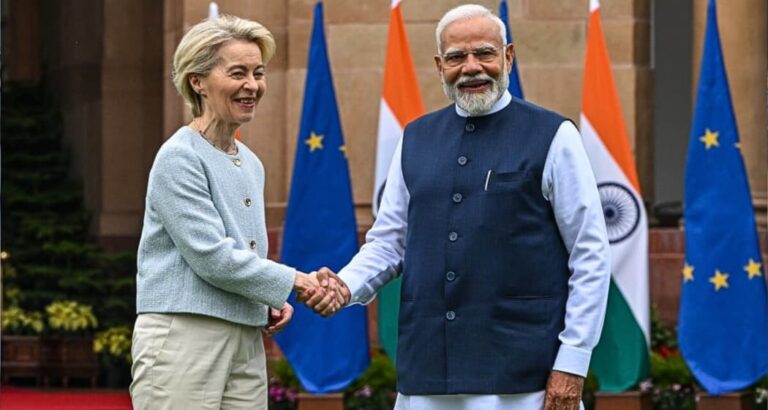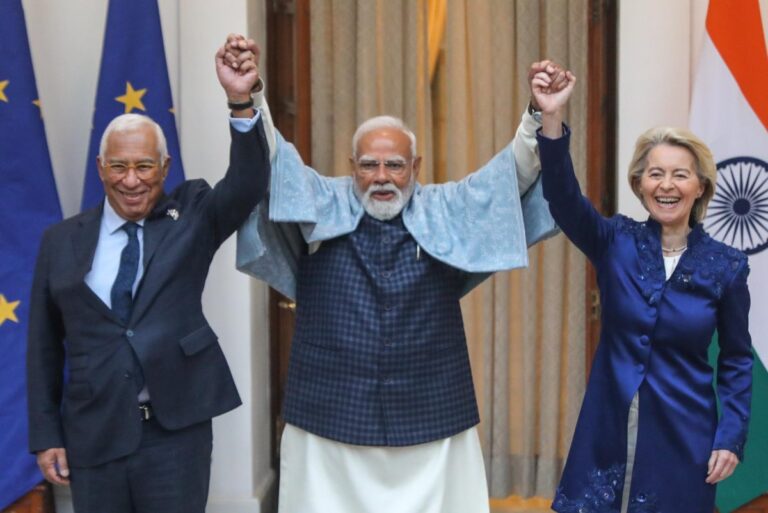
European Council President Antonio Costa and European Commission President Ursula von der Leyen will be the chief guests at the Republic Day celebrations on January 26, and the India-EU summit will take place the next day.
An EU military contingent, flying the General Staff flag and the flags of Operations Atalanta and Aspides, the group’s naval operations, will participate in the Republic Day parade.
It will be the EU’s first participation in such an event outside Europe, the sources said.
Urgent global challenges, including the war between Russia and Ukraine, the situation in the Middle East and political developments in Venezuela, will be among the global issues the two sides are likely to address at the summit, they added.

EU leaders will be accompanied by a 90-member delegation that will include foreign and security policy chief Kaja Kallas, Trade Commissioner Maros Sefcovic and directors-general responsible for trade, energy and industrial policy.
The European Union is India’s largest trading partner, with bilateral merchandise trade of $135 billion in the 2023-2024 financial year. The free trade agreement is expected to significantly strengthen trade relations.
The two sides are expected to adopt a document announcing the conclusion of negotiations on the free trade agreement, considered the largest such agreement concluded by India in recent history.
Following this, both parties will initiate the legal clean-up process and related processes for the signing of the trade agreement.
First, the European Parliament will have to vote on the agreement, then the European Council will have to give the green light to the agreement allowing Trade Commissioner Sefcovic to sign it with his Indian counterpart, the sources said.
The ambitious FTA is being consolidated amid growing concerns over Washington’s trade and tariff policies that have impacted both India and the 27-nation EU.
India and the EU are also expected to unveil a common overall strategic vision that will govern their relations for the period 2026-2030.
The sources said the two sides are still in negotiations to find common ground on controversial issues such as the CBAM (Carbon Border Adjustment Mechanism), which is a framework for tariffs on carbon-intensive products such as steel and cement.
The EU has a principled position on the CBAM and has not changed the arrangements for the United States and other partners, the sources said, adding that the two sides were working on a “compromise solution” on the sensitive issue.
Work is underway to find a way out of the inclusion of climate-related standards in the Paris Agreement, they said.
Progress was made on issues related to the agricultural sector, with both sides having “marked and drawn their respective red lines” on this subject.
India has adopted a tough approach towards dairy and agricultural products, the sources said.
An agreement has already been reached on wines and spirits and there could be tariff quotas for the automotive sector, they added.
We learn that the two parties are seeking to reduce their differences on steel.
The EU and India first launched negotiations on a free trade agreement in 2007, before negotiations were suspended in 2013 due to a lack of ambition.
Negotiations were relaunched in June 2022.
The proposed Security and Defense Partnership (SDP) will facilitate deeper defense and security cooperation between the two sides.
The SDP will bring interoperability in the defense domain and open up opportunities for Indian companies to participate in the EU’s SAFE (Security Action for Europe) programme.
SAFE is the EU’s €150 billion financial instrument designed to provide financial support to Member States to accelerate their defense preparedness.
At the summit, India and the EU are also expected to launch negotiations for a Security Information Agreement (SOIA).
The SOIA is expected to strengthen defense industrial cooperation between the two sides.
The memorandum of understanding to facilitate mobility of Indian workers to Europe is expected to be another key outcome of the summit.
It will provide a framework to advance EU member states’ mobility initiatives with India, the sources said.
France, Germany and Italy are among the European countries that have entered into migration and mobility partnerships with India.
The two sides are also expected to sign a number of other agreements aimed at strengthening cooperation in several other sectors.
About The Author