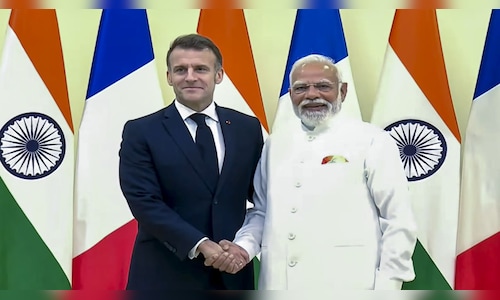
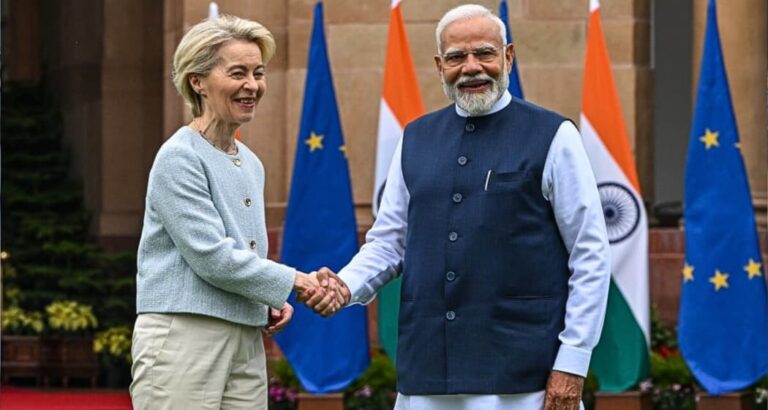
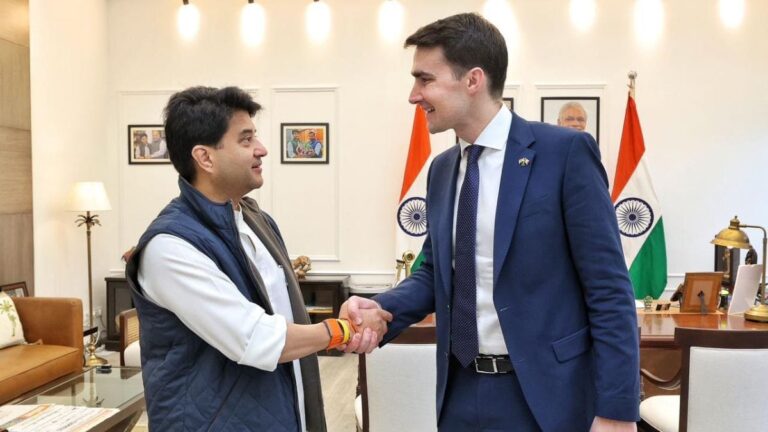
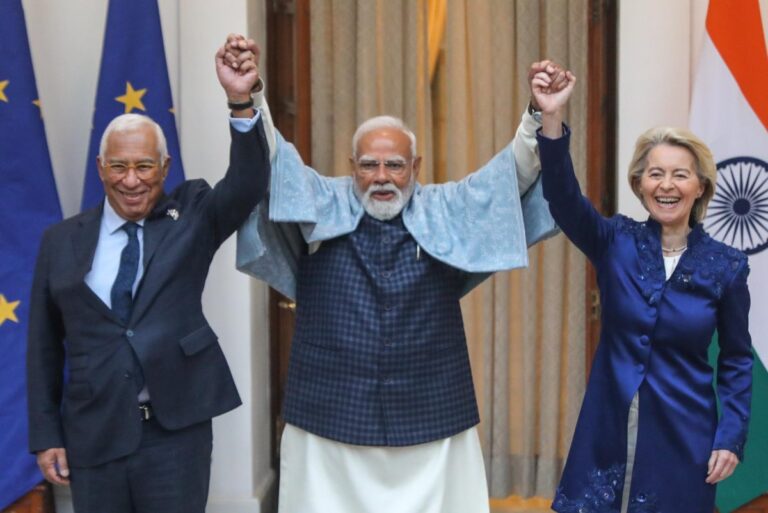
For the first time, Republic Day celebrations will not be able to host any head of state. The invitation extends to Ursula von der Leyen, President of the European Commission, and António Costa, President of the European Council, marking the culmination of a year of dynamism in EU-India relations. It started with the unprecedented visit of the College of Commissioners to New Delhi in FEBRUARY 2025 — first official visit of the Commission outside Europe.
The Commission’s visit provided impulse to accelerate the EU-India signature Free Tharbor Agreement (ALE)whose negotiations resumed in 2022 after almost a decade of stagnation. Deadline for closing the deal by the end of 2025 was missed. The accelerated pace of negotiations could result in a more limited agreement, shaped by political imperatives and the need for it as an outcome of the EU-India summit on January 27. Certain sensitive issues, notably those linked to agriculture, risk being neglected. Even if the result seems more strategic than commercially ambitious, it nevertheless has the potential to place the two economic blocs on an equal footing. closer partnership path. The EU is India’s secondIndia is the EU’s largest trading partner, while India is the EU’s largest trading partner among the Global South.
The Commission’s visit provided momentum to accelerate the signing of the EU-India Free Trade Agreement (FTA), whose negotiations resumed in 2022 after almost a decade of stagnation.
Beyond trade, this new dynamism in EU-India relations is due to changes in US foreign policy under the Trump administration, which prioritized unilateral action and adopted a more confrontational posture towards its European allies and India. This underlines the desire by New Delhi and Brussels to coordinate more closely, with the United States and China seen by both countries as key players. systemic rivals. In a multipolar and multi-aligned world, this EU-India partnership could pave the way for new partnership modelsbased on mutual, predictable and stable relationships.
However, for this cooperation to bear fruit, both actors must define their main interests and priorities. India and the EU’s divergent approach towards Russia derailed the launch of the strategic agenda last September, coinciding with the Vostok exercise. However, ties were further strengthened less than two months later when EU-India foreign policy negotiations took place. and safety consultations were held in Brussels, with both parties reaffirming their desire to ensure lasting peace in Ukraine. Finally, President Vladimir Putin’s visit to New Delhi in early December reassured Brussels, as no major agreement or strategic agreement had been concluded, underlining the largely symbolic nature of the visit.
Advancing EU-India collaboration in technology and defense
The fact that the two entities are considering a lasting partnership East evident in the focuses on New EU-India strategic agenda, unveiled on September 17, 2025. It lists key areas of cooperation in the coming years, organized around five pillars: sustainability, technology and innovation, connectivity, security and defenseand catalysts. This ambitious agenda is expected to be formally adopted at the EU-India leaders’ summit coinciding with the Republic Day visit. With such a clearly defined set of goals, the road ahead looks promising, if arduous.
In the technological field, the Trade and Technology Council (TTC) announced in 2022 must be reinforced and recalibrated if it is to succeed, like the India-United States (US) Initiative on Critical and Emerging Technologies (iCET), if elevated to the leadership level, the TTC could accelerate key components strategic relationships, particularly in areas such as digital public infrastructure (DPI), critical minerals and supply chain, and green energy. This could help the EU and India manage their dependence on energy and critical minerals, areas in which major powers such as the United States and China exert significant influence. Furthermore, the possibilities for security cooperation are considerable. Coordination in the maritime domain has already started, notably through a common exercise carried out in the Indian Ocean in June 2025 between EUNAVFOR Atalanta and the Indian Navy. These efforts could be strengthened and systematized to address regional security challenges, including piracy, illegal fishing, humanitarian assistance and disaster relief (HADR).
A formal bilateral defense and security partnership, along the lines of the EU-Turkey and EU-South Korea partnerships, could facilitate access to EU and Indian defense industrial bases.
For the future, a formal meeting bilateral defense and security partnershipmodeled on EU-Türkiye and EU-South Korea relations, could facilitate access to the defense industrial bases of the EU and India. This, in turn, could enable co-production and co-development of key components in both territoriesbuilding on synergies already established with key defense players such as HAL, Safran, Airbus and L&T. This would allow Indians to access SECURE Funds(1) to meet the EU’s defense needs, notably in munitions intended for Ukraine. This could incentivize Indian defense manufacturers to establish factories in the EU, thereby encouraging enhanced technology transfer between EU defense companies and their Indian counterparts – a move that seems increasingly plausible in light of recent announcements.
In the diplomatic sphere, India and the EU could be well placed to bridge the gap between the South and the North and offer an alternative model of cooperation, avoiding antagonism between the United States and China. In this light, the two blocs appear as potential anchor points of stabilization in an era of growing rivalries and conflictual relations. This stability is further enhanced by the democratic nature of both entities at a time of increased global uncertainty.
Strengthening exchanges between the people of the EU and India
The EU and India must find new avenues of engagement to strengthen people-to-people exchanges. Although strategic links have been supported by an increasing number of high-level dialogues on Tracks 1.5 and 2, much remains to be done on migration and mobility.
In the diplomatic sphere, India and the EU could be well placed to bridge the gap between the South and the North and offer an alternative model of cooperation, avoiding antagonism between the United States and China.
Although the two entities signed the Common Agenda for Migration and Mobility (CAMM) in 2016, the number of Indian nationals in the EU – which today stands at less than one million— is lower than the corresponding figure for Australia, despite a significantly smaller population. EU member states must do more to attract students and skilled professionals from India, including by easing visa rules and making their long-term stay more viable. In this regard, proposals from the EU-India high-level dialogue on migration and mobility—such as the establishment of an EU Legal Gateway Office in India to facilitate ICT mobility – marks a constructive step forward.
As changes in U.S. migration policy affect skilled mobility pathways, much could be achieved by expanding the EU Blue Card program, particularly in light of recent constraints affecting the U.S. Green Card and H-1B initiatives.
Guillaume Gandelin is a visiting scholar in the Strategic Studies Program at the Observer Research Foundation.
(1) Require a 65 percent share of components manufactured in the EU
The opinions expressed above are those of the author(s). ORF research and analysis now available on Telegram! Click here to access our curated content – blogs, long forms and interviews.
About The Author