Source: BT
Subject: International relations
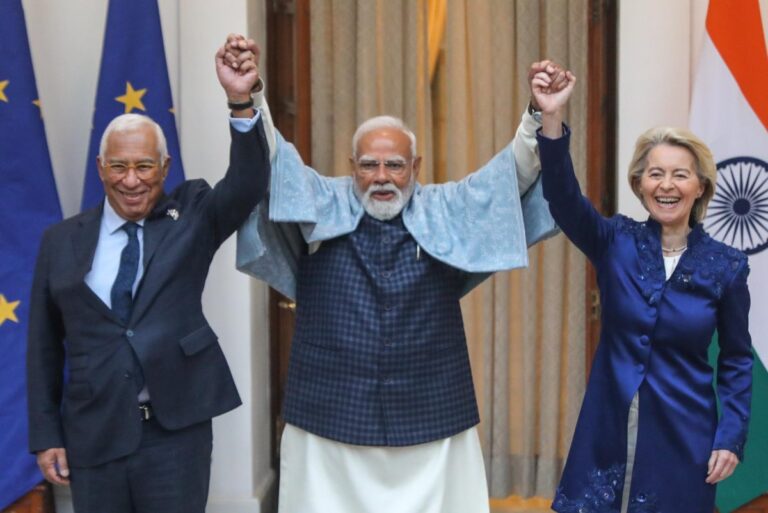
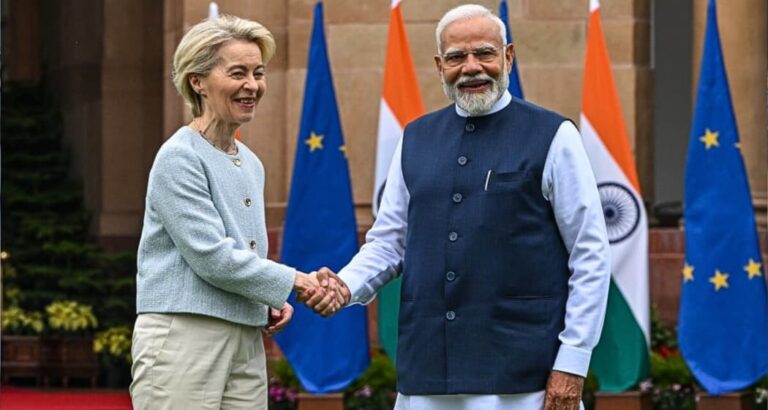
Context: India and the European Union are in the final stages of negotiating a free trade agreement (FTA) that is expected to significantly boost India’s exports and diversify its trade amid growing global protectionism.

About India-EU FTA:
What is this ?
- The India-EU Free Trade Agreement is a comprehensive trade agreement aimed at reducing or eliminating customs duties, aligning regulations, opening services markets and facilitating investments between India and the 27 countries of the European Union.
- It also includes parallel negotiations on investment protection and geographical indications (GI). Negotiations began in 2007, were interrupted in 2013 and were restarted in June 2022.
Current India-EU trade (2024-25)
- Largest merchandise trading partner: The EU is India’s largest trading partner for goods, with bilateral trade worth billions of dollars.
- Export-import distribution: India exports billion and imported billion value of goods from the EU.
- Trade in services: India exports billion in services to the EU and imported billionmainly in IT, IP, telecoms and business services.
- EU share of Indian exports: The EU accounts for around 17% of India’s total exports, making it India’s largest export market.
- Main partners within the EU: The main destinations for Indian exports are Germany, Spain, Belgium, the Netherlands and Poland.
Opportunities related to the India-EU FTA:
- Removal of customs duties for labor-intensive sectors: Removal of 12-16% customs duty will help Indian textiles and leather compete with duty-free rivals like Vietnam and Bangladesh.
- Stimulating manufacturing exports: Duty-free access will propel Indian pharmaceutical and technical products into the 450 million-strong European market, thereby promoting industrial growth.
- Growth in exports of services: The regulatory alignment will make it easier for Indian IT and telecom professionals to travel, significantly expanding the footprint of a billion services in India.
- Supply chain diversification: The deal strengthens India’s position as a reliable “China plus one” alternative, integrating domestic industries into sophisticated European manufacturing networks.
- IDE and technological contributions: Strengthened legal certainty will attract high-quality European investments in green hydrogen and semiconductors, boosting the Make-in-India initiative.
Challenges associated with the FTA:
- EU labor and environmental requirements: Strict climate standards and the Carbon Border Adjustment Mechanism (CBAM) act as non-tariff barriers that India considers protectionist.
- Data protection and digital commerce: Tensions remain as India prioritizes sovereign data localization while the EU demands free flow of data for its digital businesses.
- Car and wine prices: India faces pressure to reduce high tariffs on European cars and spirits, which risks disrupting the sensitive domestic manufacturing ecosystem.
- Intellectual property rights (DPI): EU push for data exclusivity could delay production of life-saving generics, threatening India’s status as a global pharmacy.
- Access to public markets: The EU’s requirement to bid for government contracts conflicts with India’s preference for local suppliers under the Aatmanirbhar Bharat vision.
The way forward:
- Balanced price reductions: Negotiations should focus on asymmetric liberalization, ensuring India has rapid access to exports while gradually opening its own markets.
- Safeguard domestic manufacturing: Protective exclusions for agriculture and dairy ensure that small Indian producers are not overwhelmed by heavily subsidized European imports.
- Protecting digital sovereignty: India must leverage the success of its digital public infrastructure (DPI) to negotiate data sharing rules that protect privacy while enabling global trade.
- Leverage European market for Make-in-India: Strategic alignment with PLI programs can transform the FTA into a catalyst for high-end manufacturing and global technology transfers.
- Use the FTA as a geopolitical hedge: Intensifying trade with the EU provides a vital hedge against volatile developments in global trade and rising regional protectionism.
Conclusion:
The India-EU FTA is not just a trade agreement but a strategic economic partnership with the world’s largest trading bloc. If concluded on balanced terms, it can accelerate India’s export-led growth, attract high-quality investments and integrate India into European supply chains, thereby strengthening India’s position in a fragmented global economy.
About The Author