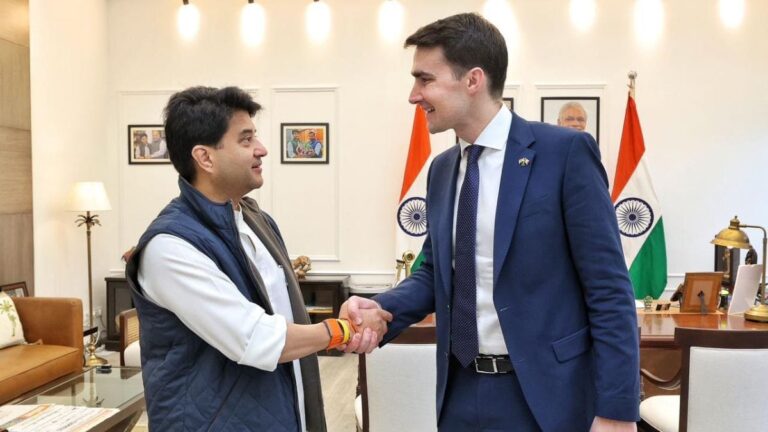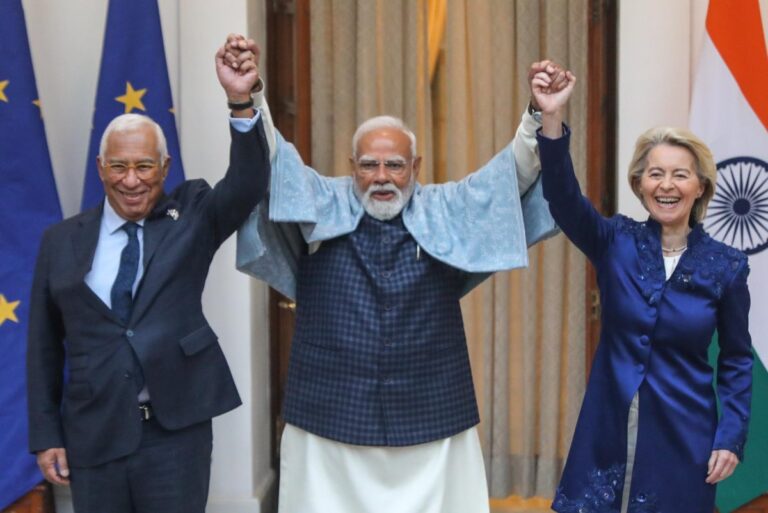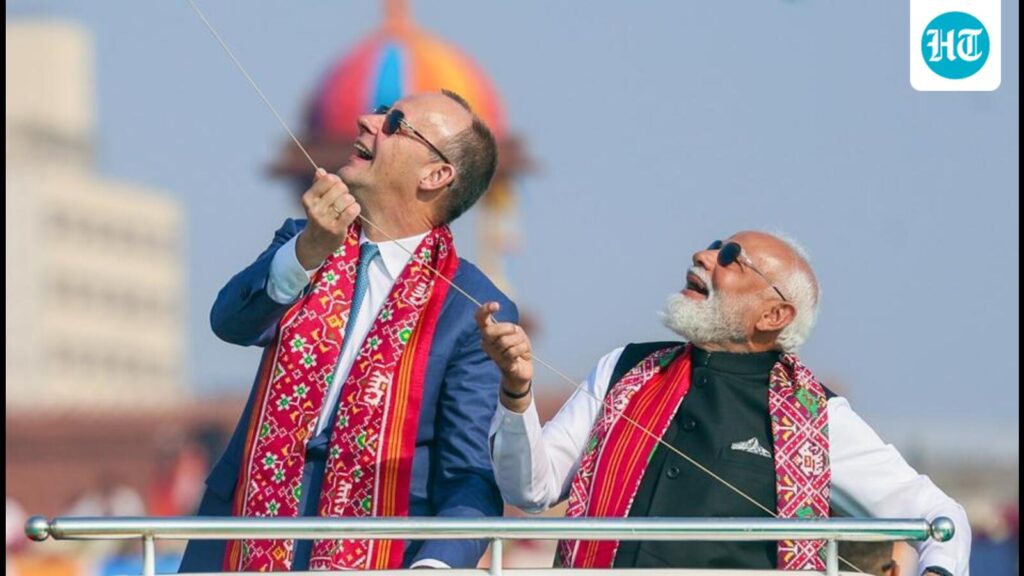
India and Germany on Monday finalized steps to deepen economic and security cooperation, including a roadmap for defense industrial collaboration, with Prime Minister Narendra Modi and Chancellor Friedrich Merz describing the two countries as natural partners in a world grappling with geopolitical upheaval and uncertainty.
{{#usCountry}} {{/usCountry}}
{{^usCountry}} {{/usCountry}}
Merz, on his first visit to Asia since taking office last year, was accompanied by a large delegation of businessmen to highlight the importance of strengthening economic ties with India amid unpredictability created by US trade policy. During his talks with Modi in Ahmedabad, Merz highlighted the importance of finalizing the free trade agreement between India and the European Union (EU) to boost trade and investment.
{{#usCountry}} {{/usCountry}}
{{^usCountry}} {{/usCountry}}
{{^usCountry}}
{{/usCountry}}
{{^usCountry}}
The two sides finalized 19 agreements, including a joint statement of intent on strengthening bilateral defense industrial cooperation, and unveiled other measures such as a Level 1.5 Foreign Policy and Security Dialogue and an Indo-Pacific Dialogue that will see them work more closely on defense and security issues. Both sides also announced visa-free transit for Indian passport holders transiting through Germany.
{{/usCountry}}
{{#usCountry}}
The two sides finalized 19 agreements, including a joint statement of intent on strengthening bilateral defense industrial cooperation, and unveiled other measures such as a Level 1.5 Foreign Policy and Security Dialogue and an Indo-Pacific Dialogue that will see them work more closely on defense and security issues. Both sides also announced visa-free transit for Indian passport holders transiting through Germany.
{{/usCountry}}
{{#usCountry}} {{/usCountry}}
{{^usCountry}} {{/usCountry}}
“The growing defense and security cooperation is a symbol of our mutual trust and common vision. I express my sincere gratitude to Chancellor Merz for simplifying the processes related to defense trade,” Modi said, referring to Germany’s relaxation of strict procedures for defense exports which has benefited India in recent years.
“We will also work on a roadmap to strengthen cooperation between our defense industries, which will open up new opportunities for co-development and co-production,” Modi said, speaking in Hindi.
Merz stressed the need to deepen the bilateral strategic partnership in the context of “profound geopolitical changes and upheavals in the world.” He said: “Europe and transatlantic relations remain important to us. Today we must forge a broader network of partnerships and we must do it quickly.
{{#usCountry}} {{/usCountry}}
{{^usCountry}} {{/usCountry}}
“India is a sought-after partner, a partner of choice for Germany, and the preconditions for a renewed, deepened and intensified partnership could not be more favorable.”
Modi also said that both countries value reliable and trustworthy partnerships in an uncertain global environment.
Both sides noted that trade between India and Germany had exceeded $50 billion – about a quarter of India’s total trade with the European bloc – and highlighted the scope for more, particularly with the early conclusion of the India-EU trade deal, which is expected to be finalized during the visit of the bloc’s top leaders to New Delhi later this month.
Modi highlighted that the presence of more than 2,000 German companies in India reflected their “unwavering confidence” in the country and said both sides were working to build secure and reliable supply chains. Technological cooperation has also been strengthened and the two sides will establish a center of excellence to boost cooperation in the field of renewable energy.
{{#usCountry}} {{/usCountry}}
{{^usCountry}} {{/usCountry}}
“We are jointly advancing new projects in areas such as climate, energy, urban development and urban mobility. The new mega project on green hydrogen involving companies from both countries will prove to be a game changer for the energy of the future,” Modi said, adding that special emphasis was being placed on improving migration, mobility and skills.
While Germany is already home to 300,000 Indian expatriates and 60,000 students, an agreement on a global skills partnership will facilitate the mobility of healthcare professionals. Merz said the number of skilled workers, including health aides and nurses, that India needs is growing rapidly. Indians are among the most successful immigrant group in Germany, which wants to promote this trend in the future, he said.
Merz also highlighted the need to intensify economic relations with India, the fastest growing economy in the G20 and a key partner in the Indo-Pacific region, amid a “resurgence of protectionism directed against free trade and open markets” – an apparent reference to the geo-economic upheaval caused by US trade policies.
{{#usCountry}} {{/usCountry}}
{{^usCountry}} {{/usCountry}}
“We see that major powers are increasingly using supply chains and raw materials as instruments of power. Together we want to oppose this. We reduce unilateral dependencies in our supply chains and this makes both our economies more resilient,” he said in German.
Among the agreements finalized by the two sides are a joint statement of intent on strengthening economic cooperation by establishing a CEO forum under a joint economic and investment committee, a joint statement of intent on a semiconductor ecosystem partnership, cooperation pacts in the areas of critical minerals, telecommunications and sports, a green ammonia purchasing agreement between India’s AM Green and Germany’s Uniper Global Commodities, and a Indo-German roadmap on higher education.
The two sides also announced new funding commitments of €1.24 billion under the Bilateral Green and Sustainable Development Partnership to support projects in the areas of renewable energy, green hydrogen and climate-resilient urban infrastructure, as well as the launch of a battery storage working group under the Indo-German Platform for Global Renewable Energy Investments.
{{#usCountry}} {{/usCountry}}
{{^usCountry}} {{/usCountry}}
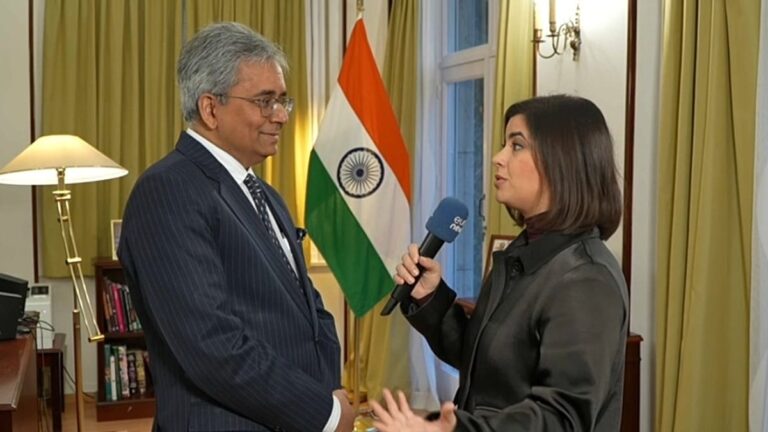
Foreign Minister Vikram Misri said Germany has taken a decision in principle to exempt Indians from transit visas, although this facility will be introduced only after completion of legal and other procedures by the German side. “Once implemented, it will significantly facilitate the movement of our population,” he said.
Misri also referred to Merz’s remarks on closer defense cooperation between India and Germany leading to India’s reduced dependence on Russia for military hardware, and said New Delhi’s defense procurement was driven solely by national interests and not ideological issues. He also spoke of a “positive dynamic” within the framework of a 5 billion euro project ( ₹44,000 crore) with German defense major ThyssenKrupp Marine Systems (TKMS) and said both sides were eyeing a “positive outcome” in the technical and commercial negotiations.
{{#usCountry}} {{/usCountry}}
{{^usCountry}} {{/usCountry}}
Modi and Merz also discussed global issues such as the Russia-Ukraine conflict, the situation in Gaza and developments in the Indo-Pacific region. Modi referred to the crises in Ukraine and Gaza and said: “India has always advocated peaceful resolution of all issues and disputes and supports all efforts in this direction. »
He added: “We agree that terrorism poses a serious threat to all humanity. India and Germany will continue to fight it together with full determination.”
Merz described Russia’s war against Ukraine as “the most drastic expression” of great power politics and new thinking about spheres of influence. He also addressed public protests in Iran and called on the Iranian government and leaders to “protect their citizens instead of threatening them.”
About The Author