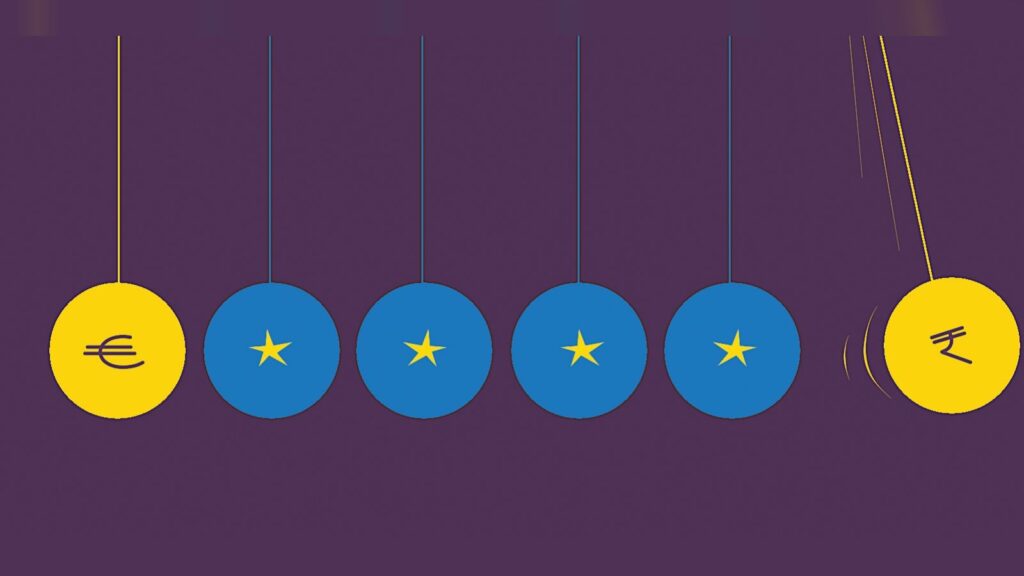
From January 1, Indian steel and aluminum exports to Europe will face higher costs and shrinking margins. Under the Carbon Border Adjustment Mechanism (CBAM), the EU will tax imports based on the carbon emissions generated during production.
The new tax could erase 16 to 22 percent of real prices collected, force the renegotiation of contracts and weaken the presence of Indian products in the EU – a market that absorbs around 22 percent of India’s steel and aluminum exports.

The tension is already visible. In fiscal 2025, India exported $5.8 billion worth of steel and aluminum to the EU – 24% less than the previous year – despite no carbon tax. The decline began after new EU rules came into force in October 2023, requiring exporters to report carbon emissions at factory level as part of the CBAM transition phase. Compliance costs, data gaps and verification hurdles forced many Indian companies to reduce exports long before CBAM officially became a tax.
The CBAM extends the EU carbon pricing system to imports. In Europe, companies pay for their emissions under the European Emissions Trading System. CBAM imposes a similar cost on foreign producers to prevent companies from moving production to countries with more relaxed climate rules. It covers steel, aluminum, cement, fertilizer, electricity and hydrogen, with other sectors likely to be added over time. The United Kingdom is also considering introducing a similar system.
CBAM liability is calculated using two factors: the amount of carbon emissions generated during production and the price of carbon in the EU, currently around €80 per tonne of CO2. If a country already charges companies for their emissions, the EU reduces the tax. But since India does not have a nationwide carbon tax, Indian exporters must pay the full CBAM tax unless special exemptions are agreed later.
Indian exporters do not pay the carbon tax directly at the EU border. The EU importer pays for it by registering with CBAM, calculating emissions and purchasing CBAM certificates. But in reality, the cost is passed on to Indian exporters. EU buyers are demanding lower prices to cover CBAM costs. This means Indian producers earn less, face harsher contracts and lose bargaining power, even if they don’t officially pay the tax.
Although EU importers are only required to submit CBAM certificates in 2027 and not 2026, this delay reflects administrative delays only. This does not reduce the tax burden. Every shipment entering the EU from January 1, 2026 will incur a CBAM cost, and buyers will set this from day one.
The numbers explain why CBAM hits so hard. The production of one tonne of steel using coal-based basic oxygen blast furnaces (BF-BOF) emits around 2.4 tonnes of carbon. With a European carbon price of €80, this equates to €192 per tonne of CBAM costs. Buyers are unlikely to fully absorb it. Experts estimate that importers will pass on 50 to 70 percent of the cost to exporters. This means that exporters could lose between 95 and 133 euros per tonne, which would reduce a selling price of 600 euros to around 467 to 505 euros, a margin loss of 16 to 22 percent.
CBAM does not concern ESG statements or sustainability reporting. This is a strict accounting system at the factory level. Only Scope 1 emissions (direct fuel use) and Scope 2 emissions (electricity use) are taken into account. Emissions from mining, transportation or product use are excluded. Company-wide averages don’t matter: only emissions from the exact factory supplying the product count.
If Indian exporters do not provide verified data, EU importers will use default CBAM values set at 30 to 80 percent above actual emissions, and sometimes almost double them. Importers will not absorb this cost. They will demand deeper price cuts from Indian exporters or change suppliers. It is therefore essential to avoid default values to protect margins.
From 2026, emissions data will have to be verified by accredited auditors according to ISO 14065 or EU rules. Not all Indian auditors are qualified, making early preparation essential.
CBAM will also require the rewriting of export contracts. European buyers will likely add clauses allowing CBAM costs to be deducted from prices, require verified plant-level data, and reopen price negotiations if EU carbon prices change. Some suppliers already offer two prices – a base price and a CBAM-adjusted price – to remain competitive.
Production routes will be more important than ever. Coal-based BF-BOF steel will face the highest CBAM burden. Gas-based DRI steel will face lower costs. Scrap or electric arc furnace (EAF) based steel will face the lowest load. Indeed, the CBAM rewards cleaner production methods.
Indian companies that accurately measure their emissions, verify the data on time, and adjust their production and pricing strategies can still protect their margins and maintain their market access. Those who delay risk losing the European market.
Under CBAM, the EU will charge around 80 euros per tonne of CO2, even on imports from developing countries. In comparison, China’s carbon price is only about 10 percent of the EU level, and India’s future carbon price will also be much lower. While rich countries can afford higher climate costs, poorer economies cannot. Applying rich-country carbon prices to countries like India increases production costs, hurts exports and slows industrial growth, with almost no impact on global emissions.
The irony is this: Steel and aluminum, which account for about 10% of global carbon emissions, are now the most protected sectors in the developed world. The United States already imposes a 50 percent import tariff and the EU will soon add a new carbon tax. What is presented as climate action is also a tool for industrial protection and revenue generation.
India needs to find a solution to the CBAM within the ongoing FTA negotiations with the EU. At the national level, India should strengthen carbon accounting frameworks and support cleaner production.
CBAM marks a structural change in global trade, not a temporary barrier to compliance. For Indian exporters, survival in the European market will depend on how quickly they adapt to carbon pricing, data discipline and contract restructuring. As carbon becomes a currency, competitiveness will increasingly be measured not only in terms of cost, but also in terms of emissions levels.
The author is the founder of the Global Trade Research Institute
About The Author