148
The completion of a year is intended to bring a sense of perspective and reflection as we look back on the months gone by, considering both our successes and our shortcomings. Often, however, we rush into the impending thrill of a new year, without properly thinking about the year that is ending. This is a classic behavioral trait of human psychology, which often manifests itself in other spheres of human and public life. In this context, it is worth reflecting on the fact that international relations can also be seen as an expression of human nature, even if expanded. This is what the famous philosopher Thomas Hobbes brilliantly argued in his seminal work “Leviathan”. However, new developments in India’s foreign policy might have prompted Hobbes to partially reassess his point, had he been alive today.
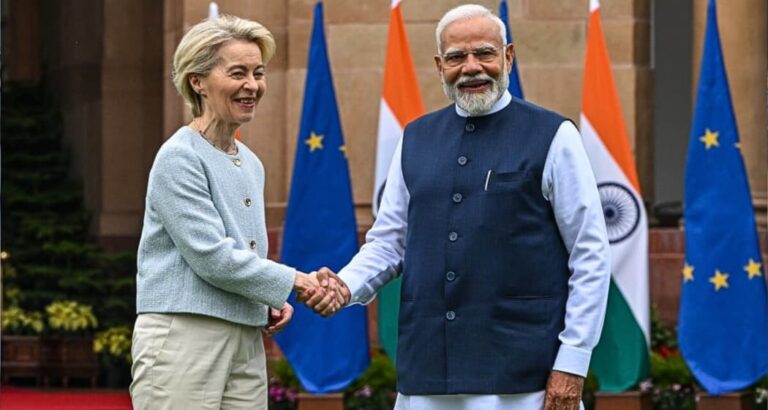
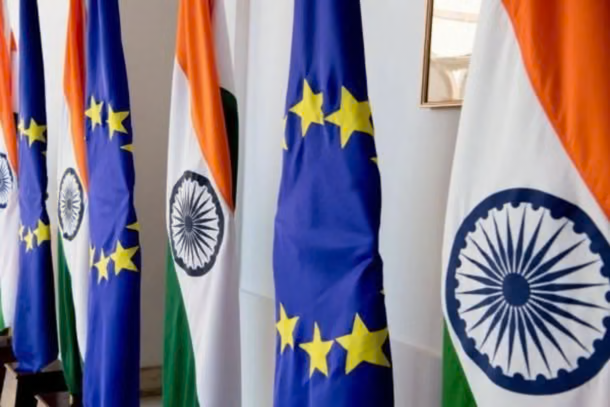
To briefly put things in context, the upcoming visit of European Commission President Ursula von der Leyen with other senior EU officials to finally and formally sign the long-pending Free Trade Agreement (FTA) with New Delhi marks an inflection point as far as India and EU diplomacy are concerned. Their mental space focuses on similar concerns, such as the need to operationalize, not just preach, norms and terms like “strategic autonomy” through tangible means rather than declaratory statements.
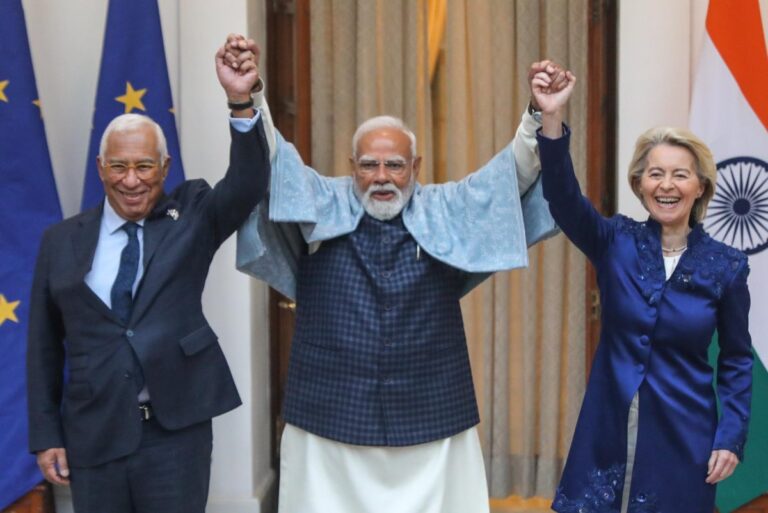
Some of this operationalization could be ingeniously appreciated during the upcoming visit of the European Commissioner and the President of the European Council as the chief guests of the celebrations of the 77th anniversary of the Indian Republic, soon after the visit of Russian President Putin to India, where, despite simplistic representations and presumptions about the EU’s doctrinal animosity towards Russia and, by extension, protests to countries which maintain close relations with the latter, the EU do not let this impinge on the evolution of the India-EU strategic partnership. This is motivated by both practical and ideational concerns. The sphere of military cooperation fits into the operation of both concerns, making defense a key link between ideas and action, as India and the EU navigate the complexities of their FTA over the coming decade.
THE PRACTICAL AND INDUSTRIAL EMERGENCY OF MILITARY COOPERATION
While the impending India-EU FTA largely revolves around markets, trade, tariffs and digital trade in popular media circles, it is the significant security and strategic implications that will ultimately follow the ratification of the deal. The FTA, if successfully executed, will invariably push both global players into each other’s defense industrial value complex, something a typically procedurally rigid Brussels is particularly keen on unless and until it is grounded in an overarching legal complex, as the FTA envisions.
The resulting low barriers in areas such as high-end manufacturing, dual-use technologies and advanced components are expected to provide a strong incentive for European companies to move a significant portion of their production units to India. India’s vast engineering base and strong skilled and semi-skilled workforce only strengthen the industrial requirements of both players. And this optimism is not misplaced, but rather supported by concrete statistics.
Dassault Reliance Aerospace Limited (DRAL), a joint venture between French aviation giant Dassault and India’s Reliance Infrastructure, established in 2017 to execute offset tasks related to the 2016 Rafale fighter jet deal, is now relatively integrated into Dassault’s global supply chain. Similarly, Airbus purchases nearly $1.5 billion worth of services and components from India every year. Additionally, India is set to sign an agreement under Project 75I, which will amount to $7-8 billion for the construction of at least six advanced diesel-electric submarines to be manufactured jointly by Indian shipyard Mazagaon Dock Limited and Germany’s ThyssenKrupp Marine Systems, under a clear technology transfer clause.
These military agreements should not be considered in isolation because they will have considerable strategic consequences. The coming decade (2025-2035) will see spinoffs sprout in the form of a renewed ideological basis for bilateral relations, driven by many factors, not the least of which are efforts to reduce Chinese supply chain risks and the episodic upheavals we witness in the foreign policy and economic realities facing the United States.
THE IDEATIONAL JUSTIFICATION FOR THE COMING DECADE
Beyond the immediate industrial and economic benefits of the FTA, it is the theoretical foundations of strategic cooperation that will shape the trajectory of this partnership over the next decade. The conventional neoliberal conception of FTAs as purely market-enhancing instruments is giving way to a more nuanced calculus in global diplomacy, where sovereignty, security and practical cooperation take center stage in policy deliberations.
In this evolving context, the India-EU FTA must be understood not only as a trade treaty but also as a structural platform through which both parties can project and protect their strategic interests.
- First, the need to de-risk Chinese dominance over economic and technological ties, long evident in supply chain debates, has intensified significantly over the past decade. India and the EU share concerns about the fragility of global value chains dominated by Beijing’s industrial policies and their over-reliance on single sources of essential inputs. This shared unease has translated into concerted efforts to diversify trade partnerships, with New Delhi accelerating negotiations of several FTAs, notably with the EU, New Zealand and Chile, to guard against tariff disputes and geopolitical volatility. These measures are explicitly aimed at protecting exporters from uncertain US tariff regimes, where import duties of up to 50 percent have been levied on key Indian sectors, incentivizing India to expand its market access through alternative trade agreements.
- Second, the changing contours of US economic and strategic power highlight the need for Europe to assert greater capacity for action. Despite the continuity of US presidential approaches from Obama to Trump, characterized by economic nationalism and pragmatism, it can be observed that the United States no longer possesses the unilateral economic dominance that it once exercised. As a result, European policymakers increasingly recognize that relying solely on Washington for security and economic stability is insufficient; Europe must therefore strive to build autonomous strategic partnerships with like-minded powers, such as India.
- Finally, contemporary international relations reflect a renewed emphasis on territorial sovereignty and hard power as essential pillars of credible political influence. The post-Cold War overemphasis on liberal institutionalism ran into practical limits in an era marked by contested borders, hybrid threats, and geopolitical competition across the globe. In this environment, the prestige and legitimacy of normative prescriptions are inseparable from the capacity to support them by material means. Defense cooperation under the India-EU FTA is therefore not an incidental complement but the strategic core, through which both sides signal that their ideas will be supported by actions. In a global order where sovereignty is once again anchored at the center of territorial control, only actors with demonstrable power projection capabilities will shape global norms and outcomes.
CONCLUSION
It is fair to note that India and the EU have long underexploited the full potential of their strategic partnership, largely due to a mismatch in political priorities and bureaucratic inertia on both sides. The imminent conclusion of the India-EU FTA, however, provides an opportunity to correct this historical delay. If leveraged judiciously, the agreement can serve as a catalyst for a normative but results-oriented partnership that transcends the narrow confines of tariff reductions and market access.
Over the next decade, the FTA is likely to institutionalize defense and military cooperation as a central pillar of India-EU engagement, embedding strategic trust in industrial collaboration, technology transfer and joint capability development. For India, this aligns with its long-term goal of strengthening domestic defense manufacturing while diversifying strategic partnerships beyond traditional dependencies. For the EU, deeper defense cooperation with India strengthens its quest for strategic autonomy and positions it as a significant security actor in the Indo-Pacific region.
The FTA goes beyond trade and is more than just a trade pact; it is a strategic instrument through which both actors can align their ideas with action. In an era marked by geopolitical uncertainty and renewed great power competition, the sustainability of the India-EU partnership will depend on its ability to combine economic interdependence with credible defense cooperation, which will ultimately shape not only bilateral relations, but also the broader contours of the global order in the decade to come.
Dr. Manish Barma was an Assistant Professor of International Relations and Security Studies at Rashtriya Raksha University, Gandhinagar, Gujarat, India. Shreya Sinha is a postdoctoral researcher at the School of Law and Government, Dublin City University (DCU), Dublin, Ireland.
About The Author