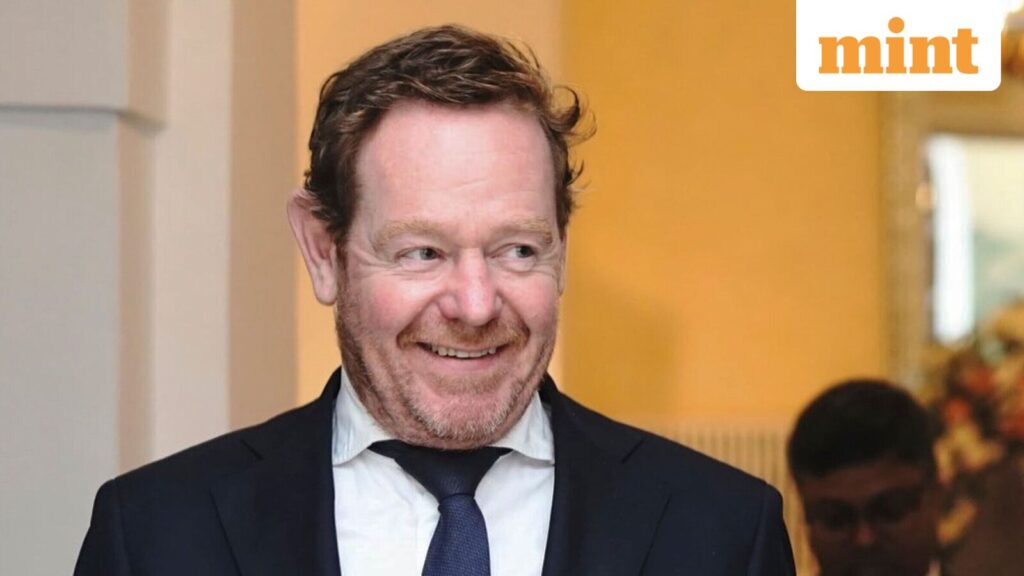
New Delhi: Negotiations for a free trade agreement (FTA) between the European Union (EU) and India are in their final stages and are expected to be concluded soon as there appear to be no major sticking points, Dutch Foreign Minister David Van Weel said on Friday.
Speaking to reporters in the national capital, Van Weel said he discussed the ongoing trade negotiations between the EU and India during his meetings with Indian ministers and expressed hope that the two sides would reach an agreement soon. He left on Friday after a first three-day visit to India.
The Dutch minister met Union Defense Minister Rajnath Singh, Foreign Minister S. Jaishankar as well as National Security Advisor Ajit Doval.
“There are many areas in which we want to intensify our cooperation and, of course, all of this is aimed at leading to a more strategic partnership that we aspire to establish with India. We have also discussed not only the cooperation between the Netherlands and India, but also the cooperation between the EU and India… The EU-India Free Trade Agreement is in the final stages of negotiations and I think on both sides… we have hoped that these negotiations will come to a conclusion successful in the short term,” he said.
The minister warned, however, that trade negotiations are always “very complicated” and often go all the way.
“These are always very complicated negotiations that continue until the last moment and then an agreement is reached. So, to my knowledge, there are no big sticking points that could not prevent their conclusion. And I hope that this will happen in the very near future,” he added.
In the middle of the exam
His comments come days after an EU negotiating team visited New Delhi from December 3-9. The visit included review meetings between India’s commerce secretary and the EU’s director-general of trade on December 7, followed by meetings between Indian and EU trade ministers on December 8 and 9 to provide strategic guidance to the negotiating teams.
This assumes significance as bilateral trade with the European Union has reached around $136.5 billion in 2024-25, making it one of India’s largest trading partners. During this period, India exported goods worth around $75.8 billion, while its imports stood at $60.7 billion.
Earlier, Mint had reported on December 17 that India had approached the World Trade Organization (WTO) for consultations with the EU after the bloc proposed tariffs and quotas on ferroalloy imports, heightening concerns over uncertainty in global trade at a time when the two sides are negotiating a free trade deal.
India has a substantial commercial interest in the affected products and has invoked the provisions of the safeguards agreement to engage in consultations with the EU, according to a WTO document reviewed by Mint.
The EU issued a notification last month, proposing a safeguard duty after alleging serious harm or threat to its domestic ferroalloy industry due to increased imports.
A statement from the Indian Ministry of Foreign Affairs (MEA), issued on Friday after the meeting between Van Weel and Jaishankar, said both sides highlighted trade and economic ties as one of the key pillars of the Indo-Dutch partnership.
They noted that the decision taken earlier this year to establish a Joint Trade and Investment Committee would help deepen cooperation, resolve trade facilitation issues and promote bilateral investments.
“Recalling the rich maritime history of India and the Netherlands, the ministers welcomed the Memorandum of Understanding for the development of the National Maritime Heritage Complex (NMHC) at Lothal, Gujarat. They also discussed strengthening ongoing cooperation in maritime and maritime sectors, particularly in the areas of green shipping, port development and shipbuilding,” the statement added.
Command visit
Earlier on Wednesday, Van Weel visited the Western Naval Command and Mazagon Docks, besides meeting the business community in Mumbai.
Van Weel added that his discussions with senior Indian government officials included discussions on defence, semiconductors and new age technologies.
The two countries signed a letter of intent on defense cooperation, which would provide a framework to further strengthen defense and security cooperation between the two countries.
The MEA statement said: “The ministers welcomed the efforts of both parties to extend the partnership to new areas of emerging technologies, including semiconductors, defence, digital, AI, renewable energy, green hydrogen, education and mobility, to give it a more strategic focus. In this context, they took note of the various MoUs/agreements reached during the year,” he said.
The two countries have already signed memorandums of understanding on partnership on semiconductors and related emerging technologies as well as green hydrogen earlier this year.
Speaking about the Russian-Ukrainian war and the ongoing negotiations for a peace agreement, the Dutch minister said: “For us this is a question of existential security and Ukraine cannot lose this war. This would harm the system we have built regarding respect for territorial sovereignty.”
Noting that this is an issue of utmost importance to the Netherlands and the European Union, he added that the war and related concerns of EU countries were discussed during his deliberations in India.
“So this is a security issue of the utmost importance for us, so we discussed it and I also conveyed that message to my Indian counterparts. I also said that we hope that at least negotiations are underway to hopefully bring a lasting and lasting end to this conflict. I also asked my counterparts to use their contacts with Russia to also hopefully convey to them the message to come to the negotiating table and I hope that we can find a solution to this subject.”
India and the Netherlands also discussed key developments in the Indo-Pacific, Ukraine, South Asia, West Asia and other regional and global issues of common interest, the MEA statement said. It added that the Dutch Foreign Minister extended his condolences to the victims of the recent terrorist incident in Delhi and both sides condemned terrorism in all its forms and manifestations, emphasizing the need to strengthen international cooperation to combat it in a comprehensive and sustainable manner.
About The Author