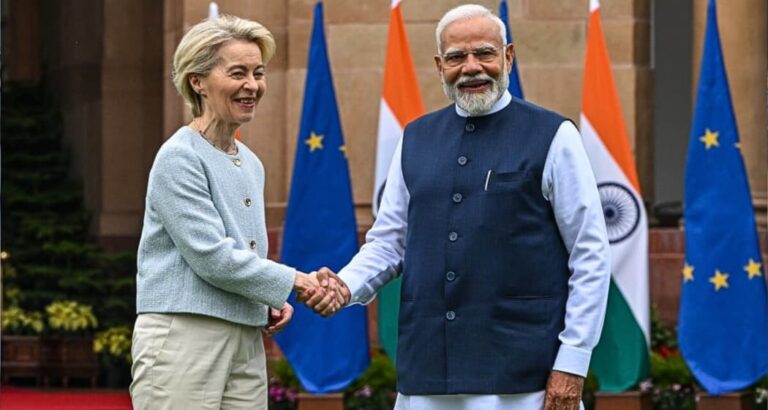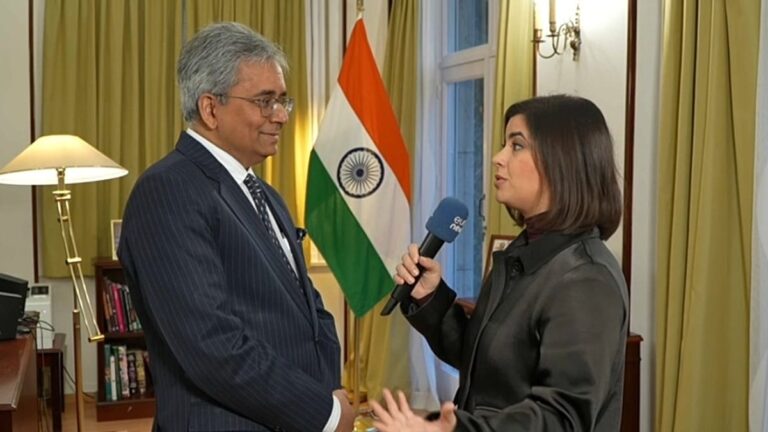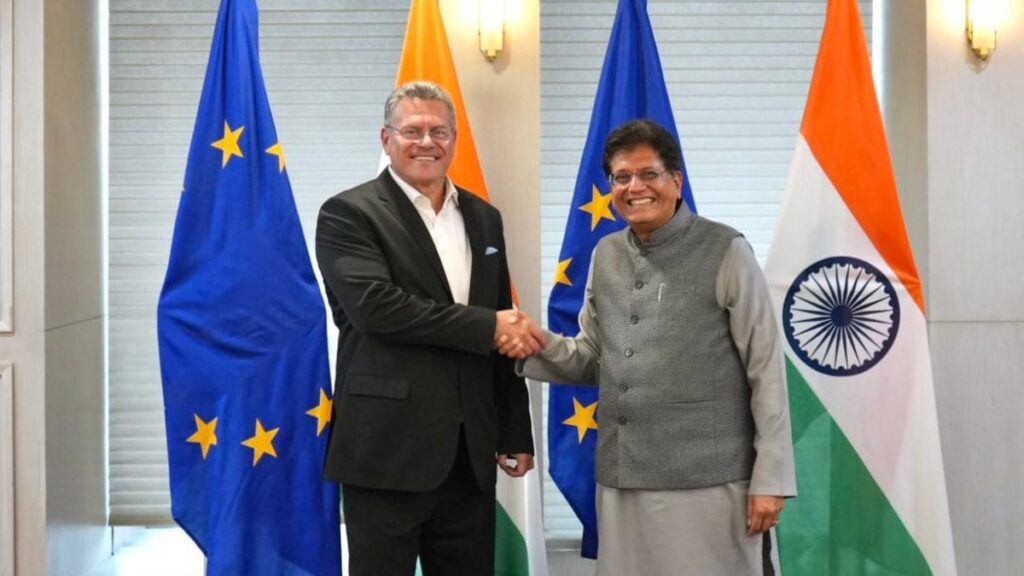
IIndia and the European Union are on the verge of concluding a free trade agreement that could become one of the defining pivots of India’s economic rise. After years of cautious diplomacy, negotiations have reached a point where a deal could reshape global supply chains, anchor India in the European trade architecture and offer Indian industry a stable, rules-based alternative to an increasingly unpredictable global trading system.
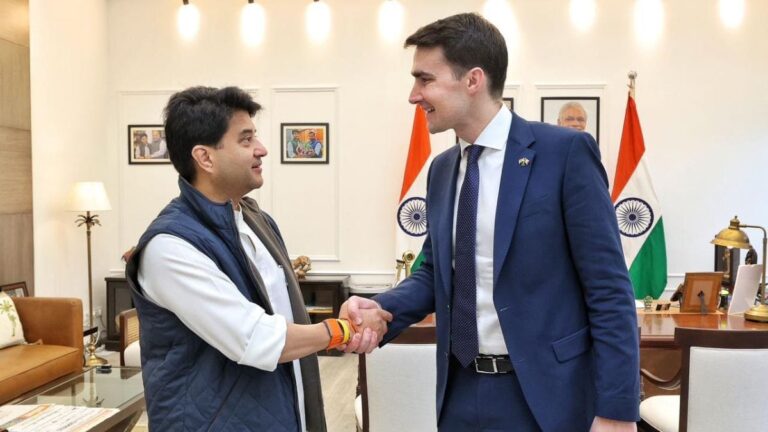
Commerce and Industry Minister Piyush Goyal on Wednesday said “the air is rich with possibilities” and that both sides pledged to close the deal quickly, following meetings with a high-level EU delegation that included Trade Commissioner Maros Sefcovic.
For Europe, trade has always been the foundation of prosperity. Nearly 30 million jobs in the EU depend on trade, and almost half of GDP comes from it. Yet its relations with the United States, its main partner, have become a permanent exercise in crisis management. In Washington, protectionist fervor now transcends partisan divisions. Whether under Democratic or Republican rule, tariffs and “reindustrialization” are a political gospel. Last August’s EU-US deal narrowly avoided a full-blown trade war, but left deep political bruises in Brussels.
Show full article
For European policymakers, this is the new norm: a transatlantic economic relationship underpinned by firefighting, not foresight. Diversifying supply chains and conquering new markets is no longer an option: it is a survival strategy. And that makes India indispensable.
For India too, the time has come. The world economy is fragmenting into blocs: on one side industrial nationalism led by the United States, on the other Chinese state mercantilism. Between them lies a broad demand for a reliable, rules-based partner with scale, stability and democratic legitimacy. An India-EU FTA offers exactly that.
Read also: India-EU agenda can fundamentally alter global geopolitics – if Europe stands up to Trump
The largest commercial partnership in the making
The EU remains the world’s largest trader, accounting for around 16 percent of global trade. An FTA with India, one of the world’s fastest-growing major economies, would be the largest such deal in terms of economic weight ever concluded.
The strategic advantages go both ways. For the EU, it is a gateway to reducing its dependence on China for critical raw materials, rare earth magnets and electronic components. For India, it is a way to ensure predictable access to high-value markets – a crucial compensation for the loss of the Generalized System of Preferences (GSP) and a chance to level the playing field against competitors like Vietnam and Bangladesh.
Equally important, it provides India with a reliable alternative to the volatility of US trade policy. Stability, consistency, transparency – characteristics that characterize European regulation – are precisely what Indian businesses need today.
Politics and optics
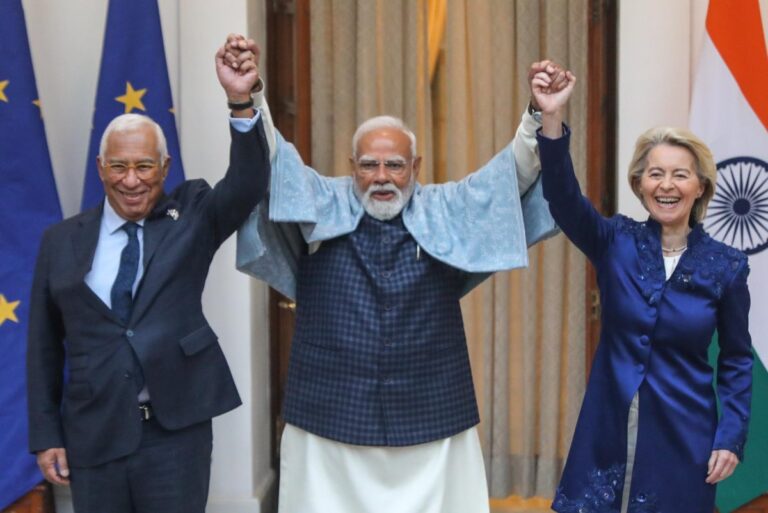
Both parties understand the political issues. The aim is not just to sign a new trade deal, but to herald a new phase in India-EU relations, ideally on Republic Day, with European Commission President Ursula von der Leyen as the parade’s chief guest. An agreement signed in Delhi would be a powerful symbol of convergence between two democratic and open economies.
But for the EU, optics must align with substance. Brussels has made it clear that any agreement must be “ratifiable”: an agreement that fails in the European Parliament would be worse than no agreement at all. The same is true in India. The policy of trade liberalization remains delicate, but the national mood has changed. As one senior policymaker put it, India finds itself in a “new 1991 moment”: a phase of confident, reform-oriented thinking, where openness is seen not as a capitulation to external pressures but as a sovereign and strategic choice.
Difficult conversations
The most difficult sticking points are well known. On the EU side, automobiles top the list. Without significant price or volume concessions in the mid- and high-end segments, European manufacturers are struggling to justify new investments in Indian assembly and production.
The EU also wants better investor protection – predictable tax policies, transparent dispute resolution and equal treatment with domestic actors. The new Indian model of bilateral investment treaties (BITs), cautious after previous arbitrations, must be strengthened to meet these expectations.
Next comes sustainability. Brussels wants India to align with its evolving green trade architecture, whether it is the Carbon Border Adjustment Mechanism (CBAM), supply chain due diligence standards or Corporate Sustainability Disclosures (CSRD). Indian negotiators are rightly looking for flexibility and time-limited transitions, but it is clear that the green border now constitutes the new tariff wall.
On the Indian side, the sensitivities are just as real. Tariffs on automobiles and spirits are politically sensitive and deeply entrenched. Yet industry leaders now recognize that progressive, calibrated concessions are essential if India wants reciprocal access to European markets for textiles, pharmaceuticals and engineering goods.
Another issue is quality control and regulatory predictability. The proliferation of quality control orders (QCOs), originally designed to limit low-quality Chinese imports, has also affected European exporters, creating uncertainty. Some rollback is already under discussion, but alignment with standards, testing and certification remains essential. Without mutual recognition of laboratories and certifiers, even compliant companies face costly delays.
The same goes for data and digital commerce. Without EU recognition of India as “secure data”, high-end collaborations in AI, robotics and advanced manufacturing remain out of reach. For the world’s most dynamic digital economy, this is an opportunity cost that India cannot afford.
The new mindset of Indian industry
For decades, Indian businesses have viewed trade deals as a source of threat rather than opportunity. This mindset is changing. Today, key sectors – automotive components, engineering goods, chemicals and electronics – view Europe as a stable and valuable partner. They believe Indian companies can meet European standards with adequate transition time and capacity building.
India already supplies advanced driver assistance systems and high safety components to Daimler, Volvo and other European companies. These partnerships show that Indian industry can align with global technical standards when the policy framework is predictable and stable.
What the industry wants now are three things: clarity on future regulations, most favored nation equivalent treatment to ensure no discrimination after signing, and a credible and transparent process for future rule changes.
Read also: The EU is evolving to become a security actor. This opens new doors for India
A decisive test of strategic maturity
For both sides, small problems now risk holding big ambitions hostage. Indian leaders understand that finalizing this FTA will require coordinated policy management across ministries, from Finance for tax and investment treaty issues, to the Quality Council of India for laboratory standards and accreditation.
For Europe, the task is to avoid excesses. The perfect must not become the enemy of the good. Overloading the agreement with non-trade conditionalities will make it politically unsellable in Delhi and virtually unenforceable on the ground.
Both sides need to keep the focus where it belongs: market access, investment confidence, and regulatory confidence.
An India-EU FTA is much more than a trade negotiation: it is a test of whether two great democracies can establish a pragmatic partnership in a polarized world.
If concluded, it would send a powerful signal: that open economies still have the capacity to act in the face of protectionist headwinds, that rules-based trade can still be built on trust and mutual benefit.
The window is narrow, the politics complex, but history rewards those who act decisively. For India and Europe, this is that moment.
Now it’s time to close the deal.
Shishir Priyadarshi is Chairman of the Chintan Research Foundation. Opinions are personal.
(Edited by Asavari Singh)
About The Author