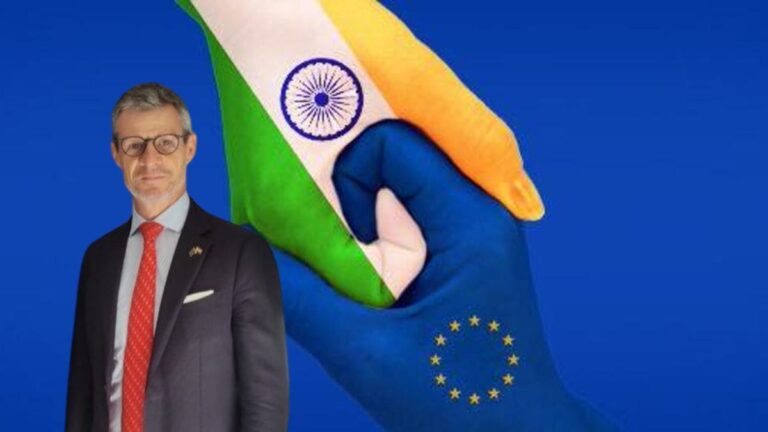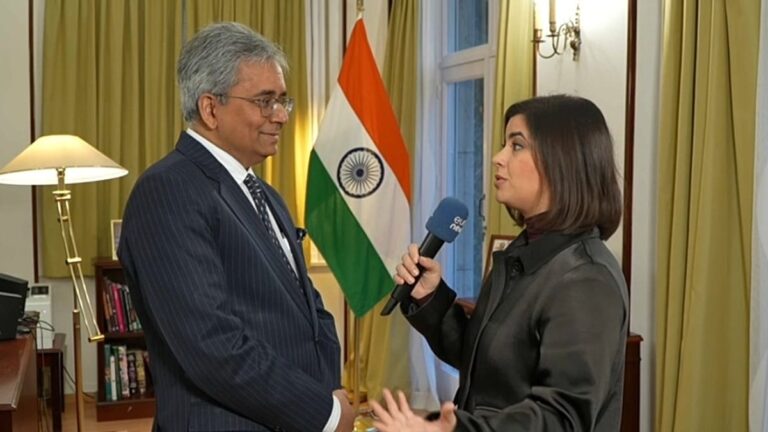
Germany sees President Vladimir Putin’s upcoming visit to India as a good opportunity for New Delhi to remind the Russian leader to end the war in Ukraine and discuss a strategy to end the fighting, German Ambassador Philipp Ackermann said.

During an exclusive interview, Ackermann also spoke about Germany’s support for a closer defense and security partnership between India and the European Union (EU) ahead of the summit with the 27-member bloc in January, as well as strengthening security ties between New Delhi and Berlin, including the conclusion of a submarine deal.
Q. Europe, particularly Germany and France, has made it clear that Russia is blocking efforts to bring lasting peace to Ukraine. Russian President Putin is expected to visit India. How do Germany and Europe view this visit and do you think India has a role to play in ending the conflict?
A: First of all, I think we need to recognize that there is progress in the peace talks right now. The Americans have put something on the table, a plan that does not meet the expectations of many, but at least it is a start. I think it’s a good sign that we are now discussing this plan. However, it needs to be changed very clearly and needs to be negotiated, which is why I don’t think the solution will come very soon. The noises we hear from Russia are not very reassuring. I don’t think the Russian side has really engaged actively and constructively in these talks.
President Putin’s visit to India is one of the rare visits he is making to another country. This might be a good opportunity. India maintains good relations with Europe and the United States, but also with Russia. I think there is no harm in reminding the Russian president that it would be better to stop this war as soon as possible. I think in these circumstances we have ample opportunity to sit down around the table and discuss the strategy to get there.
Q. There is a growing perception that the United States is withdrawing from the security of Europe and Ukraine. Security and defense cooperation is also a key part of the upcoming India-EU summit. Your views.
A: I would not say that we are now seeing a withdrawal of American security guarantees for Europe. We found that the United States very clearly expects Europe to spend more on its own security. This is a good argument because for many years we have not spent as much as we could have. Europe feels threatened today, more than ever. You saw everywhere the intrusion of airspace through planes and drones, drones with lights on. This is an obvious provocation which must be perceived as a threat. This is why many European countries, including Germany, have decided to spend much more on defense, up to 5% of their GDP. We remain confident that the all-important alliance between the United States and Europe will not cease to exist in the near future.
The India-EU summit will be very important for two reasons. One of them is the Free Trade Agreement (FTA), which everyone hopes will be concluded. And there is the new security and defense partnership.
Q. Are you concerned that Putin’s visit could cast a shadow over the India-EU summit?
A: I would say that Europe understands very well that countries have different relationships with other countries. We feel threatened by Russia. India does not feel threatened by Russia. It is national interest that compels India to treat Russia more constructively. We accept it and we understand it. We also believe that when dealing with Russia, we should not forget what Russia is doing in Eastern Europe. It is our wish and hope that the Indian side keeps this in mind in its relations with Russia.
That aside, I would say that India and Europe have developed such strong ties currently that I do not see much danger in the run-up to the India-EU summit. I think we will have a great summit with excellent results. The FTA is a game changer in many ways. I would say it’s great for our business and our economy. This will change our view of India and our investments in India. But the same goes for defense: we are negotiating a submarine deal with India and we have significantly increased our defense cooperation over the years. This means that Europe sees India as a very strong partner and a very strong ally when it comes to defending the rules-based international order.
It is not the government which participates in the negotiations (for the agreement on submarines), it is the companies. Once they agree on a price, we enter into a government agreement to accompany that agreement. I say this with caution, but I am quite confident that in the coming weeks we will begin to negotiate this government agreement.
Q. Could this be one of the results of the German Chancellor’s planned visit next year?
A: We hope that the chancellor will come very soon and I think there is a good chance that he will. I would not be surprised if this issue came up during the leaders’ discussions. But of course, government-to-government relations are a very precise and extremely technical arrangement, so it’s not something that the two leaders negotiate. It will be negotiated at the Ministry of Defense level and it remains to be seen how it will work.
Q. Will Germany be interested in advancing the security and defense partnership with India, for the rearmament of Europe and cooperation in the defense industry?
A: Without fail. I think there are a lot of interesting ideas to pursue. We have joint ventures between German and Indian defense companies, for example Hindustan Aeronautics Limited. Where we feel there is absolutely room for cooperation and that goes for both sides – not only in purchasing German equipment or technology by India, but also in exporting Indian technology to Germany. I think it’s a possibility and we’re looking at it.
Q. What other elements are expected from the Chancellor’s visit in areas such as trade?
A: If he comes, he will certainly come with a business delegation. If we add goods and services, our trade represents approximately 50 billion dollars per year. It’s a good amount (but) we can increase it. Interestingly, this is a fairly balanced trade. In goods, the German side is a little more, but in services, the Indian side is more. There are 750 companies investing in Germany and their number has grown exponentially over the years. German companies like India as a location. We hear from two companies every week who are inquiring about opportunities for our Chamber of Commerce to open branches in India. More and more small and medium enterprises or niche businesses are very keen to come to India because of your fabulous 8% growth. It’s more interesting when you grow at this speed for years. But at the same time, it is very important to reduce risks.
Q. Would you like India to do more to ensure predictability and security of investments?
A: For us, the investment and protection would be very important. I think it’s an integral part of the whole process. It would be great if you could come to a conclusion on an investment protection agreement, which is useful to any company, I would strongly recommend them to go further.
Q. India has its own concerns in the Indo-Pacific region. There is detente with China, but both sides still have large numbers of troops deployed on the border. Indian leaders have said Europe sometimes does not appreciate India’s security problems. How does Germany view the situation in this region?
A: I would say that we fully recognize the challenges that India faces on its northern borders. We followed very closely what happened in 2020 and before and we are happy that since then, at least the border has been rather peaceful. Our European experience tells us that it is good for neighbors to talk to each other. You might be very far apart (on some issues), but it’s best to sit down together and develop an understanding of each other’s position. This is why I would say that the idea of India maintaining regular contact with its Chinese counterparts is better than not. I don’t know if this will solve the problem, but I think that, generally speaking, we would always encourage closer contact with neighbors. The Indian private sector is attracting great interest in China. China is India’s largest trading partner; there is therefore a very strong link that should not be underestimated.
Q. Germany now has the largest Indian diaspora in the EU. What are the next steps to strengthen people-to-people ties?
A: Germany is very happy with the 300,000 Indians present in the country. Their monthly salary is higher than the German average salary. This means that this is a group of high achievers, comprising 60,000 students from our universities, who value Indian students because they are ambitious, hardworking and dedicated. We hope that after graduating they will stay in Germany and find work.
We have a lot of nurses, caregivers and apprentices in small Indian craft shops. We always want to welcome dedicated and competent people to Germany.
In this flow you also have elements that are not very good. For example, agents who deceive customers in a very sad way. We see people going into debt and attending so-called universities that don’t offer value for money. They work illegally on the black market, which constitutes a punishable offense, and live in very precarious conditions that we want to avoid. It is often not the fault of the people who come to Germany, but they simply have the wrong agent. So be careful, think twice, ask for advice, go to another agent to compare.
Overall, it’s truly a success story. We have a very happy and widely accepted Indian community, even though migration is a controversial issue in Germany. But more than other diasporas, the Indian diaspora is truly accepted and has proven to be very quick to adapt and assimilate.
We will continue to recruit within the framework of the systems we have put in place, which are mainly aimed at nurses and caregivers, because they must be trained in German to a certain level.
About The Author